


The “Down” Safety is the most important position no one is talking about.
Football is cyclical by nature, and 2025 was a season in which the NFL turned back to heavier personnel on both sides of the ball. The patterns are predictable and reflect the game's ebbs and flows. Offenses get heavy to punish lighter, faster packages. Defenses start to put bigger bodies on the field, and the offense pivots back to more 11 personnel and hybrid TEs. Defenses are now forced to adjust.
The “Big Nickel”
Heading into 2014, NFL.com’s Bucky Brooks wrote a piece on how the “Big Nickel” package was the “hottest defensive trend.” In his explanation, the schematic shift mirrored one from the mid-’90s when the Packers’ Fritz Shermur used his three Safeties, Eugene Robinson, Mike Prior, and LeRoy Butler, on the field together. Butler’s role would be to move down near the box to defend TEs.
Fast forward to 2014, and hybrid Safeties like Kenny Vacarro (Saints), Eric Berry (Chiefs), and Tyrann Mathieu (Cardinals) were being implemented near the box over a smaller Slot Corner. Brooks explains that one added benefit of an extra Safety near the box is, “it becomes tougher for the quarterback to identify potential rushers from the second level.”
The added value in the run defense is there as well. With the defense's overall speed and quickness amplified by a Safety near the box, offenses can struggle to gain traction on play-action passes.
Bucky highlighted rookies Lamarcus Joyner (Rams), Jimmie Ward (49ers), and Terrence Brooks (Ravens) as being players solely selected to play the position. In 2014, the main objective was to address the rise of hybrid TEs such as Zach Ertz (Eagles), Jimmie Graham (Saints), Rob Gronkowski (Patriots), and Julius Thomas (Broncos).
Fast forward a decade, and the Big Nickel was back! In 2025, the use is more nuanced. Both sides of the ball have fully embraced that passing is a much more efficient way to move the ball down the field.
Defenses like the Texans’ and Seahawks’ tried to live in Nickel and Dime personnel in 2025. Even with more offenses using 12- and 13-personnel packages, the ability to play Nickel allows them to match up in the passing game without sacrificing much efficiency on the ground.

But to live in “Big” Nickel, a defense needs a special type of player who can survive near the box from down to down. Budda Baker (Cardinals), Jalen Pitre (Texans), Nick Emmanwori (Seahawks), and Kyle Hamilton (Ravens) have become the new standards for defenses that want to keep three Safeties on the field.
Defenses need an Apex player.
In the current environment, an enforcer near the box who can stabilize the front is more valuable than a pure coverage specialist in the Slot. The NFL “market” is already adjusting to this “heavy” trend.
Teams opted to use Base personnel in 2025, with usage jumping from 22.7% (‘24) to 27%. Nickel, which had been played on two-thirds of all downs in ‘24, dropped to 61% in ‘25.
Still, few talk about the other personnel trend in the NFL. The Nickel position is obvious, but the rise of the Down or Box Safety seems to be returning, with a different twist. Most teams are now playing from a two-high shell.

The Light Box Theory 2.0
The light box pivot, which optimized the two-high revolution, appears to have hit a wall. Defenses are increasingly opting for a third linebacker (4-3) or extra defensive linemen (3-4). The shift is giving defenses more front-line size and gap integrity as offenses utilize more FBs and TEs on the field.
Split-field coverages are also losing their novelty. Last season, the league-wide EPA in MOFO coverages was -.082, favoring the defense. In one season, that advantage evaporated. In 2025, the NFL’s average split-field EPA rose to .014.

More teams are also trying to repurpose Fangio-style split-field rotations, which are highly complex and not easy to reverse-engineer. Once something isn’t new in an environment, it loses its impact. Offenses have quickly figured out how to attack these split-field zone structures, forcing defenses to become smarter about how they disguise their coverages or utilize their personnel.
Seattle actually used this to their advantage on the way to a Super Bowl. Though teams had high completion rates, they were typically low in the zone, and the receiver was tackled almost immediately. The Seahawks were funnelling the ball while capping verticals, leaning into Cover 2 over Quarters or “targeted coverages” Mike Macdonald featured in Baltimore.

The decades-old philosophy of limiting explosives and forcing offenses to drive the ball still rings true. Where college defenses typically play Quarters to get this done, one coverage within the split-field umbrella has seen a renaissance in the NFL: Cover 2.
Though football is cyclical, it doesn’t mean the game goes back to running “old” schemes. Instead, most are repurposed. There really is nothing “new” in football, just new ways of implementing or teaching schemes.
We are currently seeing the “death” of the Pete Carroll “Legion of Boom” systems that dominated football for the past decade. Static, player-reliant alignments won’t cut it.
Even “simple” defenses like the Texans have nuance. Tampa 2 is officially back, too, and teams are running all sorts of different versions instead of the standard coverage popularized in the ‘90s.
Here are two major coverage trends from this past season:
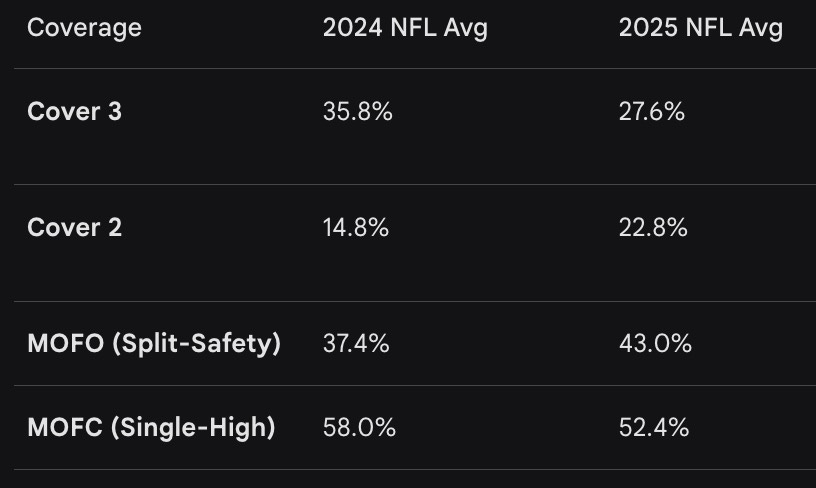
Cover 3 to Cover 2: The massive swing from Cover 3 to Cover 2 indicates that coordinators are no longer comfortable leaving a single high safety to “close” the middle of the field and want to cut the run/pass conflict for their Mike linebacker. Defenses are now using split-safety shells to keep a “cap” on explosive plays and using Quarters tools (weak rotations) to assist in vertical compression. In Tampa, teams are using non-traditional rotations to get a DB as the middle run through (MRT).
Man Coverage: Overall Man-to-Man usage increased from ~27% to 31%. The shift suggests that when defenses play closed post defenses, they are asking their corners to win more often in isolated assignments. It also cleans up heavier box counts. We haven’t seen man rates like this since 2019, when teams overcorrected versus the RPO fads post-Eagles Super Bowl.
Nickel Processor: With offenses “solving” standard split-safety looks by attacking the intermediate “hole” between the Safeties, the shell itself is no longer a deterrent. That places a lot of pressure on the Nickel or “Apex” player to be an elite processor. He is no longer just a man specialist; he is the primary eraser for the seam and off-tackle versus the run game. In a recent press conference, new Cowboys defensive coordinator Christian Parker said the Nickel position is now a “1st Round” need.
One of the key areas where Tampa is being utilized is on 3rd Downs. Defenses across the NFL are shifting their blitz focus to the early downs to stop the run and accelerate the reads on play-action passing. 3rd Downs are becoming the battleground for mental warfare.
Coordinators are less likely to send an all-out blitz and more likely to lean into non-traditional Tampa 2 rotations (NTTs) that force quarterbacks to read" the defense post-snap. The scheme typically places the Safeties in non-traditional areas outside of the standard Deep Halves.
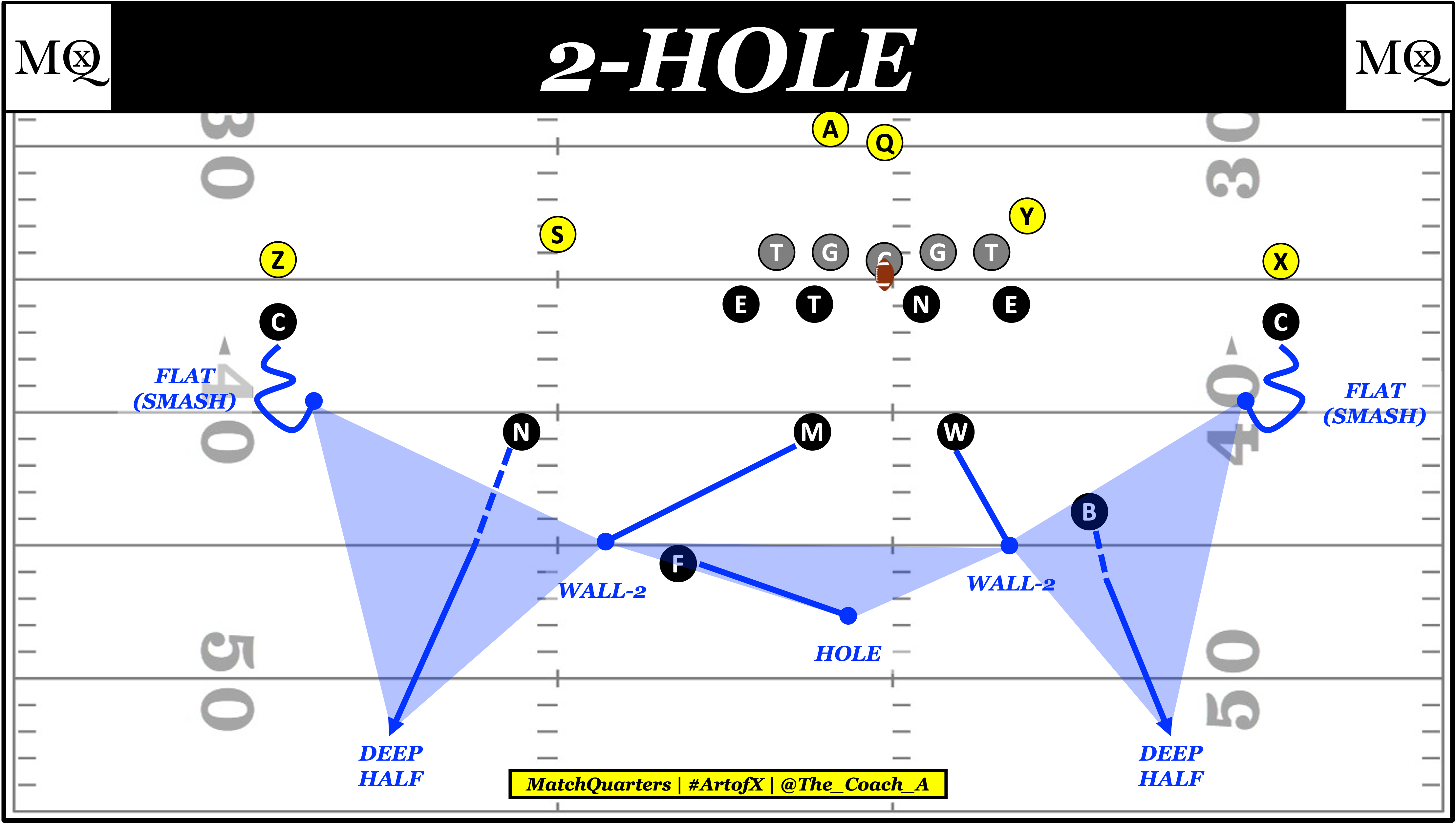
“Robber” roles are most often used to close the middle of the field rather than a Mike running through the middle. The concept meshes well with the current trend in coverage disguise. By running Tampa, there is also less room for error, given that the concept is more of a spot-drop than a matchup-based one.
Though Cover 2 has seen a rise in favor, that hasn’t meant that simulated pressures have also risen. For the past five years, “Sims” have been a coaching buzzword, but the data shows NFL teams are shifting towards more traditional five-man pressures.

But here, again, we see the modern iteration of standard schemes. The trendy pressure design right now is a five-man pressure with Cover 2 behind it—a literal synthesis of two major defensive trends: Palms Pressures (Tango or Deuce coverage) and five-man pressure schemes.
The NFL is again in another “market adjustment.” Offenses went “heavy” to kill the split-safety craze, a proven standard philosophy. Defenses responded by staying in two-high shells but making their units “heavier” (Base) and more aggressive (higher Blitz Rates). The only difference in 2025 was that offenses were just cosplaying as a running offense, only to attack heavier packages with the play-action pass.

Chicago Bears Defense
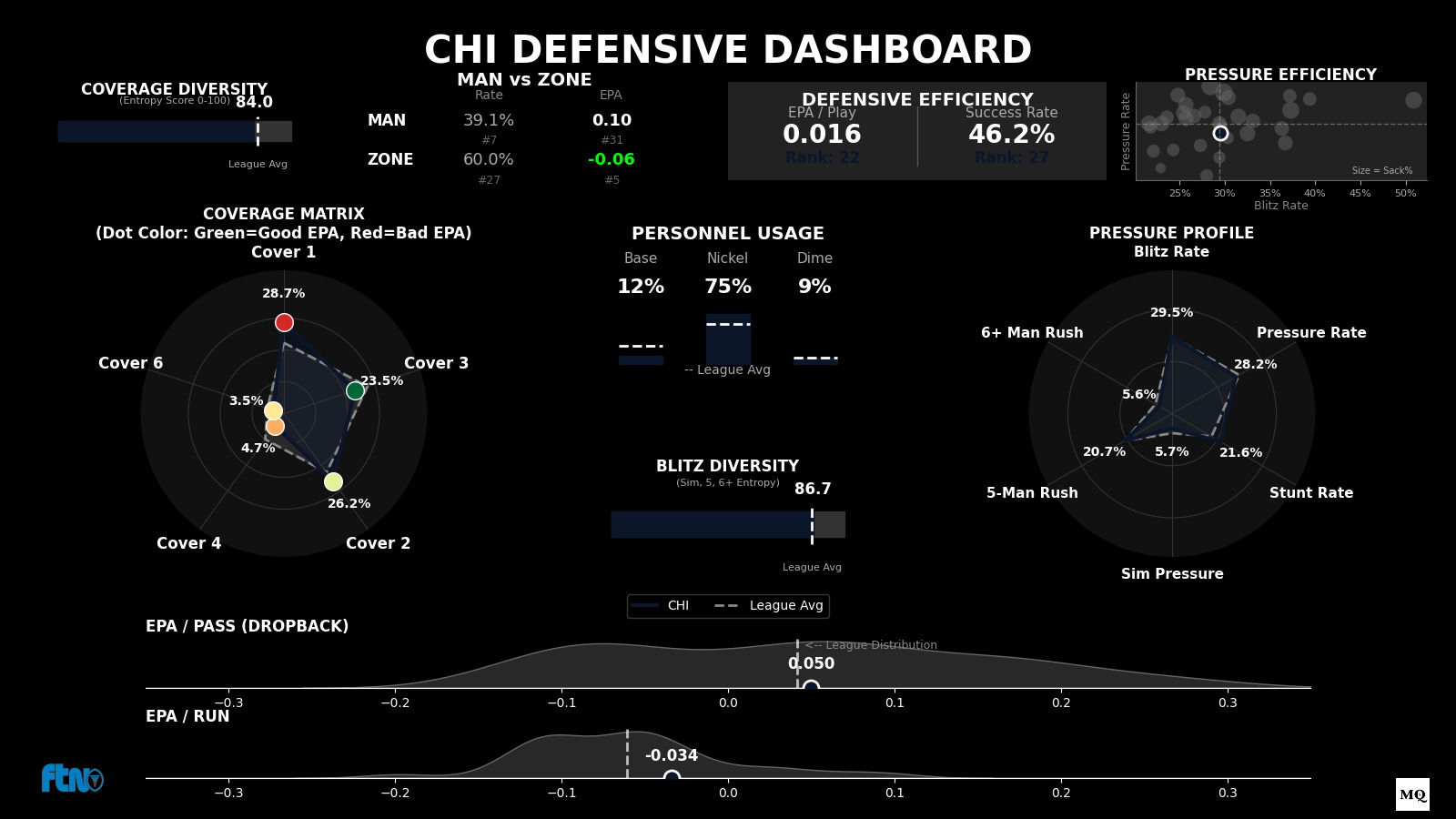
With the NFL’s “legal tampering” period opening today, I wanted to examine current NFL trends through the lens of the Chicago Bears, whose scheme under Dennis Allen reflected those trends while also highlighting major issues. I wanted to chart a path for evaluating defensive roster construction in the modern era.
Chicago’s use of two very distinct Safety types in Jaquan Brisker (Down) and Kevin Byard (Post), along with an elite Nickel in Kyler Gordon (when healthy), gives us a nice roadmap for the modern defensive paradox of trying to stay “light.” The personnel data from 2025 reveals a league-wide divergence in the evolution of defenses.

