


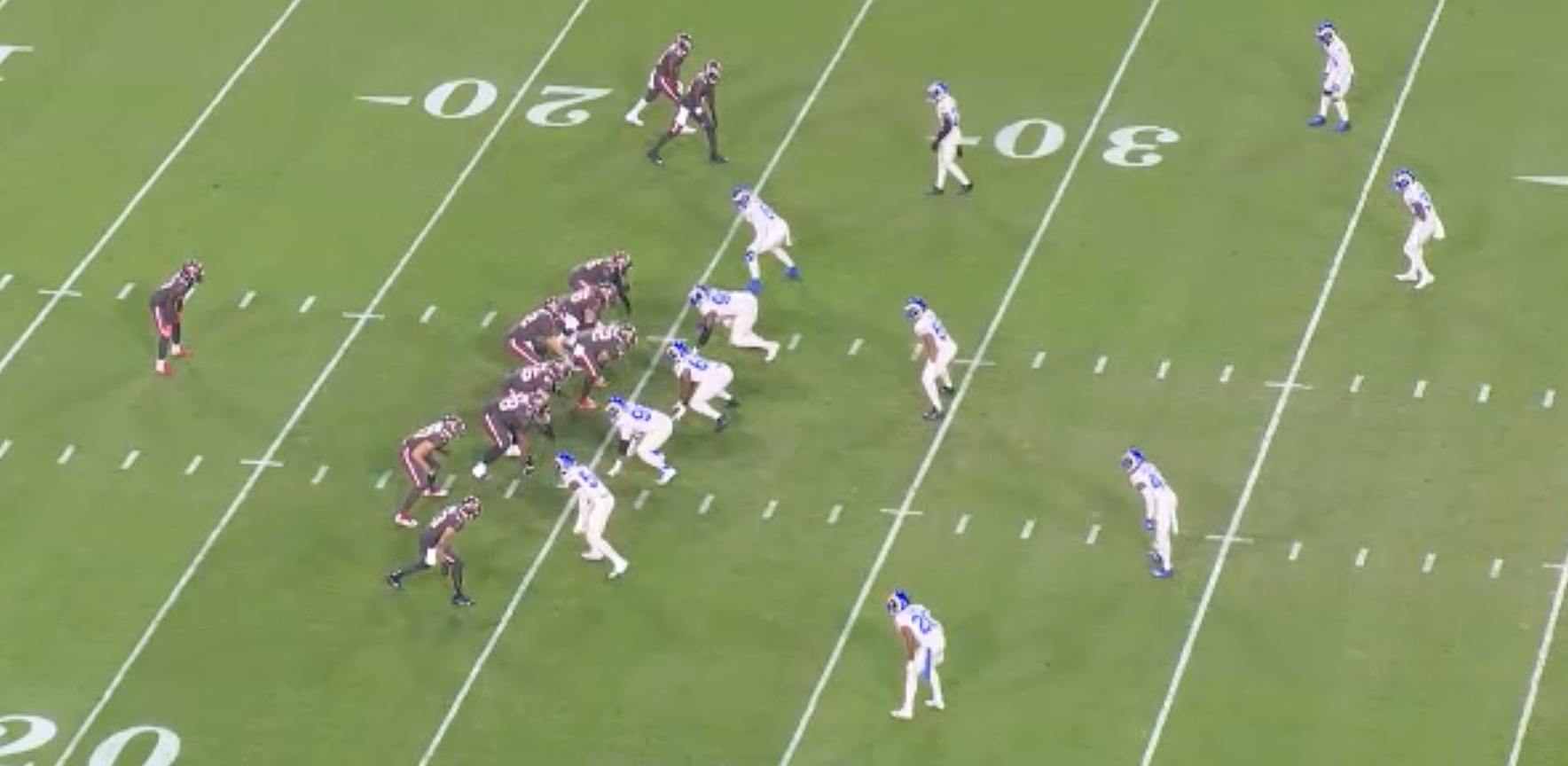
The offensive side of the ball tends to be more forward-thinking and less rigid in terms of trying new things. So it is not surprising that the embracing of modern analytics on that side of the ball has been quick to take hold. Most coaches understand that passing is a much more efficient way of moving the ball down the field (yes, this comes with caveats, but this is not the article for that). The offense has now made RPOs and reading static pre-snap coverages into a science, allowing them to attack every inch of the field. In turn, the modern defense has to attempt to cover more space with fewer resources.
At the NFL level, 2018 is the year that broke football. The Eagles had just won a Super Bowl on the back of a backup QB and “college” like plays. 2018 would see the explosion of the LA Rams offense, the ascent of Patrick Mahomes (remember the 54-51 matchup?), and the option offense of Lamar and the Ravens. Defenses were put on notice, and offenses began to shift toward early down passing, play action, and RPOs. The Spread had finally taken hold of the NFL.
With NFL teams now running RPOs and manipulating coverages like never before, points are aplenty. NFL defenses are struggling to figure out how to manage the risk of packing the box versus giving up fatal shots. High-powered offenses like Kansas City, the Rams, and Green Bay manipulate coverages with motion and alignments, constantly seeking a mismatch (or creating ones).
Outside of RPOs, the growth of the Crossing route in the NFL has challenged the pre-snap alignment of many NFL teams. According to Seth Galina of PFF, 60% of passing snaps over the past six seasons have come against a single-high structure. This makes sense as the league (and defensive football in general) is focused on stopping the run. To do that, a defense stuffs the box and is generally in a single-high structure.
So how have offenses adjusted to the high usage of single-high coverages? Run deep crossing routes. These routes are great against Zone or man because the WR is running across the field either away from their man or into a window opposite the targeted defender. Versus single-high, the deep safety cannot assist with the crossing route because he has to protect the middle of the field from deep. Usually, a Post is complemented by the crossing route to maintain high Safety coverage. The intermediate space is the sweet spot in every offense (i.e., high percentage throws)
In fact, according to PFF data, 76% of crossing routes are thrown against single-high defenses. Since the NFL, and many of the top college leagues, are dominated by single-high coverage, it is no surprise that offenses have adapted. Opponents are eventually going to get good at what they have to combat. It’s simple evolution. NFL defenses now have to counter this onslaught at what was seen as a “stable” solution to stopping the run on early downs.
