


In a league that is quickly becoming defined by hybrid defensive schemes, disguised coverages, and an uptick in early-down Blitz Rates, the Houston Texans have become the NFL’s “anti-defense.” Head coach DeMeco Ryans and defensive coordinator Matt Burke are bucking the trends of modern defensive philosophy. The Texans have a clear thesis on how to play defense, proving complexity isn't the only path to dominance; sometimes, execution is king.
Ryans has only worked under Kyle Shanahan and Robert Saleh. The defensive philosophy that emerged from the 2018 defensive pivot was, in part, due to Saleh getting frustrated with Shanahan destroying his Pete Caroll Cover 3 defense on a daily basis. But while others in this tree have evolved toward complexity—like Green Bay’s Jeff Hafley, who relies heavily on stunts and disguises—Ryans has doubled down on simplicity.
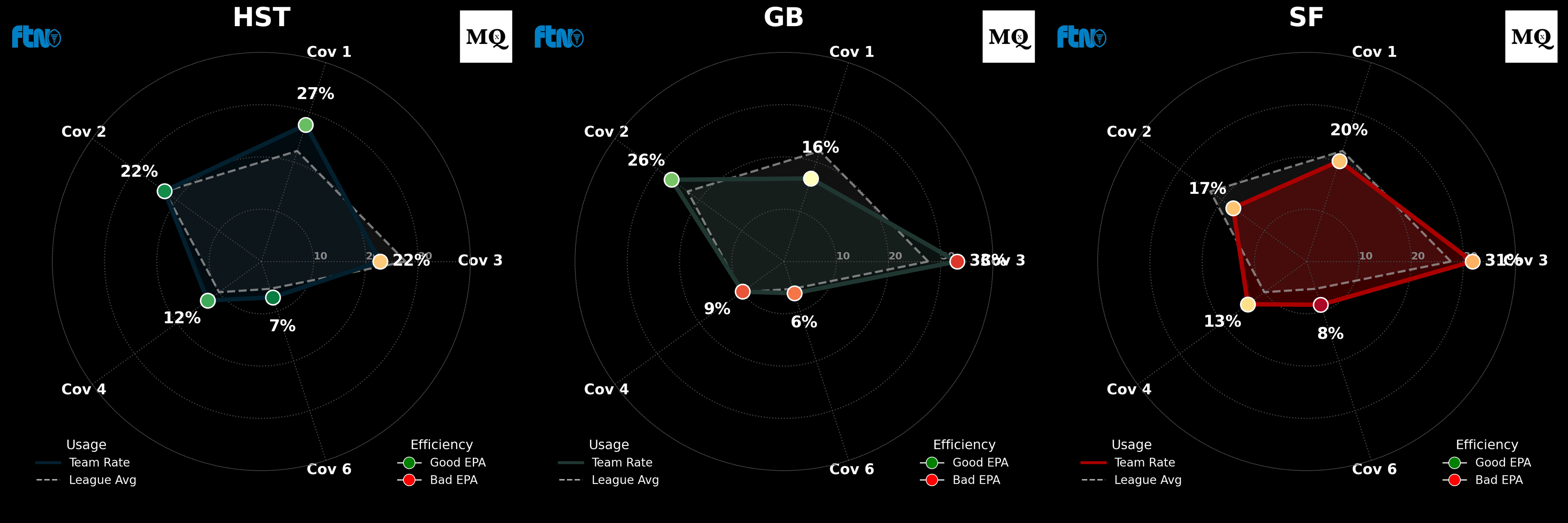
The foundational scheme is “passive-aggressive” in design: low blitz rates, high zone usage, and a Wide-9 front. Saleh relies on his core coverages (Cover 1, 3, and Quarters) and the highest stunt rate in the group (~21%). Hafley uses disguises to gain an edge on opponents, using stunts, simulated pressures, and coverage disguises at higher rates than the other two, while also relying more on Base personnel.
Of the three, Houston is the most balanced in coverage and relies the least on “scheme” to manufacture pressure. They are an outlier, ironically, in that they aren’t unique. They literally line up and attack offenses with technique, speed, and simple structures.
Simplicity at this scale requires elite talent, and at Ryans’ disposal is arguably the best CB tandem in the NFL (Stingley Jr and Kamari Lassiter) and the highest-paid Nickel in the league in Jalen Pitre. The linebacking duo of Henry To’o’To and Azeez Al-Shaair is athletic and rangy, perfect for the system. But the engine is the defensive end tandem of Will Anderson Jr and Danielle Hunter.
The entire unit is built to run and hit.
Coaches talk about “keep it simple” (KISS) and “playing fast,” but the Houston Texans in 2025 have defined what that actually looks like. Meet what can only be named the “Ass Whooper” defensive scheme.
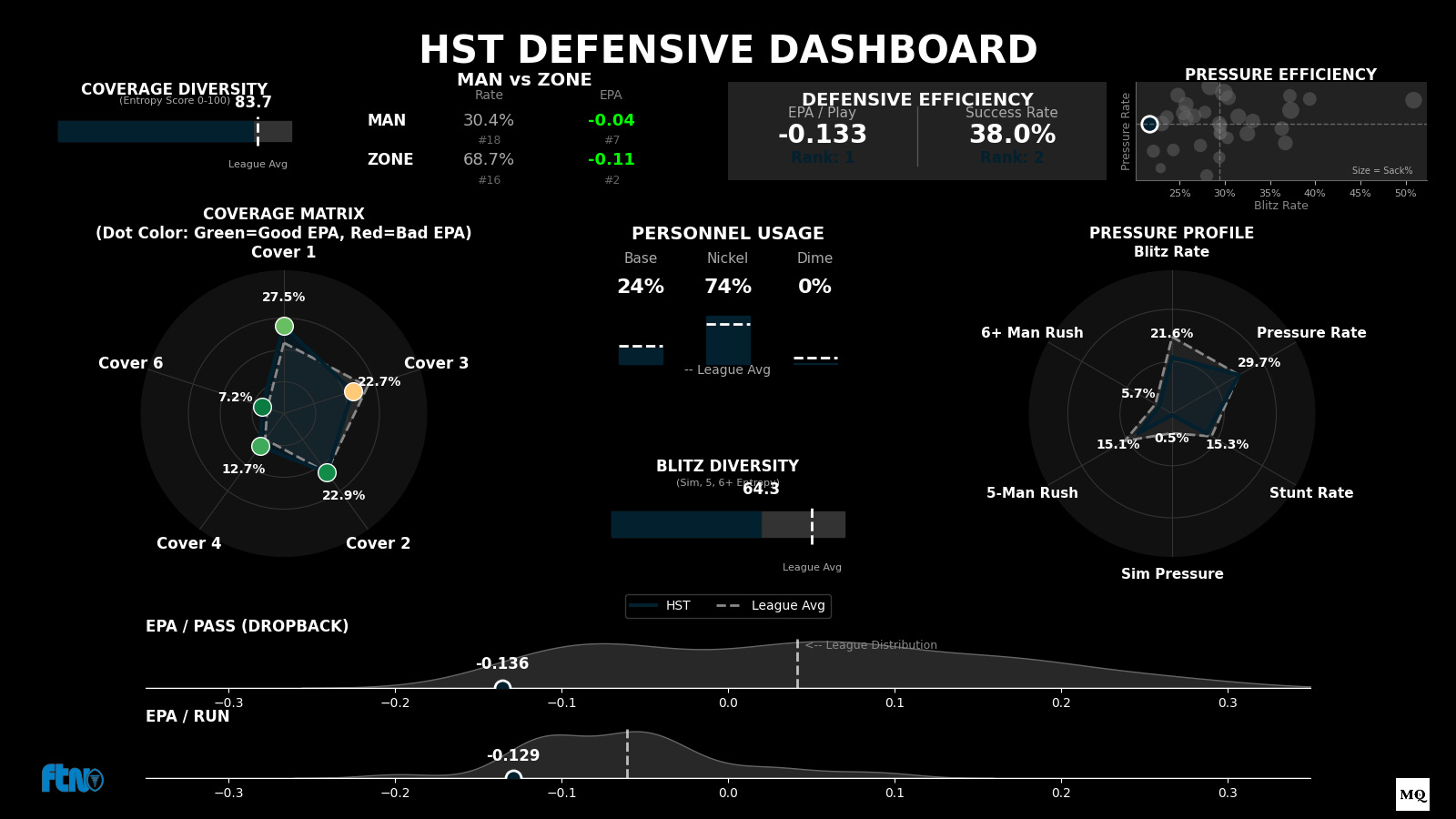
In 2025, Houston finished in the top five in almost every defensive metric that matters. Yet it is where they finished last that makes this defense truly unique.
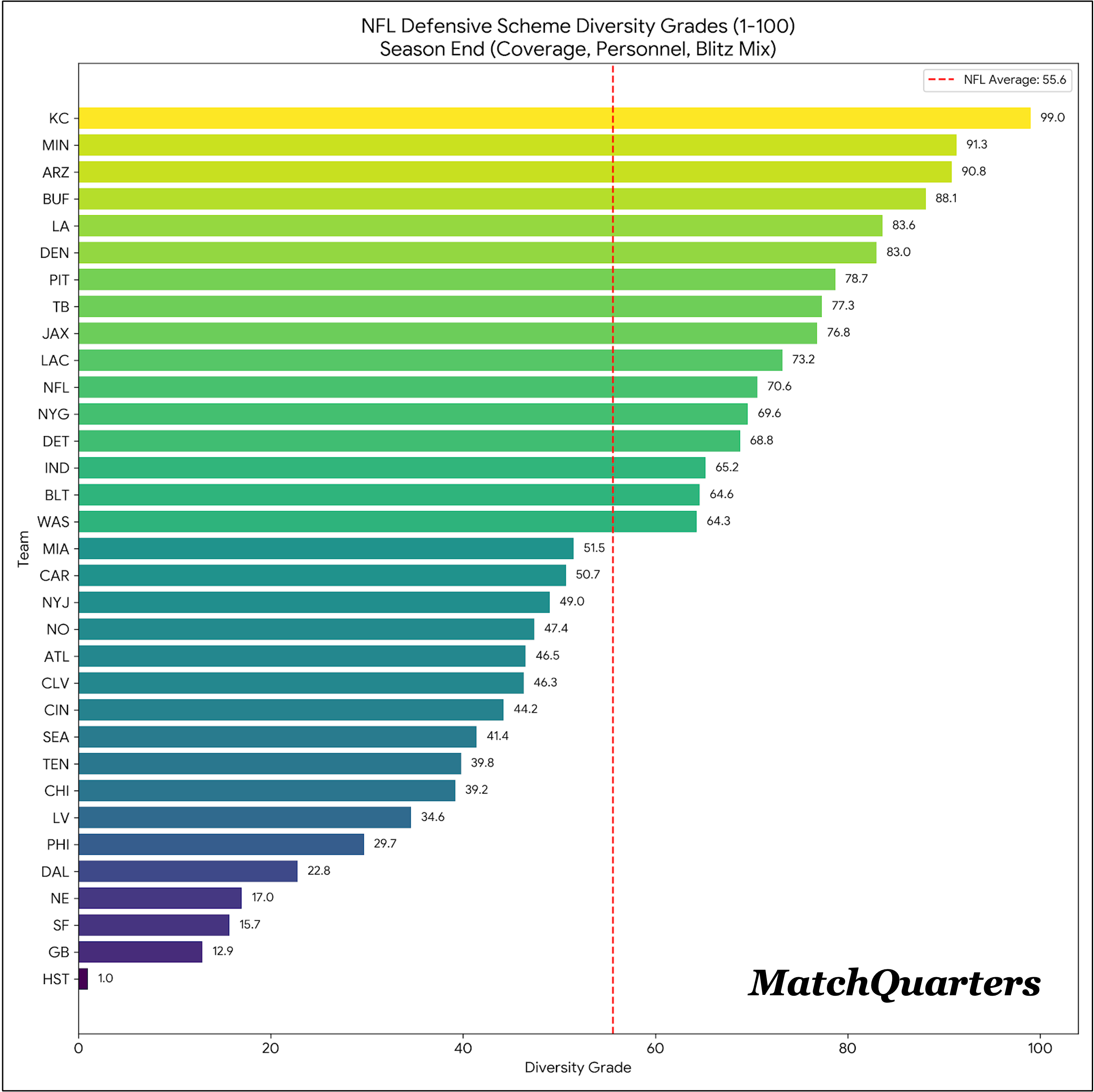
The Texans ranked 32nd in Blitz Rate and Simulated Pressure Rate and played Base defense (4-3) on only 24% of their snaps (28th overall). Like San Francisco, they are hyper-focused on Nickel, playing almost no Dime because the eleven on the field can all run, and the box can win one-on-one matchups.
It is the inverse of the Vikings’ Brian Flores, in a sense, who wants to blitz on every down but plays almost exclusively zone. Ryans and Burke have built a defense that is ultra-aggressive yet structured.
The secondary is aggressive when needed to fit the box and at the point of attack in coverage. What looks to be a solid gain on an early-down run quickly gets smothered for minimal gain, and receivers find it difficult to gain separation.
Houston stylistically is nowhere near Minnesota, but the early-down philosophies are the same: win 1st to win 3rd. And this is where the Texans are unique, and are the most efficient defense on early downs (1st/2nd).
The NFL remains dominated by zone runs, and the Texans allow 3.67 yards per carry on Inside Zone. Coordinators at the higher levels are willing to gamble on run-yardage early to get the offense into a passing down late. Most defensive coordinators want the offense to gain fewer than three yards on 1st Down.
According to Sumer Sports, the Texans’ average 2nd Down length in ‘25 was ~8 yards. Houston also led the league in EPA/Play on early downs (-.187) and ranked second in completion percentage (59.7%). They are doing the work.
But if the defense, in appearance, is static and predictable, why are they so good? The answer is in the numbers and how they attack these early downs situationally.

Early Down Sequence & Philosophy
—
To understand Houston's patience on early downs, you first have to know where they use their blitz capital. The most “aggressive” down for Houston is 3rd & Long (7+). That is the only time their Blitz Rate goes above 30%. Ryans and Burke want to play defense and limit the amount of explosives on early downs, but are willing to force the issue when they know the quarterback has to hold onto the ball.
Blitzing can open up seams or create one-on-ones down the field. Houston has an elite secondary, but they don’t want to turn each down into a potential track meet. That’s a losing battle overall.
