


2019 was Tom Brady’s last Super Bowl with the New England Patriots. Seven years later, the Patriots are back in the “big game,” but with a completely different cast of characters. Instead of Bill Belichick stalking the sidelines, it’s Patriots legend Mike Vrabel. And instead of a future Hall of Famer commanding the huddle, it is the second-year phenom, Drake Maye.
Belichick built the Patriots around solid defense and Tom Brady. Seven years later, the blueprint is much the same. Don’t make mistakes (Do Your Job!), play solid mitigating defense, and “build the entire plane” from your quarterback.
Most of the national media and pundits are focused on the run game of New England, which, in turn, leads them down the path to the Patriots’ use of play-action. The theory is that if the Patriots can get the Seahawks' Nickel defense to close in on the box, that would open up the backend for Maye.
The main talking point of this approach is Seattle’s unique defense, which is among the best against the run and is designed to operate within light boxes. The Patriots will not be able to turn this into an “ugly” game and win each series with “efficiency.”
Seahawks’ Head Coach, Mike Macdonald, has built a system that slowly squeezes the life out of an offense as it works down the field, eventually snuffing the drive out. Eventually, an offense will make a mistake, either a penalty, a sack, or a turnover, flipping the advantage (and the ball) back to Seattle.

Most offensive coordinators prefer 3rd-&-Medium situations because they are in control of the series. The problem with that theory is that the Seahawks’ defense is an efficiency monster, winning the down, any down, at a 60% rate.
The Patriots offense doesn’t want to “die a slow death.” If they are to win, they need to take the fight to Seattle and take the offensive quickly. The only way to beat the Seahawks is to make them chase points.
The paradox facing New England is that they don’t want to play “on schedule”; rather, they need to attack early and often, treating any series that gets between the 40s as four-down territory. 1st Down is a “bonus” down—take the shot!
The main argument among many in the media is that the Patriots need to use early-down play-action to take deep shots down the field, attacking the perimeter and the deep intermediate area behind the linebackers. Utilize horizontal runs (Outside Zone) and attack the perimeter.
The movement should get the speedy front seven of the Seahawks to push, and the Cover 2-heavy secondary exposed in the middle of the field and in the “Turkey Hole,” between the CB and Deep Safety. But that’s not really the Patriots' style under Josh McDaniels, who has built an offense to utilize Maye’s elite ability to hit the deep ball.
Offensive Design
The play-action shots are a great theory, but analyzing the bones of the New England offense tells you a different story. McDaniels has developed a highly efficient, pass-first offense on the back of Drake Maye. The passing attack outclips the ground game by a significant amount, but that is by design.
The Patriots’ offense is third in DVOA and second in Pass DVOA. That is in stark contrast to their 21st-ranked DVOA run game. The dropback passing game is elite as well, finishing first overall in EPA/Dropback and Success Rate (59%). So, as good as the Seahawks defense is, that’s how good the Patriots have been all year, even when adjusted for opponents.
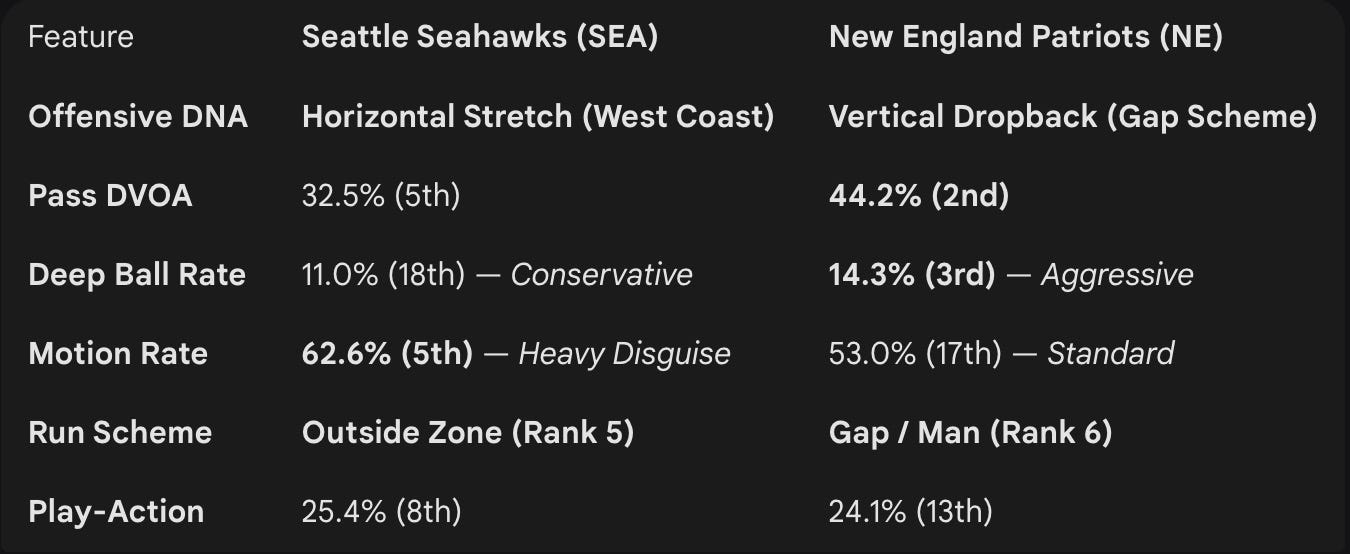
McDaniels’ core philosophy for staying ahead of the chains is to challenge defenses through the air and keep just enough weight in the run game to keep opponents honest. Klint Kubiak’s offensive philosophy, a Shanahan derivative, is built similarly, but these two teams are getting there in completely opposite ways. Kubiak uses horizontal action to create windows, while McDaniels uses vertical schemes to create one-on-ones and explosives.
Seattle stays ahead of the chains by using horizontal stretches, whether in the throw motion or the Outside Zone, to attack the structure of a defense. New England is more traditional. The Patriots’ run game is more vertically based (Gap/Duo) and built around a traditional vertical passing game.
The Patriots’ offense is “hunting” big plays instead of manufacturing them. McDaniels's offensive playbook utilizes motion, but not at a high clip. Unlike Seattle, New England wants to throw the ball deep, and in 2025, it did so at an elite rate.
Kubiak, similar to Shanahan in San Francisco, is looking for the completion-rich intermediate and uses Deep Shots as a “side” instead of the main course. In the Seattle offense, Sam Darnold is essentially a point guard; Maye is a shooter. Seattle’s quarterback needs to distribute the ball to his weapons, which are created by motion and run fakes.

McDaniels puts all the weight of the offense on Maye’s shoulders. His massive efficiency against the blitz (0.605 EPA) shows that the young QB is solving his problems with his arm (or legs), whereas Seattle is creating “designs” to eliminate their problems on the whiteboard.
New England lays a clever trap for their opponents. On paper, the run game looks average, but the attacking style forces the defense to load the box. When teams move into closed-post coverages, Maye slings it to his receivers downfield.
Sit in light boxes, and the Patriots run right at the defense. The Patriots also like to use extra linemen to get teams into their Base personnel, which is where they attack downfield in the play-action game. These are well-timed haymakers, not “designed” or baked in like the Seahawks.
Drake Maye’s ability to throw the ball deep and scramble away from pressure has made this a top unit in the NFL. Blitzing is also off the table for most teams at volume.
Though the Patriots’ O-line is solid (12th in Pass Block Win Rate/ESPN), Maye has shown an escape ability, finding almost seven yards a pop when he takes off. His legs alone are why they beat the Broncos. Here’s a look at his data as well as who his main targets will be in the Super Bowl:
The Engine: Drake Maye
Performance: An MVP-caliber season.
Metrics: 0.287 EPA/Dropback (#1) and 25.8% DVOA (#4).
Situational Mastery: Against the blitz/pressure, he is nearly unstoppable with an EPA/Play of 0.605 (#1) and a massive 52.9% DVOA (#2). He’s quickly solving the puzzle.
Style: He is aggressive (8.9 YPA/#1) yet efficient (50%/#3), punishing defenses that try to heat him up.
—
The Weapons:
TE Hunter Henry: The safety valve and chain mover. 50 catches, 504 yards, and 4 TDs.
RB Rhamondre Stevenson: The workhorse back. 603 rushing yards (4.6 YPC) and 345 receiving yards. While the team’s rush DVOA is low, Stevenson can provide dual-threat production.
WR Stefon Diggs: A veteran route runner who fits perfectly into a high-success-rate offense. At 32 had a 1,000-yard season and can be moved anywhere on the field to create leverage.
WR Kayshon Boutte: Has emerged as the main deep threat in the playoffs. 15 targets for 8 catches and 147 yards. That is ~18-yard clip per catch.

Game Theory
The Seahawks defense doesn’t give up explosive pass plays (7.3% Explosive Rate/6th), but that number increases to almost 10% when teams run play-action (9.5%/8th). The theory that the Patriots need to use the deep shot from their play-action menu is valid, but it has an issue.
New England just doesn’t run play-action; they are 24th in usage and extremely explosive when blitzed. The problem?
Seattle doesn’t blitz on early downs. So, the thought process behind the play-action note is reasonable; it would be out of character for the Patriots to lean into it during the Super Bowl, even with an extra week of prep.
Can New England take a play-action shot? Yes. But it won’t be the recipe to win on a drive-to-drive basis.
The Patriots get most of their production in the deep passing game from a traditional dropback menu. These aren’t “manufactured” throws like we see in other offensive systems.
Looking at the Seahawks’ season, three teams could argue they took advantage of the Seahawks’ defense: the 49ers (first match), the Jaguars (vs. Shaquille Griffin), and the Rams. Only LA consistently pushed the ball down the field and owns almost half of Seattle’s deep ball completions (dropback or play-action).
Diving deeper, all three of those teams like to use motion to identify the coverage, but that isn’t in the Patriots’ DNA. They are 17th in Motion Rate. Drake Maye has become one of the best deep ball passers in the NFL, and New England is more than willing to give him the volume.
Maye is #1 in dropback Explosive Rate (13.6%) and second only to Sam Darnold when teams blitz him when running play-action (22.7%). The signal for the Super Bowl is in the dropback passing game at a neutral site and in good weather.
Can the Patriots hit home on some of these concepts similar to the Rams?
The data shows the Patriots can hunt for big plays. History shows McDaniels knows how to do it. Now, let’s look at the specific dropback concepts New England can use to exploit Macdonald’s “Darkside” defense and bring another trophy to Foxborough.
Let’s dive into the tape!
