

It is fitting that the first college football game in 2025 was against two upper Midwest teams from the Big 12. For decades, the Big 12 conference has been the bastion of innovation in college football. Since 1999, when Mike Leach introduced the Air Raid to the nation in Oklahoma, the Big 12 has been an incubator for some of the best offensive coaches in the country. The conference has also been a place where good defensive coordinators go to have their careers reset.
Last year at the highest level, scoring and offensive output cratered. There had always been dips along the way, but analytically, passing is much more efficient than running. Additionally, the going rate for a top-ten quarterback is $ 60 million or more. Teams aren’t just going to let that money hand the ball off to a $10 million or less running back.

Passing has always been a “better” way to move the ball in football. Running is hard. However, collectively, football players weren’t very good at throwing the ball. Then, in the late 1970s to early 1980s, the West Coast and Air Coryell systems emerged as bona fide solutions to the problem. The game, though, was still not ready for a full-on shift.
As the decades passed, the NFL began to tighten the rules regarding defending receivers and tackling the quarterback. Offensive line play began to get better. More fans filled the seats and watched the games on TV. Eventually, the dam broke, and in 2018, the NFL became a pass-first league, a goal it had been working towards for 50 years.
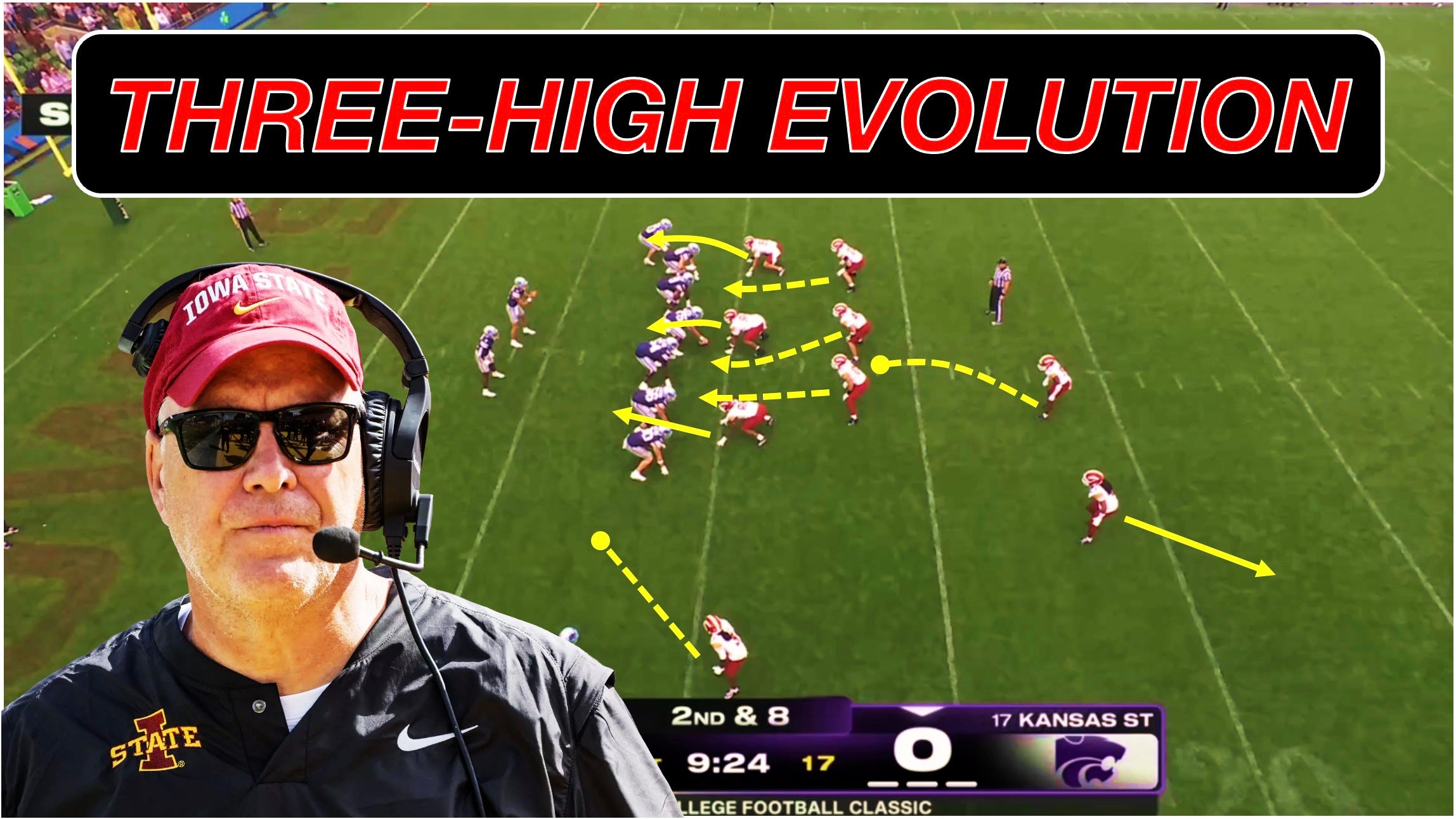
Which brings us back to the Iowa State vs. Kansas State matchup in Ireland. The game featured two programs that are the poster children for the era of college football we live in today. Both offenses feature hybrid TEs and FBs (H-backs), but run a three-safety structure on defense.
The Wildcats have had a bruising Power Spread attack since the days of Bill Snyder, while Iowa State under Matt Campbell has leaned into its Midwestern roots and has developed its own brand of a 12-personnel-dominant Power Spread system. The irony is that both teams run Odd Stack defenses, which are notoriously vulnerable to larger personnel groupings, especially two-TE formations.
In their defense, both teams face these offenses on a daily basis. Over the better part of a decade, both Chris Klieman and Campbell have had to wade into the unknown waters of the Big 12 and find a way to compete with limited recruiting resources. Kliemann has been doing that his entire career as the defensive coordinator for Northern Iowa and North Dakota State.
Both DCs in the game cut their teeth at the lower levels and have been tied to their head coaches for quite some time. Jon Heacock (Cyclones) and Joe Klanderman (Wildcats) followed their head coaches from previous spots. They understand the culture and have experience in implementing schemes.
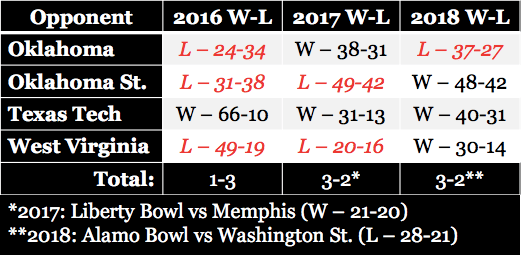
It is well documented that Heacock and Campbell, in the Spring of 2017, felt they needed to make a change defensively. Heacock landed on the Odd Stack, but with a twist, the defense would align from a three-safety shell.
The Odd Stack, also known as 3-3-5, is not a new concept. Joe Lee Dunn is credited with inventing it in the 1990s at the University of Memphis and then brought it to the University of Mississippi in 1991. The system is typically closed-post dominant. Heacock was planning on changing that. Iowa State would feature a Tampa-style defense, with the middle safety playing the high hole and fitting the run from depth.

At this point, teams were also experimenting with the Tite Front. Dave Aranda in Wisconsin and the East Coast 3-4 systems that stemmed from Appalachian State were being experimented with. Aranda’s Tite Front was introduced to Nick Saban and Kirby Smart by Todd Orland after their loss to Ohio State in the 2014 Sugar Bowl. From that meeting, the Mint Package was born.

By 2019, the three-high system had hit the SEC. To stop the offensive onslaught of the Joe Burrow-led LSU Tigers (with Jamar Chase and Justin Jefferson), teams started to tinker with the Iowa State structure. Teams across the country were tuning into the Big 12 to see Iowa State’s “Air Raid Killer,” as Oklahoma State’s Mike Gundy coined it. College football was on the verge of a defensive revolution.


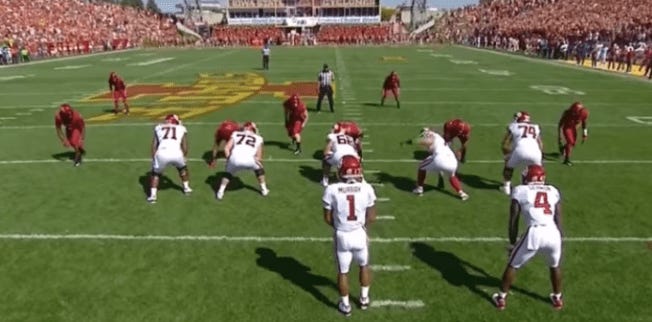
Most pundits saw the Iowa State system as another Big 12 gimmick, but on defense. The “Tite Tampa” was a common phrase, though that was far from the truth. In reality, the Cyclones only played the Tite (404) in their Bear Fronts (above) or versus Empty formations. Heacock had devised several ways to counter the Air Raid systems within the Big 12.

By 2020, a majority of the defenses in the Big 12 were playing some version of the Iowa State system. Campbell and Heacock led the Cyclones to their first Big 12 Championship birth, but they lost to Oklahoma 27-21. Their reward was a spot in the Fiesta Bowl against Oregon, which they won, marking the first time in program history that they finished in the top ten.
For all the focus on the passing game limiting effects of the defense, the real secret sauce in the system is how it stops the run. The Middle Safety (Iowa St. calls him the Star) is responsible for shadowing the #3 offensive player and fitting off him accordingly. The technique is called a “3-Fit,” and against the basic 11 personnel Y-off offenses that are prevalent at the lower levels, the Safety fits from depth and is often not considered part of the “box.” Even still, most O-lines won’t look to block him.
» What looks like a light box quickly becomes packed with numbers.
The run fits allow the defense to flood the seams with overhangs to combat pesky Run-Pass Options (RPOs). The Middle Safety also clogs the middle of the field, where modern Spread teams like to hit Y-Cross. The system is designed to eliminate the two most critical points of attack for a Spread offense: the B-gaps and the intermediate middle of the field.

The rest of college football, especially at the G5 level, followed suit. Now, in almost every conference, there is a team running a three-high structure. With a defense that requires hybrids to play, the lower level, including high school, finally found a defense that suited much of their rosters. The system has exploded in popularity, and along with the Tite Front, it is probably the most run defense in football.
» Coach’s Note: Tony Gibson (Marshall HC) and Rocky Long (along with his disciples) are probably the most well-known Odd Stack coaches in college football prior to Heacock. Although both employed some three-safety schemes, neither used it as a base, which distinguishes Heacock and explains why he is often credited with the three-high revolution.
Klanderman needed to go through his own evolution at Kansas State. The North Dakota State football team is one of the best programs in the country at the FCS level. The Missouri Valley Conference, in which they play, is the toughest conference at that level. Most of those teams use multiple TEs and have running quarterbacks, a nightmare for defensive coaches.
In Fargo, the Bison (pronounced Bi-zuhn) played a four-down Tampa 2-based structure. In the Big 12, and especially at K-State, the defense would need to shift to accommodate more “tweener” players, a traditional staple of the Wildcats’ recruiting map. Kleimann and Klanderman pivoted to a three-down three-high Tampa structure, which could be smoothly transitioned to within their original scheme.
The Big 12 has long been seen as the Air Raid capital of college football, but after decades of pass-happy dominance, there was a predictable shift. As more defense in the league shifted to hybrid Odd Stack schemes, offenses started to “get big” and develop their TE rooms. The Air Raid isn’t dead in the Big 12; it just matured, forcing defense to adjust.
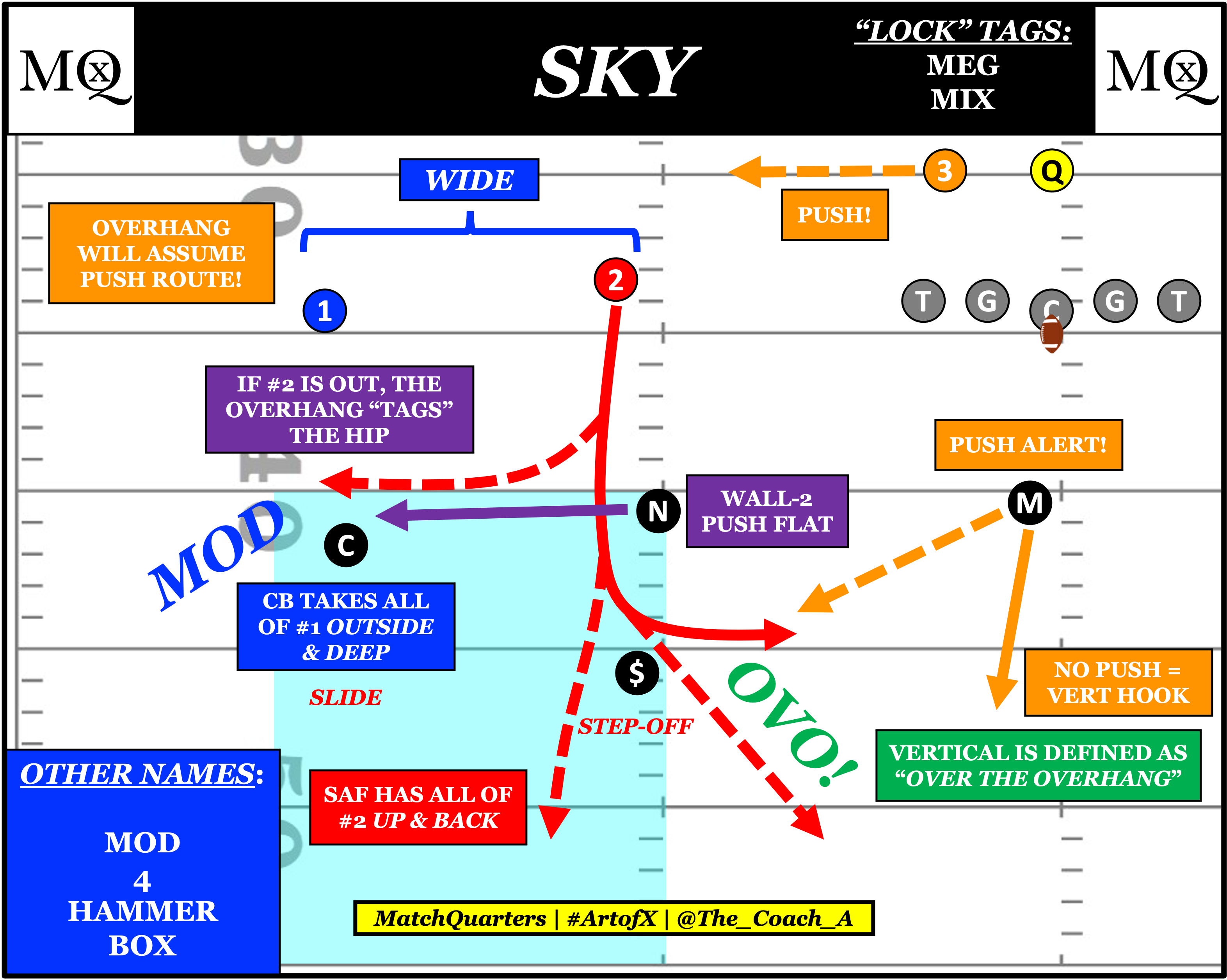
Over time, both K-State and Iowa State have morphed from Cover 2-based systems to ones that feature Quarters. Many feel like Quarters cannot be run from an Odd Front structure, but that isn’t true. Both teams run a version of MOD Quarters and attempt to use their static shell to disguise their coverage rotations.
Iowa State was 18th in Quarters usage last year in the FBS, while K-State, which has a much more diverse coverage menu, finished 44th. The Cyclones were 14th overall in split-field (open-post) coverage as well. The Wildcats run a lot more man coverage than the Cyclones. Iowa State finished 116th in man coverage usage (PFF). Although similar, the two defenses are not the same.

Full circle. The Big 12 is now a Power Spread league that features plenty of teams with multiple TEs. The natural extra gaps and blockers force defenses to add defenders to the box. Isolation outside is typically where offenses can find space. The other is in the box, where lighter defenders now have to fit the run. Think of it as space by force.
Jim Knowles at Ohio State, also a former Big 12 DC, created a four-down three-high structure to combat the Power Spread schemes found in the Big 10. That gave three high defensive coaches more ideas on how to combat 12- and 21-personnel offensive packages. Even Nebraska (another former Big 12 head coach) got in on the trend last year. Hopping into a four-down structure allows the defense to spread its anchor points out and get bigger bodies on the line of scrimmage.

When facing each other in Ireland, the Cyclones and Wildcats had two separate philosophies to counter their opponents. Iowa State used Odd Stack defensive alignments even when K-State tried to get big on them. K-State featured some four-down alignments, especially against unbalanced formations. Let’s dive into the tape!
