


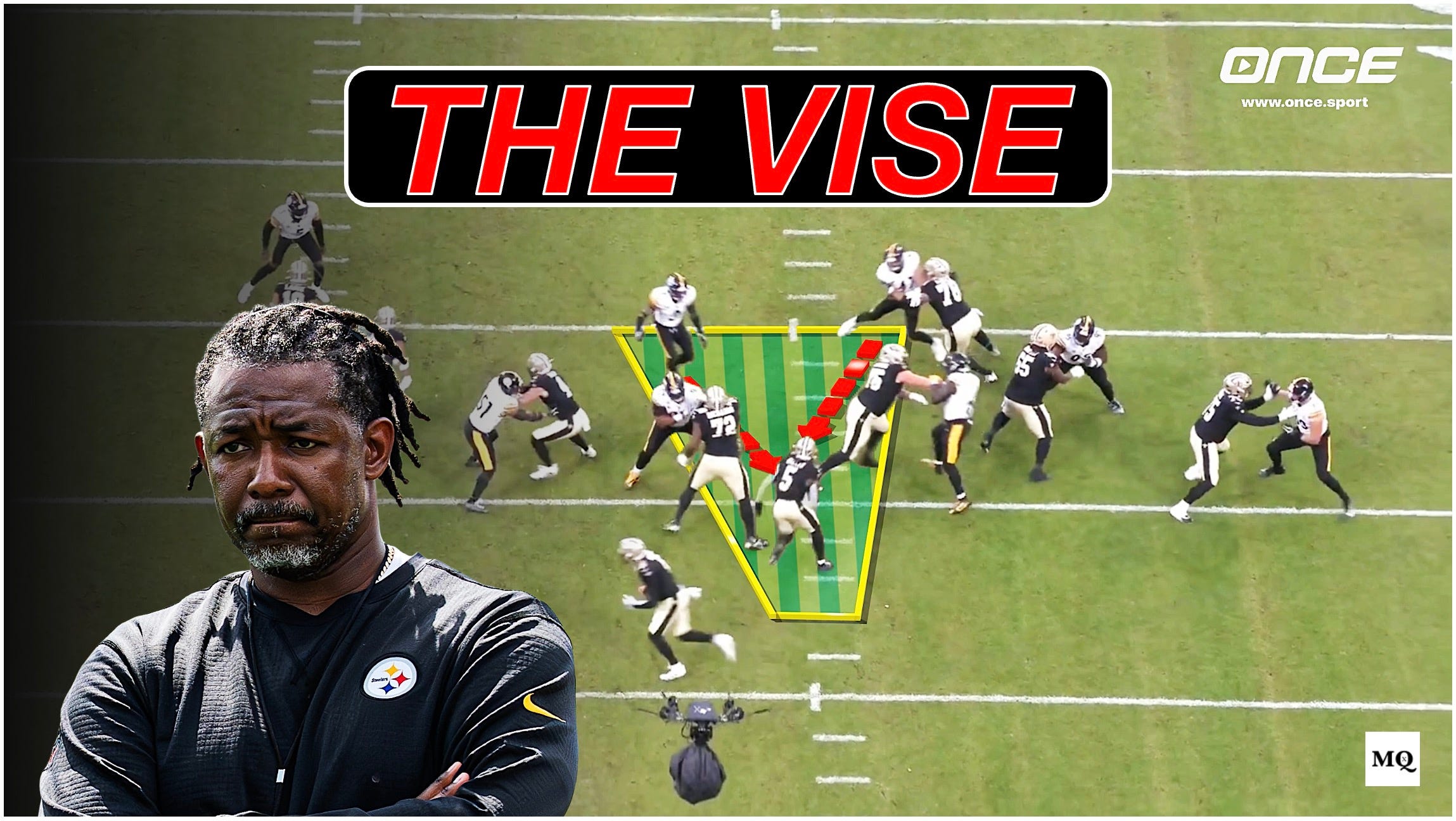
The Nickel position has become a priority in the NFL because defending the run is difficult with five defensive backs on the field. The modern game is passing-oriented, and offenses hunt for matchups, which is why the league has seen more 12- and 13-personnel groupings.
Defenses that can stay in Nickel are more adept at defending the pass but can pay a price in the box. A Nickel that is a net plus against the run has led many teams across the league to start using “Big” Nickel packages, or three-Safety personnel groupings.
2026: 22.7%
2025: 19.4%
2024: 14.2%
Kyle Hamilton (Ravens), Derwin James (Chargers), and Nick Emmanwori (Seahawks) are the new prototypes for this position. All three are over 220 pounds and dynamic near the box. The search for a “Down” Safety has increased Big Nickel usage by more than 8% over the past two seasons.
Sitting in static sub-packages on early downs can spell disaster for defenses that play with a traditional Slot CB. Some “smaller” DBs like Kyler Gordon (Bears) and Jalen Pitre (Texans), both under 200 pounds, have illustrated a dynamic skill set and set the market for Nickel contracts.
But those players are few and far between, and teams are starting to hunt for them early in the draft, with Dallas selecting Caleb Downs with the 11th overall pick. Offensive play-callers know this, and consistently attempt to manipulate the package on the field to get advantageous looks in the run game.
At the end of the day, running the ball is non-negotiable at every level of football. Understanding how to stop it, regardless of the package on the field, is critical for the modern defense to succeed.
But what do defenses do without an alien at Nickel?
Some defenses, especially at lower levels, like to “cut” the front or use stunts to change the math in the box. At the NFL level, where run stunts account for less than 5% of all plays, that philosophy can create wide efficiency gaps, as one misstep can lead to an explosive play.
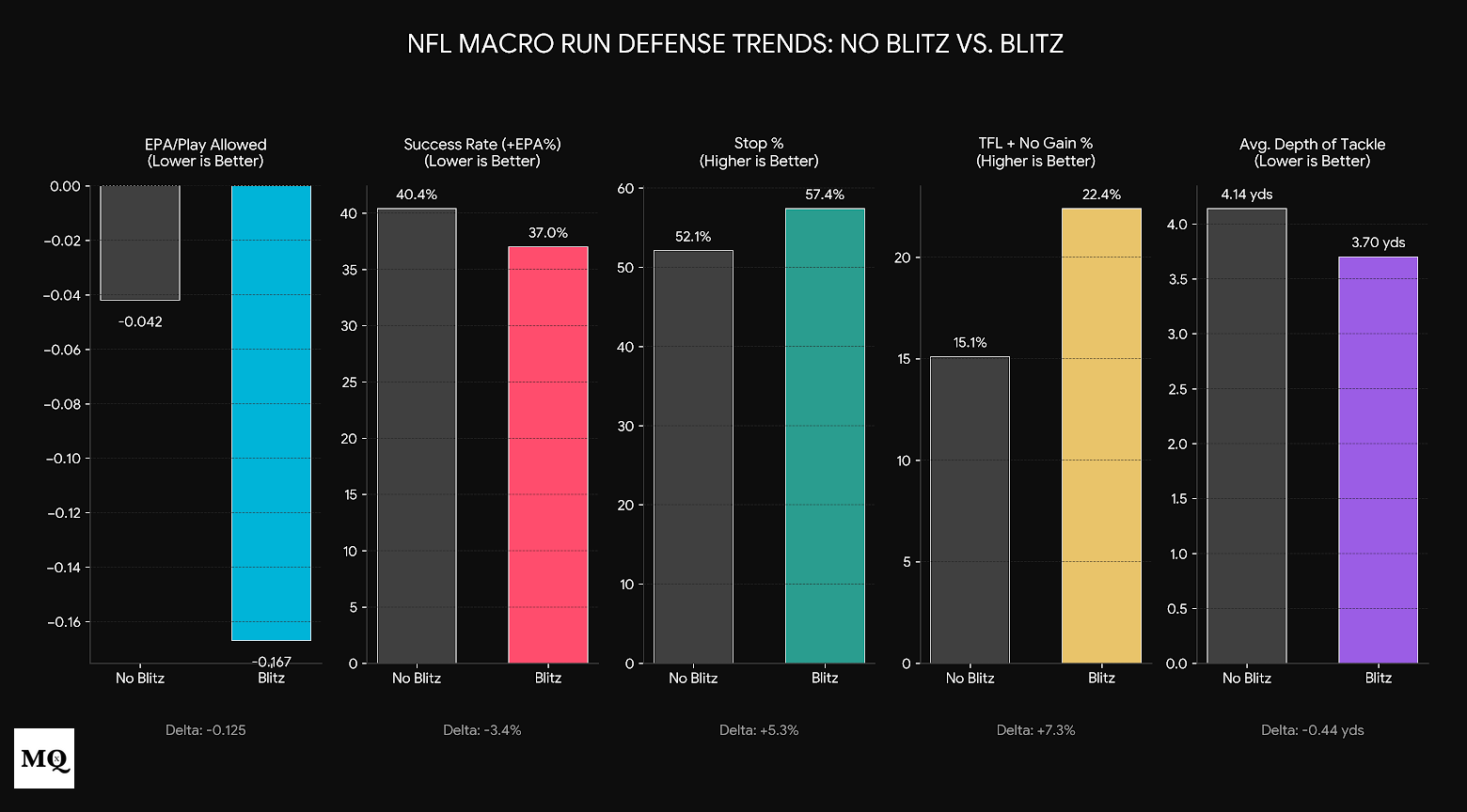
A safer change-up to playing standard fits is to send pressure. Last season across the NFL, run blitzes lowered EPA/run by -.125 and increased Tackles For Loss (+ no gains) by over 7%. Blitzing is a highly coordinated change-up to basic structures and can shield a smaller Nickel or force his fit, giving him an opportunity to go unblocked into the box.

One of the best examples in the NFL is the Pittsburgh Steelers, who use Big Nickel on less than 5% of their plays and rely on Jalen Ramsey and Brandin Echols (who weighs less than 185 pounds) as their main slot defenders. Defensive coordinator Patrick Graham follows best practices by limiting pressure to under 25% of his Nickel calls against the run; his sits at 18% (20th).
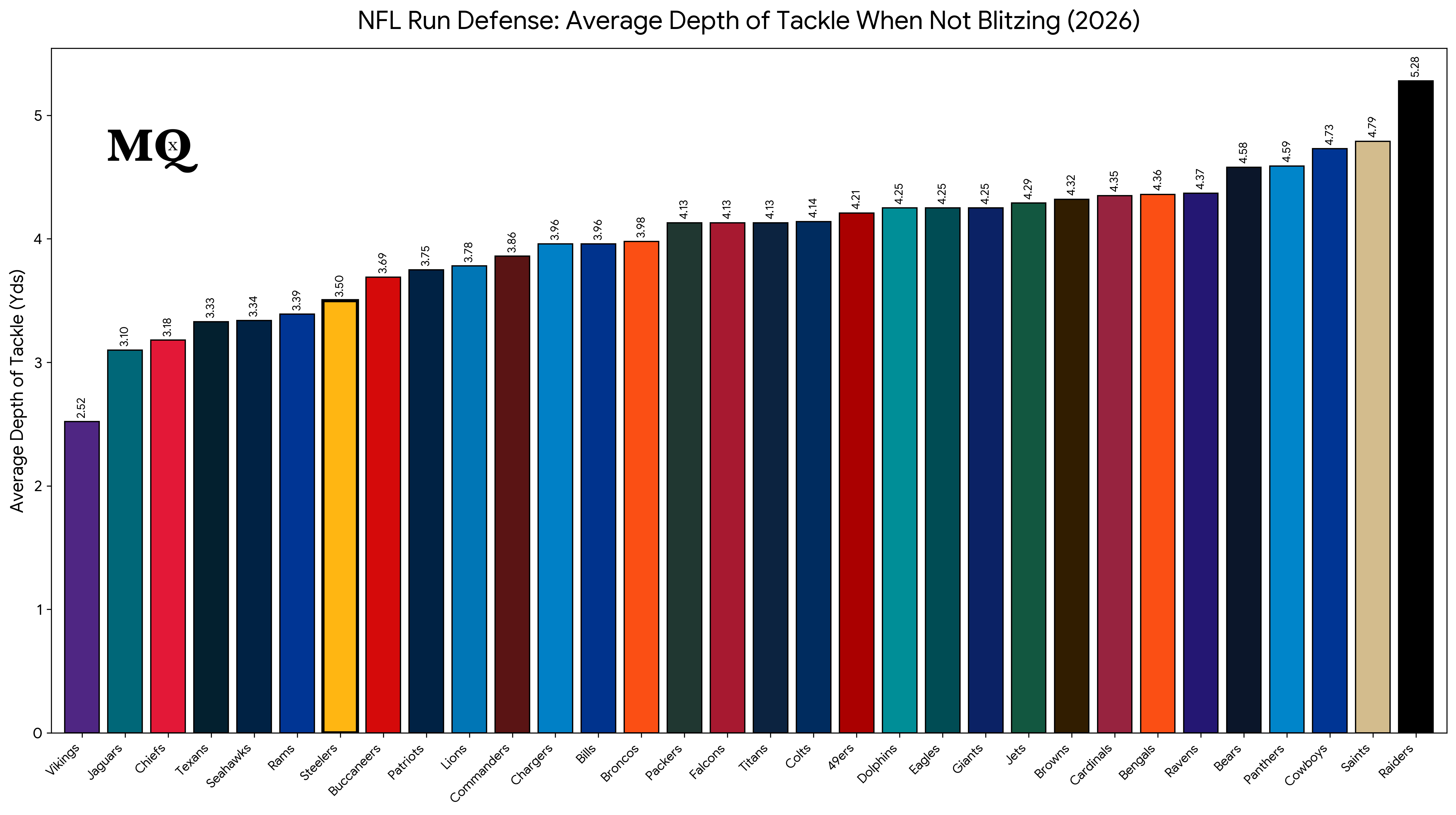
The Pittsburgh defense is already stout against the run, regardless of the package. Currently, the defense sits fifth in Stuff Rate (23.5%) and second in Run DVOA (FTN). But with two primary coverage defenders at Nickel, Graham uses the linebackers and safeties as the main blitzers, with Nickel pressures on about 17% of calls. They also sit seventh in Average Depth of Tackle (ADOTK) when not blitzing (above).
Without pressure, the Steelers Nickel defense is neutral against the run (-.010), ranking 25th in EPA/run with an ADOTK of 3.5, which ranks in the top ten (7th). But Graham uses blitzing to tip the scales in his defense’s favor, amplifying the immense talent he already has in the box.
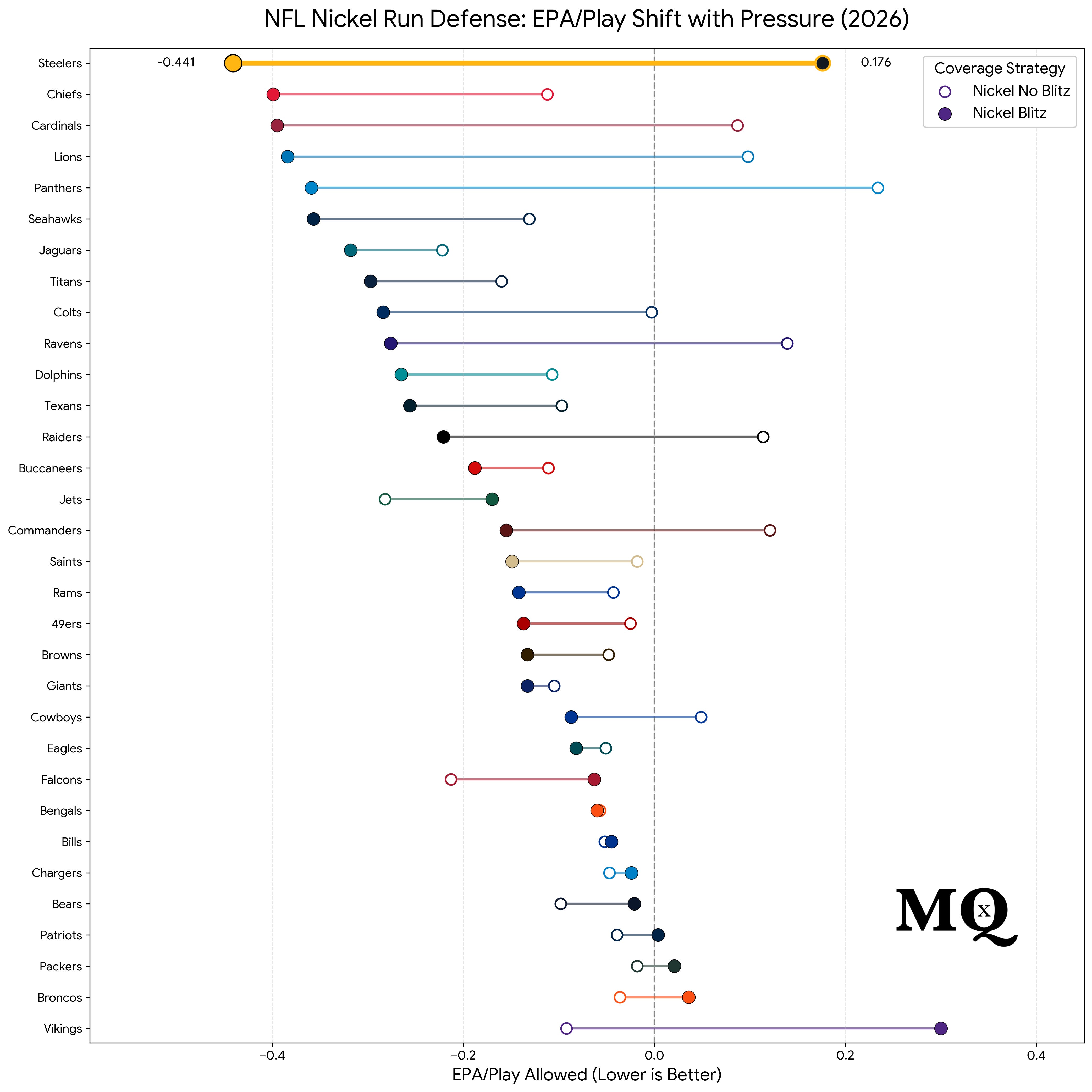
In Nickel, the Steelers hold a modest 27% Pass Blitz Rate (22nd), but when Graham can dial in on a run down, he hammers it with pressure. On early downs (1st/2nd) in Nickel, Pittsburgh’s Run Blitz Rate jumps to 37%, making it the league's fourth-most aggressive defense.
Graham uses his light boxes in Nickel to trick opponents’ offensive coordinators on early downs. OCs who run into these looks find well-timed pressure, which holds the league's lowest EPA/play (-.441). Their 30% Blitz Rate on early downs (18th) shows Graham is hunting run tendencies and taking full advantage.
Pittsburgh’s run blitzes are not necessarily “explosive.” Despite ranking #1 in EPA/blitz in Nickel, they have only accumulated nine total TFLs (22nd). Graham uses pressure to stabilize the defense and lower opponents' ceilings while maintaining a high floor on standard downs.
The Steelers’ Nickel pressure menu guarantees a low-yardage down and doesn’t gamble on manufacturing TFLs. The result is the league's second-best ADOTK (2.3). It also protects the secondary by keeping them in their primary roles defending play-action schemes.
Against the Saints in Paris, the Steelers Nickel philosophy was on full display. Graham shifted between using internal LB pressures and attacking the edges of the box with his Down Safety. Let’s dive into the tape!
—
The data shows early-down pressure solves the Nickel run spacing problem, but execution happens on tape. Upgrade your MatchQuarters subscription to step into the film room and unlock:
The “Cross” & “Dog” Mechanics: How to cross-dog your LBs to cut off zone tracks and create a vise on the RB.
Boundary Safety Pressures: Tactical rules for using a Down Safety to clog cut-back lanes and set an unblocked edge.
Complete Tape Analysis: Five detailed film clips breaking down the exact technique, front movement, and Fire Zone coverage rotations.
