


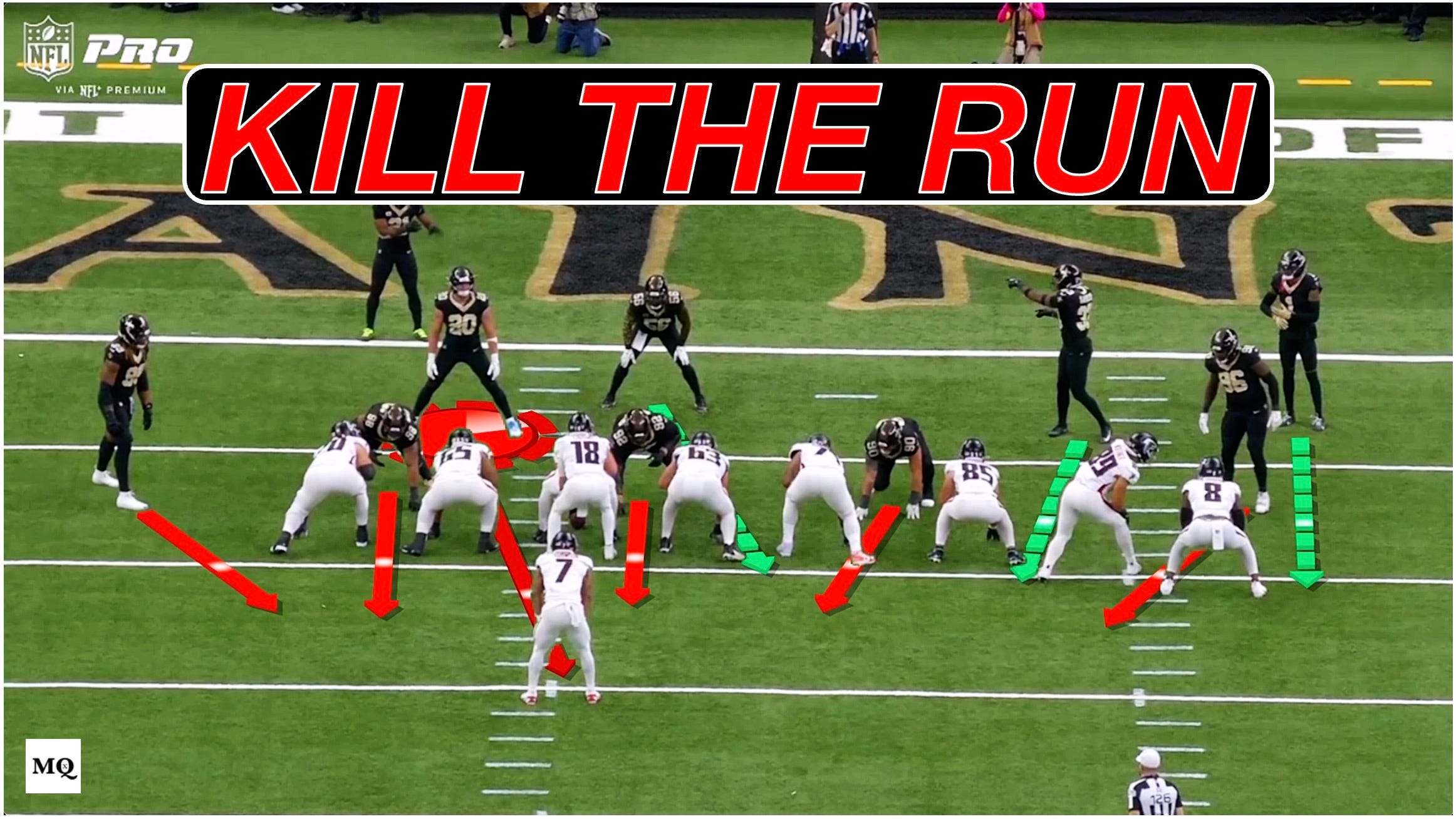
Running the ball has not fundamentally changed in the NFL over the past five years, but the way offenses use it has. There has been a slight oscillation from one year to the next, which is normal; defenses are always playing catch-up and reacting to the new meta. Here is how the last five years have played out:
2021: 4.33 YPC
2022: 4.46 YPC
2023: 4.20 YPC
2024: 4.44 YPC
2025: 4.36 YPC
If there has been an offensive trend over the past two seasons, it is that NFL offenses are finding more ways to get the ball into the end zone on the ground. 2021 saw over 500 TDs scored by rushing the ball; ‘22 and ‘23 saw those numbers dip below 500, with ‘23 seeing only 470 total rushing TDs. The numbers from the past two years (both over 500) haven’t been seen since 2020, when, in a 16-game season, there were 532 rushing TDs (ESPN).
2023 is an interesting year because it marks the end of the NFL’s “Spread Era.” That year, defenses caught up and stabilized light box run defenses, especially against 11-personnel units. That season, the EPA/rush on average for 11-personnel fell to -.134.
Offenses in the past two seasons have shifted towards using heavier formations, primarily 12-personnel. Since the ‘23 season, the overall usage of two TEs has grown from 19 to 23% of all packages, with 13-personnel hitting 5%. Combined with the shift in personnel, play-action passing has surpassed the 50% efficiency mark in the past two seasons (NFLfastR).
Running and passing do not live in a vacuum, and offenses shift philosophies once defenses catch up. In modern offenses, running the ball has never shifted, and statistically, it has remained stagnant. What offenses have adjusted to is the modern defensive meta of playing from a two-high shell.
Five years ago, early down passing was all the rage, but since ‘21, those rates have declined by over 5%, with 2025 seeing a 1st Down run rate of over 50%. The same trend has been reflected on 2nd Downs as well. Offenses are getting bigger and running the ball more on early downs (NFLfastR).
The shift in offensive style is forcing defense into “Base,” with larger bodies to stabilize the box and fewer defensive backs to defend the pass. Play-action passing has been a way to gain chunks of grass on the field while the run game keeps offenses on schedule. Defenses are now adjusting to an offensive landscape that isn’t spreading them out but is getting condensed, attacking them both horizontally (Wide Zone is king) and vertically through play action.
Re-Setting the Line of Scrimmage
With a new focus on the run game in the NFL, defenses have predictably started to adjust. The added danger of play-action passing has shifted the focus of split-field coverage from later downs to early ones. That inherently limits the number of defenders in the box, inviting the run.
Versus standard defenses, NFL offenses are operating with a 40% Success Rate on run downs, with an Average Depth of Tackle (ADOTK) at just over 4 yards (4.1). Defenses heading into 2026 are still prioritizing the pass by playing neutral boxes (seven defenders) on 75% of all plays. Coverage disguise is part of this and has been used to leverage early down play-action.
Blitzing at volume was a trending concept in ‘23, led by the ultimate outlier in the Brian Flores-led Vikings. Taking them out of the equation, early down run Blitz Rates were near 25% in ‘23. That number fell to 18% in ‘24, only to stabilize last season at ~22% (PFF).
2024 is interesting because it shows how quickly and uniformly the league can move. Nearly the entire NFL defensively decided to stop blitzing versus early-down runs. Coordinators around the league opted for static alignments and two-high coverage shells. When 2025 rolled around, defensive coordinators had a more coordinated plan.
One pivot was the use of simulated pressures on early downs, especially from Base. These pressures allow the defense to hold coverage integrity while using a coordinated pressure path to cut off a run or attack protections. In the case of a play-action pass, the defense can gain an extra coverage defender later in the down as the quarterback is setting up for a pass.
Five-Year League-Wide Simulated Pressure Averages (1st & 2nd Downs)
2021: 13.99% Mean | Max System: Titans (42.1%)
2022: 14.83% Mean | Max System: Falcons (40.7%)
2023: 15.24% Mean | Max System: Rams (34.5%)
2024: 20.29% Mean | Max System: Falcons (45.3%)
2025: 18.60% Mean | Max System: Eagles (39.4%)
Is Blitzing the Answer?
Blitzing has been shown to significantly affect the run game, but it can come at a cost when it fits poorly against coverage or is used too often. Tackles For Loss (TFLs) are an excellent way to kill a drive, and coordinators are constantly hunting them on early downs.
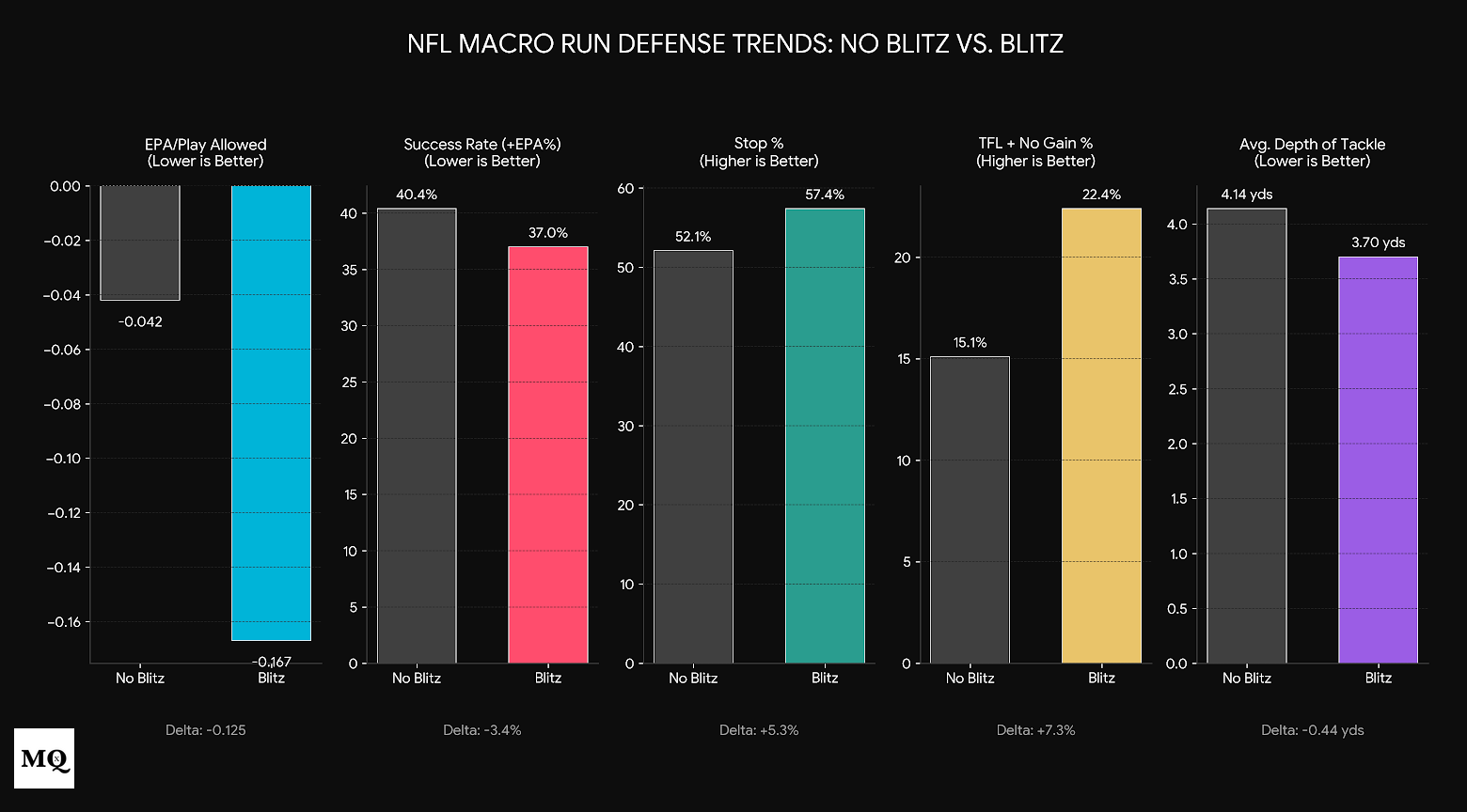
When a defense blitzes, the average negative play percentage (TFL + no gain) jumps from 15% in static defense to over 22%. The ADOTK on a blitz plummets from the normal 4.1 to 3.7, with Success Rates falling to 37%. Everything indicates that a defense should blitz more often, but everything comes at a cost.
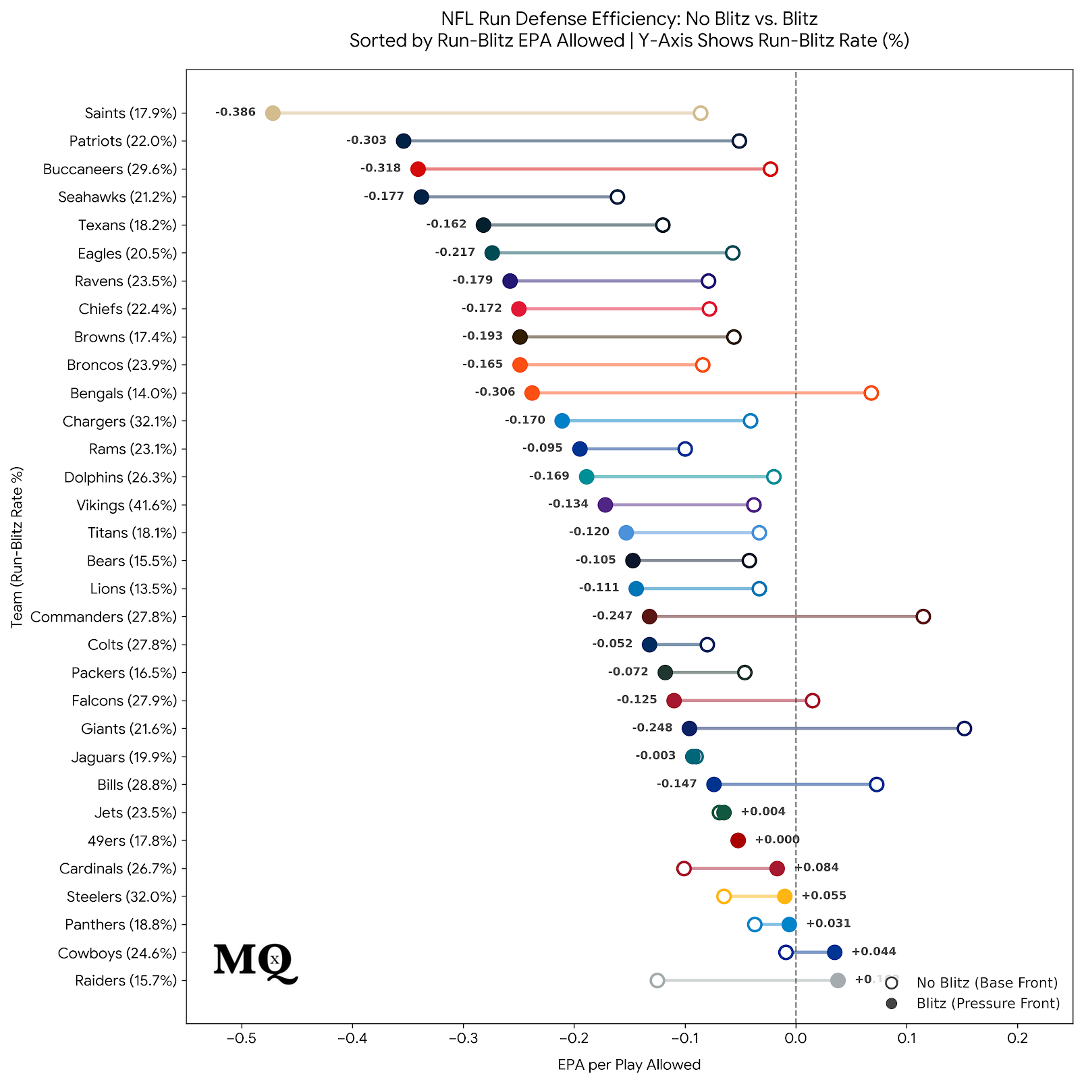
The best run blitzing defenses outside of the Buccaneers land in the “sweet” spot of an 18 to 24% Blitz Rate. Every time a blitz is sent in the NFL, there is a larger room for error. The more bodies that move around, the greater the risk of losing leverage.
Proof of this has been a pivot away from stunting to stop the run on early downs, from over 5% to right at 3%. Defensive coaches around the league aren’t willing to move defenders, instead opting to play static in two-high shells and send pressure on nearly a quarter of their play calls.
For early down run defense, going over the 25% Blitz Rate threshold yields diminishing returns. EPA/run is essentially cut in half from -.201 (<25% BR) to -.091 (>25% BR). Missed tackle rates also begin to increase, moving to over 16%.
Play-action also factors into this, with a Touchdown Rate spike of 2% and an Explosive Play increase of one full percent. Those may seem small, but over time, that slight inefficiency can be the difference in a game.
How a defense utilizes blitzing is also a critical factor. The five teams at the top of the EPA chart all used similar pressures. Vertical run concepts like Duo and Inside zone account for a combined 47% of all runs against a blitz in 2025. Defenses are hunting these run concepts and formational looks.
Below, I examine how the Saints, Buccaneers, and Patriots attacked opponents’ run games in 2025. The goal of the two major concepts covered is to disrupt the ball carrier’s path and funnel him into a phone booth.
Finally, it is not the quantity of pressure these teams applied; only the Buccaneers have a high Blitz Rate. Instead, it is the mechanisms they used to stuff the run. Let’s dive into the tape!
—
Become a paid subscriber to unlock the full breakdown. Gain instant access to the complete data analysis on early-down blitz thresholds and the film study detailing the exact run-fit mechanics used by the NFL’s best run-blitzing teams: Saints, Buccaneers, and Patriots.

