


Indiana’s defensive identity all year was disciplined aggression. The Hoosiers finished the regular season tenth in Blitz (42.5%) and Stunt Rates (33.5%), trailing only Ron Roberts and the Florida Gators in Simulated Pressure usage (54.5%). Defensive coordinator Bryant Haines created a defense that stumped most opponents.
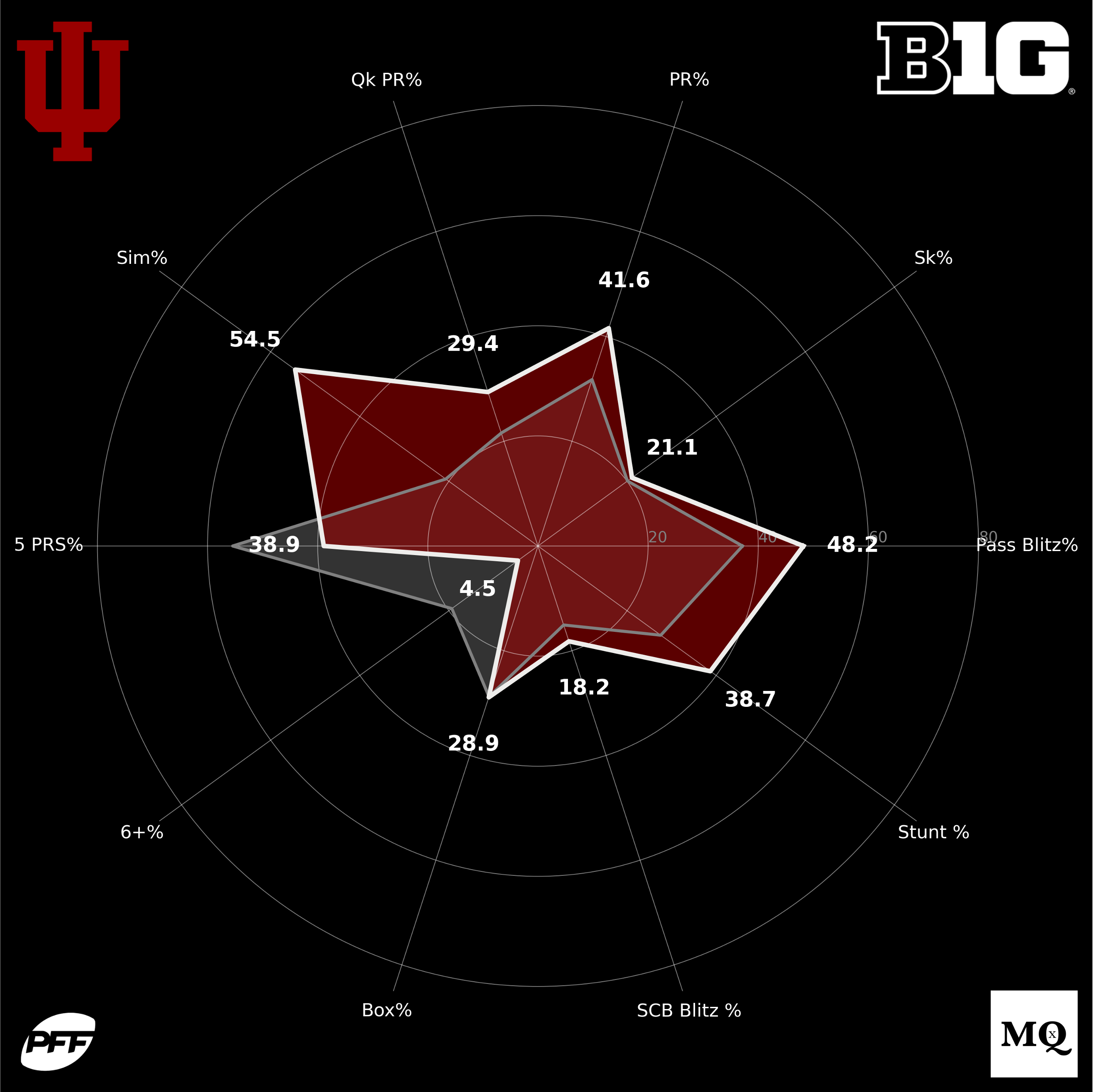
Haines' 3-4 scheme could bring defenders from anywhere at any time. Offensive coordinators struggled to neutralize the blitz threat and protect their quarterbacks. Overall, Indiana had a slightly above-average Sack Rate (~21%), but the pressures were there.
Quarterbacks facing the Hooisers’ defense could never get comfortable. PFF defines a “Quick Pressure” as “any quarterback pressure (hurry, hit, or sack) that occurs within 2.50 seconds or less after the snap.” Indiana was fifth in that metric, about 2 percentage points behind the Miami Hurricanes at #2. The efficiency with which Indiana blitzed never allowed opposing quarterbacks to get comfortable.
The most impressive stat that defines the “smoke and mirrors” scheme in Bloomington is the Unblocked Pressure (UPB) metric. Indiana finished third in that data point (~14%), illustrating that the blitz paths Haines was cooking up were overwhelmingly confusing offensive lines.
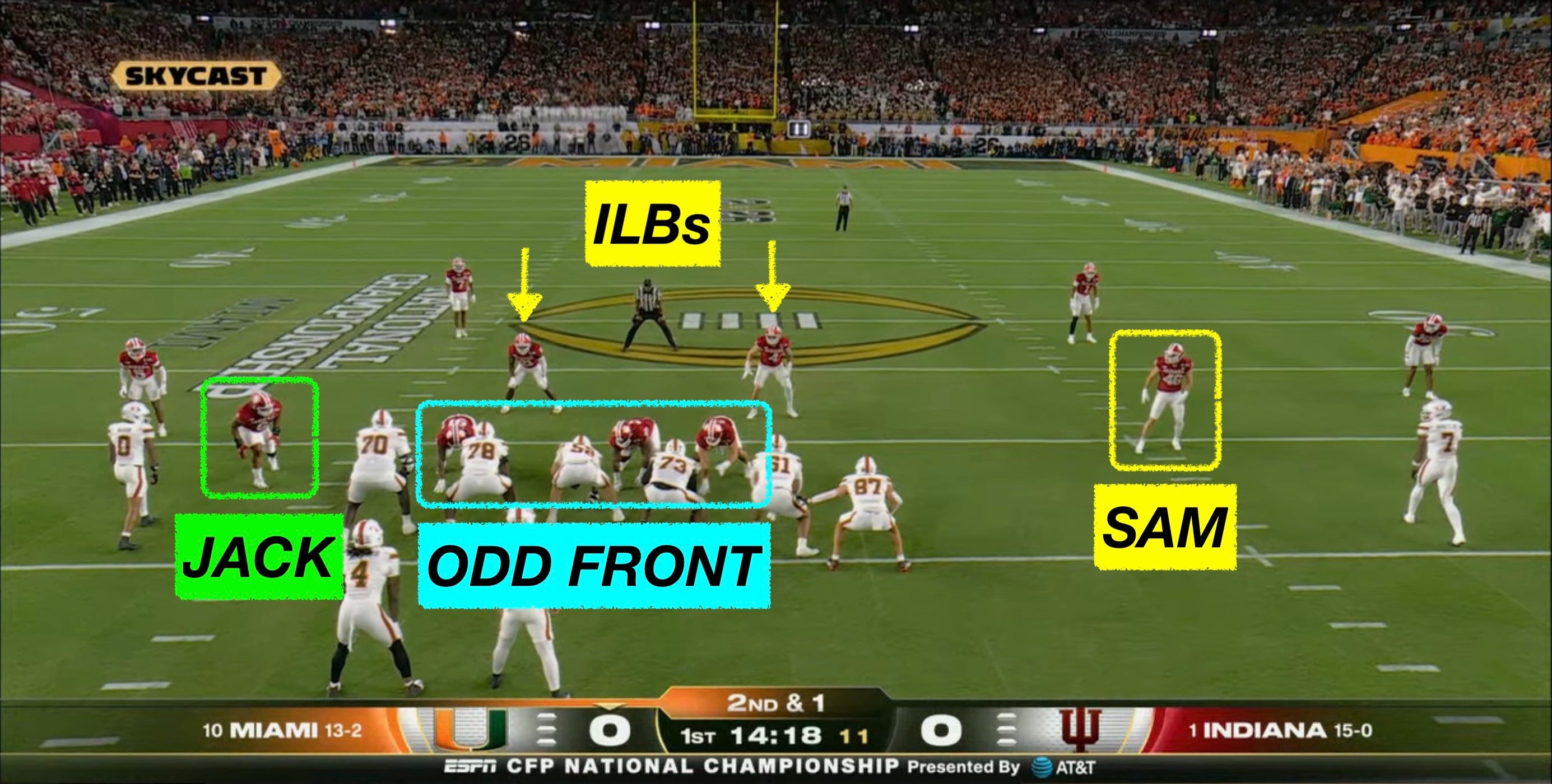
Indiana’s defense is unique in that it plays “Base” defense on most of its snaps. Sam linebacker Isaiah Jones (46) is a 6-2, 230-pound hybrid ‘backer that plays mostly to the field. In modern football, he serves as the field overhang. The Hoosiers use his size to build a “wall” to the field, and he can also add as a blitzer, where he finished with seven sacks on the year.
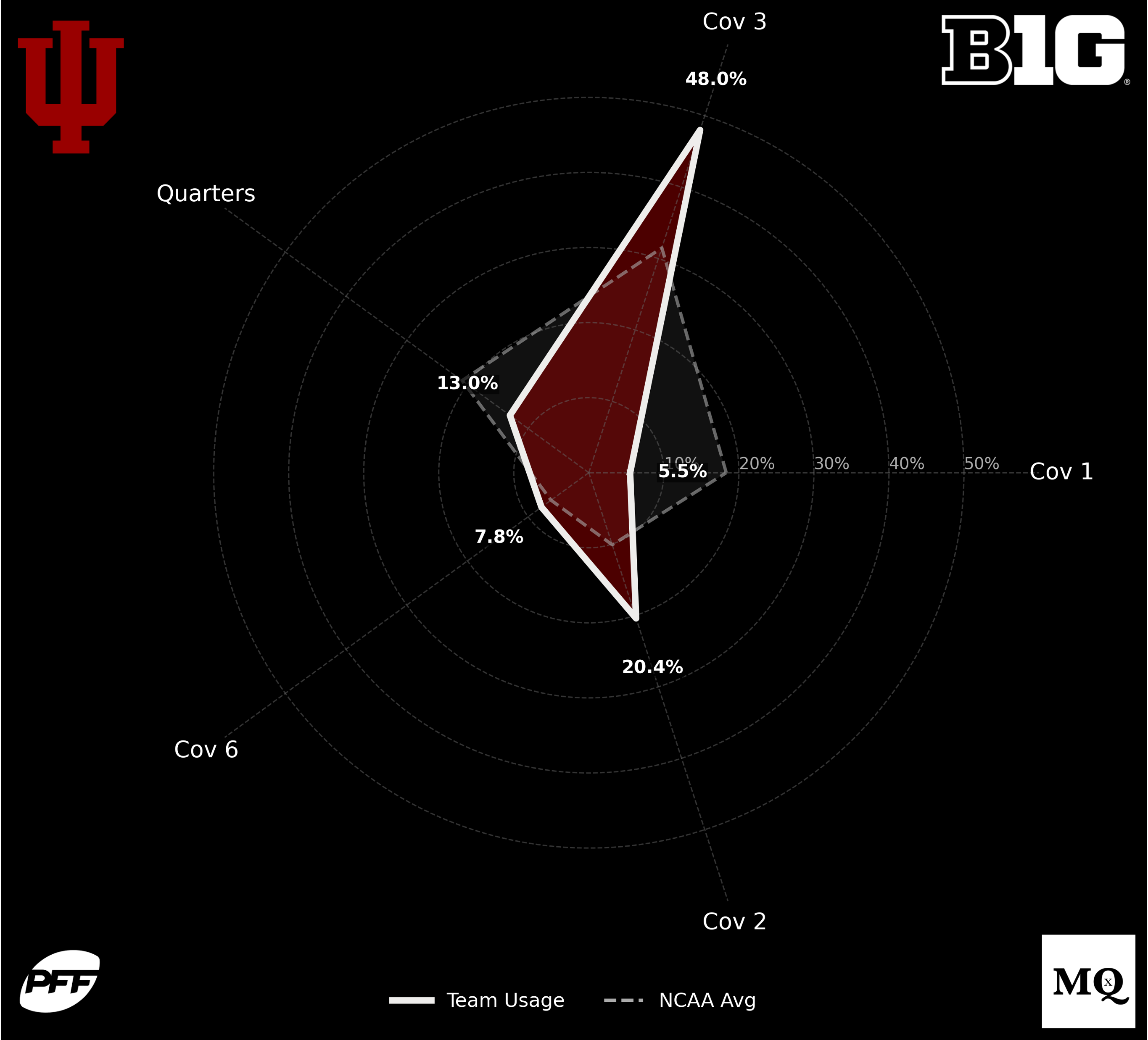
In an era where the Spread is still king in college football, the Hoosiers tried to keep their base personnel on the field as much as possible. To eliminate conflict, the Hoosiers mainly played Cover 3, with Tampa rotations as a change-up. To help their linebackers, Haines played the second-lowest percentage of man coverage in the FBS (8%) and ran almost no Cover 0 (2.5%).
Indiana is built to stop the run and attack your protection schemes with off-ball linebackers. In fact, the sack leaders for Indiana in 2025 were Rolijah Hardy (21) and Jones. The Mike linebacker, Aidan Fisher (4), finished with 4.5 sacks, barely behind three of the starting D-linemen.
The coverage aspect feeds into the pressure loop and design of the defense. The Hoosiers will run a simulated blitz, creating quick pressure and forcing the quarterback to throw it to a release (“Hot”) route.
Behind the pressure is Vision Zone coverage, which quickly rallies to the ball. Play over for minimal gain. Produce a long 3rd Down and attack with another designed simulated pressure.
The Hoosiers were below average in turnover stats, but forced offenses to drive the ball. Indiana finished the regular season third in TD% (10.8%), first in TD% in the Red Zone, and fourth in Points Per Drive (1.14). Even when teams moved the ball, they rarely scored touchdowns.
Indiana’s defense is a statistical unicorn. They are arguably the most extreme “outlier” defense in the FBS because they achieve elite results (Pressure, Red Zone) by doing the exact opposite of what traditional aggressive defenses do. Haines has essentially built a defense designed to slowly take the air out of an offense as the game goes on.
To opponents, they are “wolves in sheep’s clothing.”
Looking at the defense analytically, they are not particularly explosive and rarely overpower an offense with numbers. Zone coverage complements this feeling. The Hoosiers are not going to “out-athlete” an opponent; they lull them into thinking they can handle the scheme, only to leave them knocked out at the end.
The Trenches: Strength vs. Finesse


Facing a Miami Hurricanes offense in the National Championship was going to be a daunting task. The sentiment above was held by many around the country.
How was the smaller “movement” base defense of Hoosiers going to deal with the size and spacing (heel-to-heel) of the Miami offensive line?
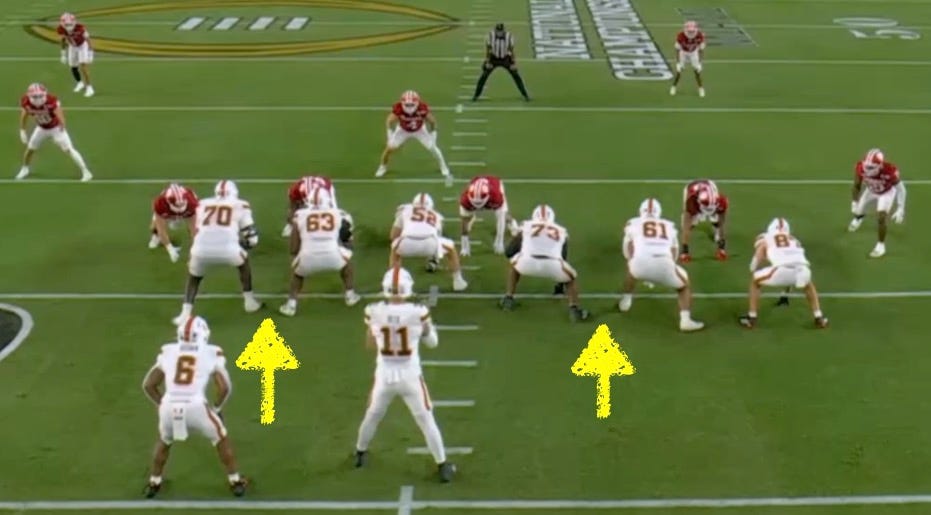
Miami’s O-line typically kept its splits tight, which meant the Hoosiers would have difficulty utilizing quick stunts or “plug” pressures (vertical LB blitz) to attack the downhill run game of the Hurricanes. Attacking from the edges could be dangerous as well, because of Miami’s dangerous Slot Malachi Toney (10).
Haines was facing a conundrum. If he kept up the blitzing, he might be running into a brick wall, which would give the seasoned vet Carson Beck (11) plenty of time to pick apart the Hoosiers secondary. If Haines decided to stay still and play “sit-and-get,” Indiana’s lighter defensive line might be driven back, and the Hurricanes would control the game from the ground.
Bryant Haines, again, had a masterful defensive game plan to limit the Miami Hurricanes’ explosiveness, but he executed it in a completely different way than he had all year. Let’s dive into the tape!


