


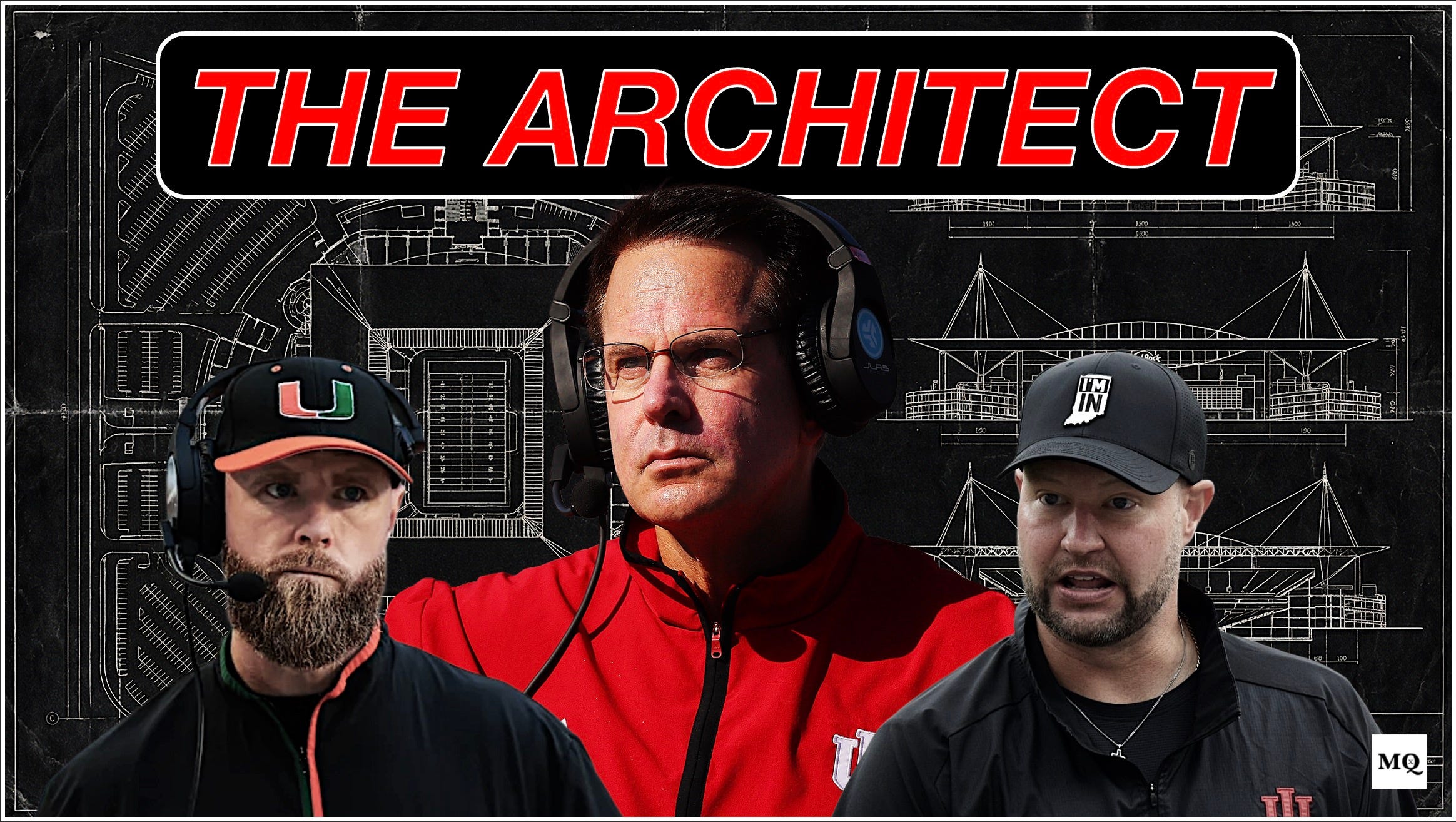
The story of Curt Cignetti is well documented by now.
He left a cushy job with Nick Saban to take over an Indiana University of Pennsylvania program (D2) once led by his father. From there, he moved to Elon, then James Madison, and eventually landed at Indiana.
In his own words, “It’s pretty simple. I win. Google me.”
That statement echoed around the college coaching world as Cignetti took over a “basketball” school and one of the worst Power 4 football programs. But in two years, he’s changed the narrative. Indiana is on the precipice of history and is a team unlike any college football has ever seen.
The roots of Indiana's success lie in James Madison. The Dukes were already a quality program, and Cignetti continued that tradition by reaching the National Championship in his first year and the FCS playoffs semi-finals the next two years. In year one of their transition to the FBS, Cignetti led the team to eight wins, then 11, and a bowl victory.
Cignetti brought 13 players from the JMU program to Bloomington in 2024.
In 2025, four of them are cornerstones to the Hoosiers’ defensive success: Aiden Fisher (LB), D’Angelo Ponds (CB), Mikail Kamara (DL), and Tyrique Tucker (DL). In an era defined by the constant reshuffling of players in the transfer portal and Power 4 teams, especially at the top, chasing four- and five-star players, the Hoosiers have doubled down on production over perception.
Miami currently has 52 five or four-star players. Compare that to just seven on the Hoosiers. Indiana is not without talent. Heisman Trophy-winning quarterback Fernando Mendoza is likely the first pick in the 2026 NFL Draft. But the paths to the National Championship, recruiting-wise, are very different for these two teams.
Shared Defensive DNA
When Miami plays Indiana in the National Championship, both teams will be connected, in a way, through Cignetti. Both defensive coordinators come from under his tutelage and run a very similar scheme, one that was first installed by Miami’s Corey Hetherman in 2019, when he joined Cignetti’s initial James Madison staff from Maine, where he was the defensive coordinator.
Despite Bryant Haines’ success as a coach at Elon, Cignetti wanted to look outside his coaching staff for the DC job at JMU. Haines had been the “right-hand man” to Tony Trisciani, Cig’s DC at Elon, who would take the head coaching job once Cignetti left. Right before Hetherman was to interview with Cignetti, Haines made the coach aware that Trisciani had offered him the DC job at Elon.
To keep the young coach, Cignetti offered him a co-coordinator role, but Hetherman would call the defense. In 2021, Hetherman would leave to be the linebackers coach for Rutgers under Greg Schiano and eventually take the Minnesota DC job in 2024, where he caught the eye of Miami’s Head Coach Mario Cristobal.
With Hetherman’s departure, Bryant Haines’ scheme began to diversify. As Cignetti told the Bloomington Herald-Times, “We didn’t do a lot with Corey. He [Haines] did a lot of it, but he was the 'co,' and Corey was the guy.” Still, the roots of both Miami’s and Indiana’s systems rest in those early days in Harrisonburg, Virginia.
Both offensive staffs will be able to use their coordinator to understand the DNA of their opponent’s defense. In essence, the schemes are cut from the same cloth and fanatical about the fundamentals, thanks to Cignetti’s influence (Hetherman can throw Schiano in there as well).
Neither defense is exotic. Both teams are built like a boa constrictor. The air (space) for offenses is slowly squeezed out by a unit that makes little to no mistakes. Both adhere to the idea of complexity through simple structures and an overwhelming reliance on Cover 3.
But there are distinct differences:
Coverage: Miami plays more man. Indiana plays more Tampa.
Pressure: Miami runs 5-man pressures. Indiana runs simulated (or Creeper) pressures; only Florida ran more.
Movement: Miami doesn't stunt; it uses the brute force of its two talented defensive ends. Indiana favors movement, which feeds into their “disguised” philosophy.
Blitz Design: Miami will blitz their Nickel. Indiana uses the field pressure sparingly.
The Hoosiers rank 10th in the FBS in blitz rate; Miami sits at 14th. Both coordinators like to send pressure, but they do so in entirely different ways. The Hurricanes led the nation in Slot Blitz Rate (Nickel/Star), sending him on almost a third of their calls (31.5%). Indiana uses their field overhang at a much lower rate, but uses the pressure as a change-up or a “jab” to opposing offenses, especially on 3rd Downs.
We will first define each unit's base defense, then jump into the two distinct overhang pressures found in each other’s playbook. For the National Championship, this is where we come full circle in the Hetherman-Haines story. Let’s dive into the tape!
