


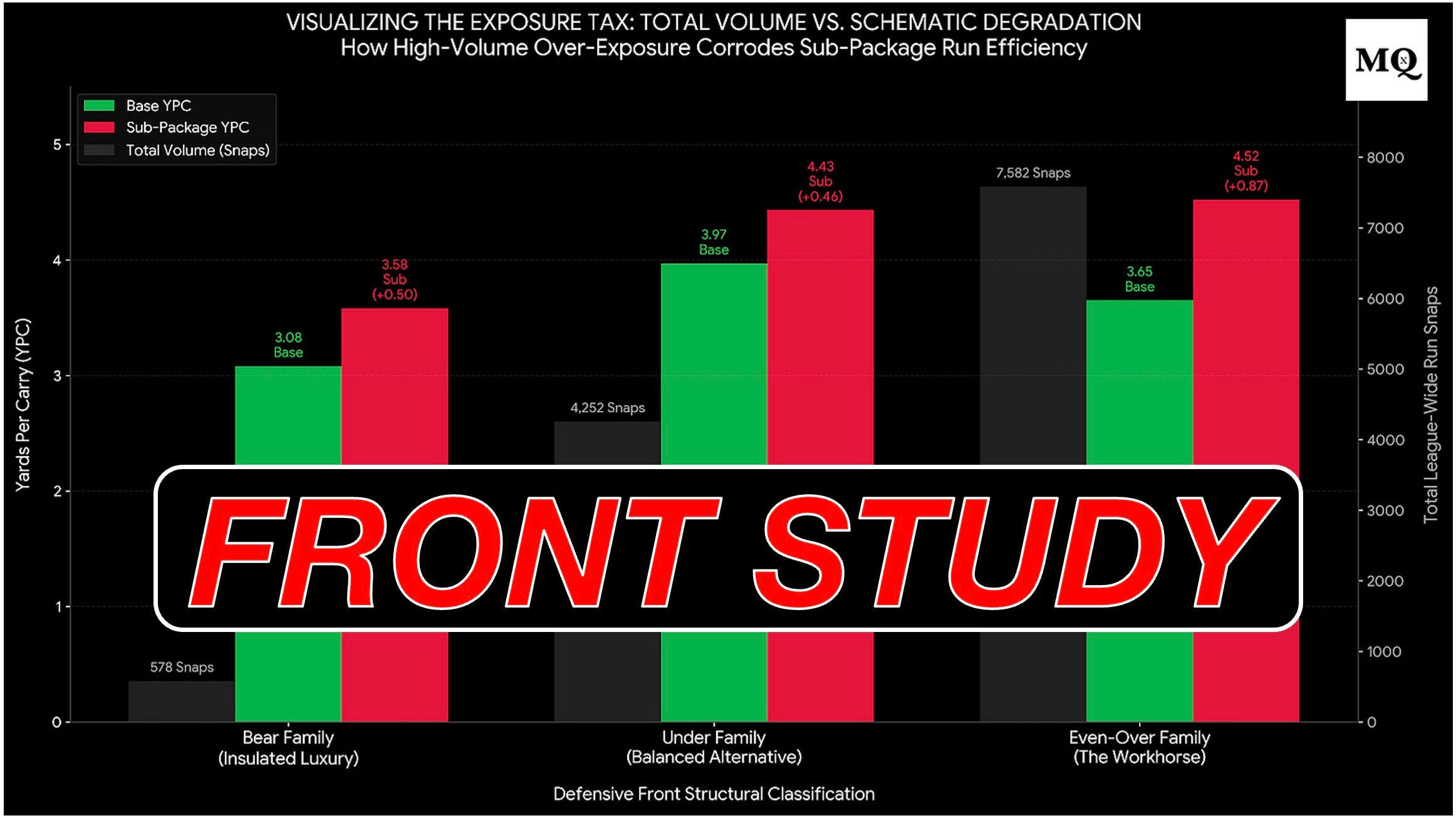
Modern defensive coordinators are caught in a constant structural conflict between prioritizing coverage spacing and maintaining box integrity. While playing light boxes in sub-packages is necessary to limit explosive passing games, 2025 defensive charting data shows a razor-thin margin for error when nickel and dime personnel are forced to fit the run.
A micro-analysis of post-snap execution reveals that elite run defense is fundamentally driven by a unit’s ability to limit space at the point of attack, neutralizing horizontal displacement before the ball spills into the secondary.
By analyzing comprehensive Expected Points Added (EPA), Yards Per Carry (YPC), Average Depth of Tackle (ADOTK), and other advanced metrics, this study isolates the structural parameters of the league’s three foundational front families: Even-Over, Under, and Bear. The following breakdown details how elite coordinators optimize these box fits to survive the modern ground game and counter the play-action meta.
» Data: PFF
Top-3 Front Structures
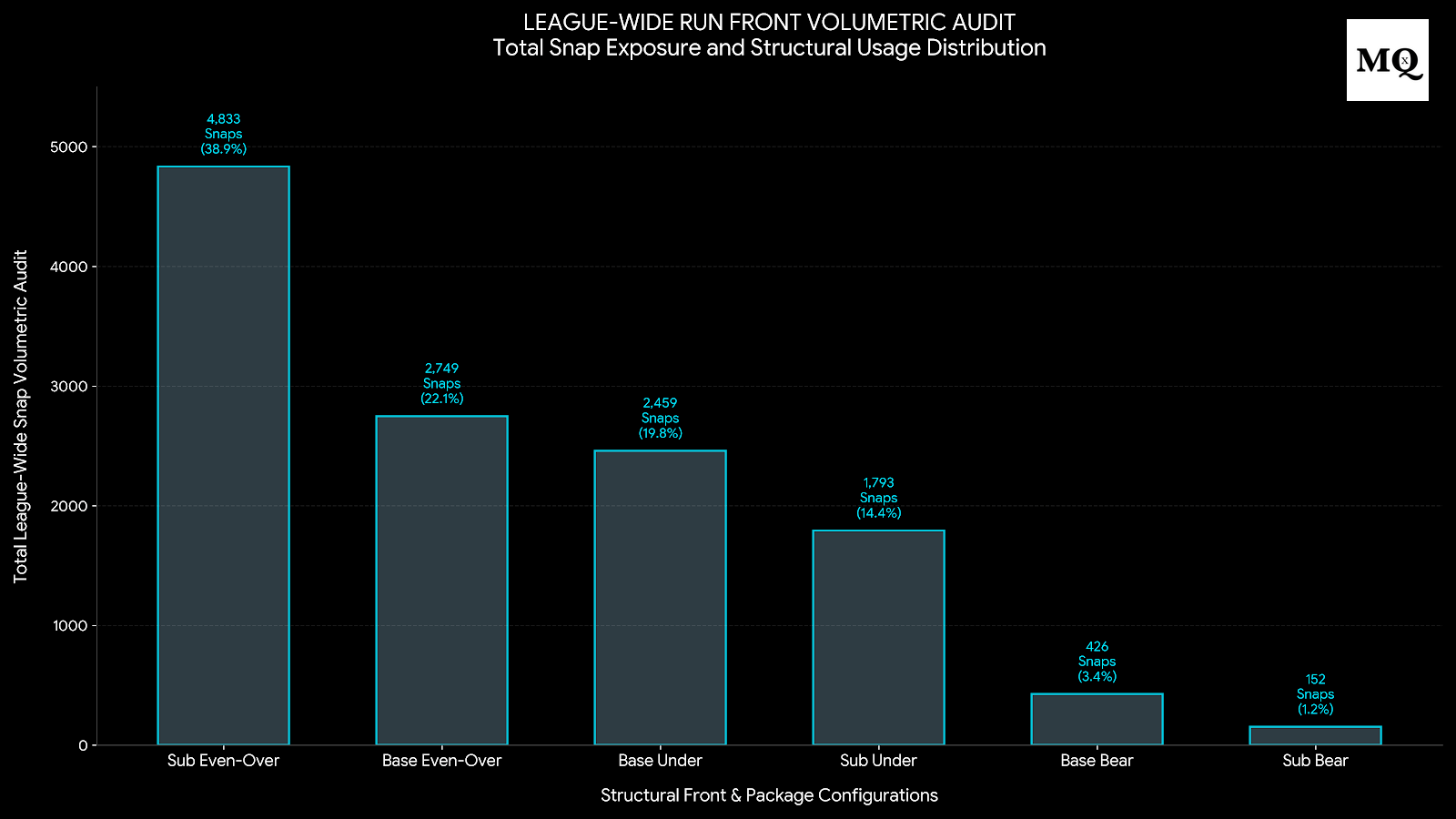
Even-Over Front Family
Base (2,749 ATT): 3.65 YPC | -0.109 EPA | 16.8% TFL+NG Rate
Sub-Package (4,833 ATT): 4.52 YPC | -0.030 EPA | 16.0% TFL+NG Rate
The Reality: By far the most heavily utilized front structure in the NFL. While the alignment anchors a highly efficient Base run defense, that efficiency collapses in sub-packages, surrendering nearly an additional full yard per carry (+0.87 YPC).
The Even-Over front family serves as the structural baseline for the modern NFL, acting as the primary high-volume anchor for defensive playbooks. It is designed to establish a balanced horizontal wall in Base personnel. However, it faces a heavy execution tax when defenses try to preserve that same gap discipline with lighter sub-package boxes.
In Base personnel, the front is extremely efficient, holding offenses to a stifling 3.65 YPC while pairing a solid 55.0% Stop Rate with a 16.8% TFL+NG rate. However, because it is the most heavily exposed front family in football, logging over 7,500 cumulative snaps league-wide, it pays a steep physical exhaustion tax that creates a major performance drop in sub-packages (+0.87 YPC).

—
Under Front Family
Base (2,459 ATT): 3.97 YPC | -0.096 EPA | 15.9% TFL+NG Rate
Sub-Package (1,793 ATT): 4.43 YPC | -0.045 EPA | 15.3% TFL+NG Rate
The Reality: Highly stable volume in Base matching the Even-Over family. Sub-package drop-off occurs (+0.46 YPC) but remains tighter and slightly less volatile than Sub Even-Over looks.
Under As Your Base
With a TFL+NG rate hovering between 15% and 16%, the Under family rarely creates immediate, explosive negative plays behind the line of scrimmage. However, it offsets this lack of backfield disruption by maintaining a steady down-and-distance floor. Its Base Stop Rate (55.7%) tracks right alongside the Even-Over family, but it achieves this metric with far less volatility within the data set.

—
Bear Front Family
Base (426 ATT): 3.08 YPC | -0.206 EPA | 23.0% TFL+NG Rate
Sub-Package (152 ATT): 3.58 YPC | -0.1531 EPA | 24.3% TFL+NG Rate
The Reality: A highly specialized, low-volume tool designed to choke out heavy offensive sets. It is easily the most efficient run-stopping structure in the NFL on a per-snap basis.
The Bear Front Paradox
The data shows a highly variable profile within the Bear front family. With a league-leading 23.0% TFL+NG rate in Base and 24.3% in Sub, nearly a quarter of all run plays against Bear spacing are stopped immediately at or behind the line of scrimmage. However, the Bear front’s Base Stop Rate is only 44.8%, well below Even-Over (55.0%) and Under (55.7%).
Covering both guards and the center blocks natural vertical double-teams and forces immediate penetration into the interior. This creates a high volume of quick-win tackles for loss. The structural risk is losing leverage behind that interior wall.
If an offense seals the edge or handles the initial interior spike with an Outside Zone, the defense loses consistency in tracking the second level. With second-level defenders pulled tight into box conflicts, there is no safety net once the front line is bypassed.

—
Overview
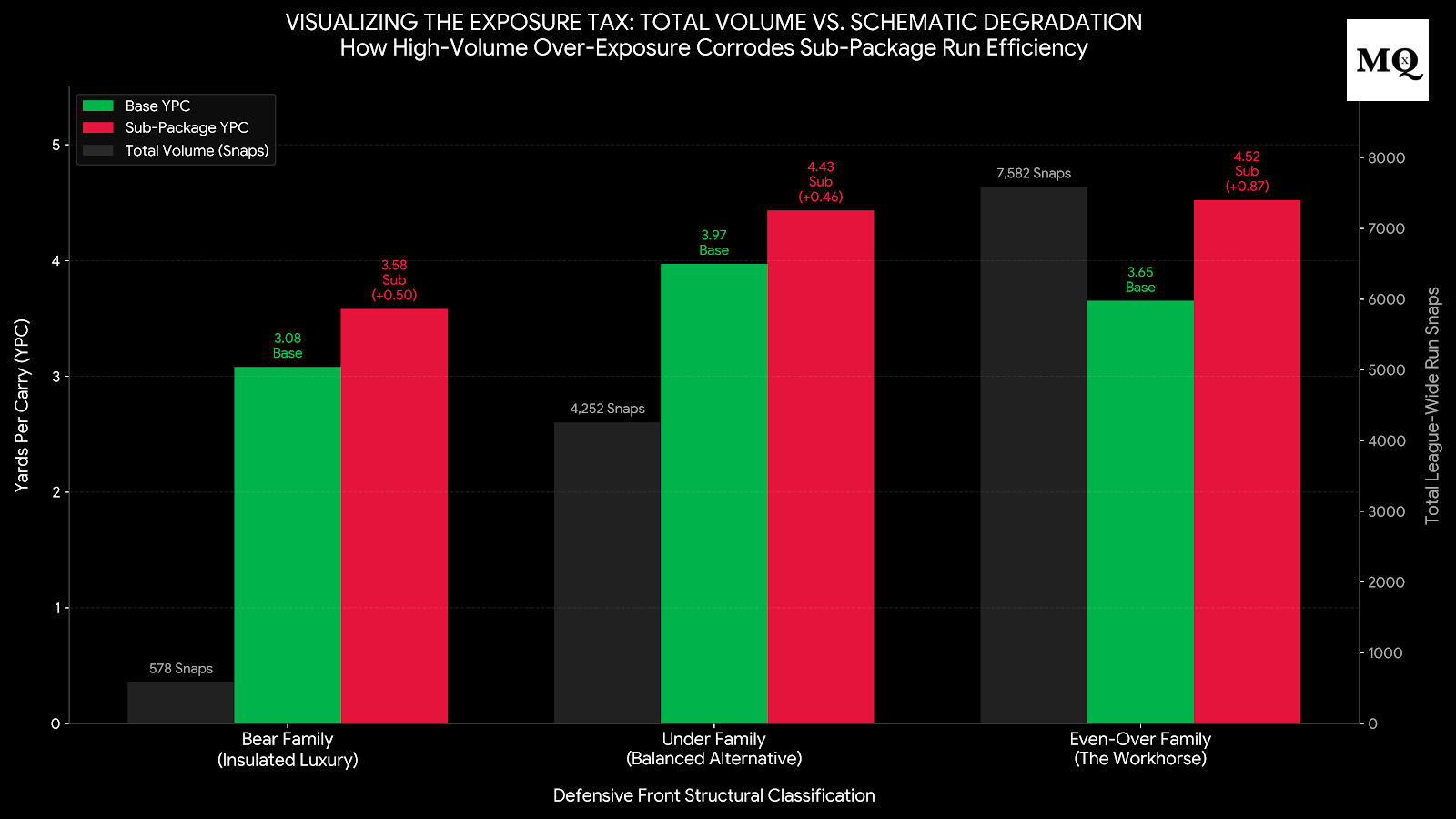
The Bear Front is a defensive gamble and depends heavily on the players. The Under front is a traditional standard, while the Even-Over front is the league’s everyday best practice.
Over gives defenses a high floor that keeps them structurally sound with Base personnel, but because its efficiency drops sharply in Nickel alignments, coordinators can’t run it statically at volume. The front needs post-snap line stunts, blitzes, or aggressive Safety triggers as timely change-ups to stop offenses from getting past the second level.
Coach’s Note: The Saints were a clear inverse outlier in 2025, bucking the league trend by defending the run far better in sub-packages than in base personnel. In the Under and Even-Over front families, their sub-package alignments posted highly efficient marks of -0.159 EPA/play and -0.199 EPA/play, respectively. That performance effectively shut down opposing ground games, compared with their more permissive base anchors (-0.041 and -0.043 EPA/play).
The front profile is only half the battle. Pre-snap alignment doesn't solve post-snap spatial distortion. To see exactly how elite defensive coordinators anchor the point of attack, limit Yards Before Contact (YBC), and protect their light-box personnel against heavy run sets, unlock the full clinic by becoming a paid sub.
Plus, resources linked throughout.

