


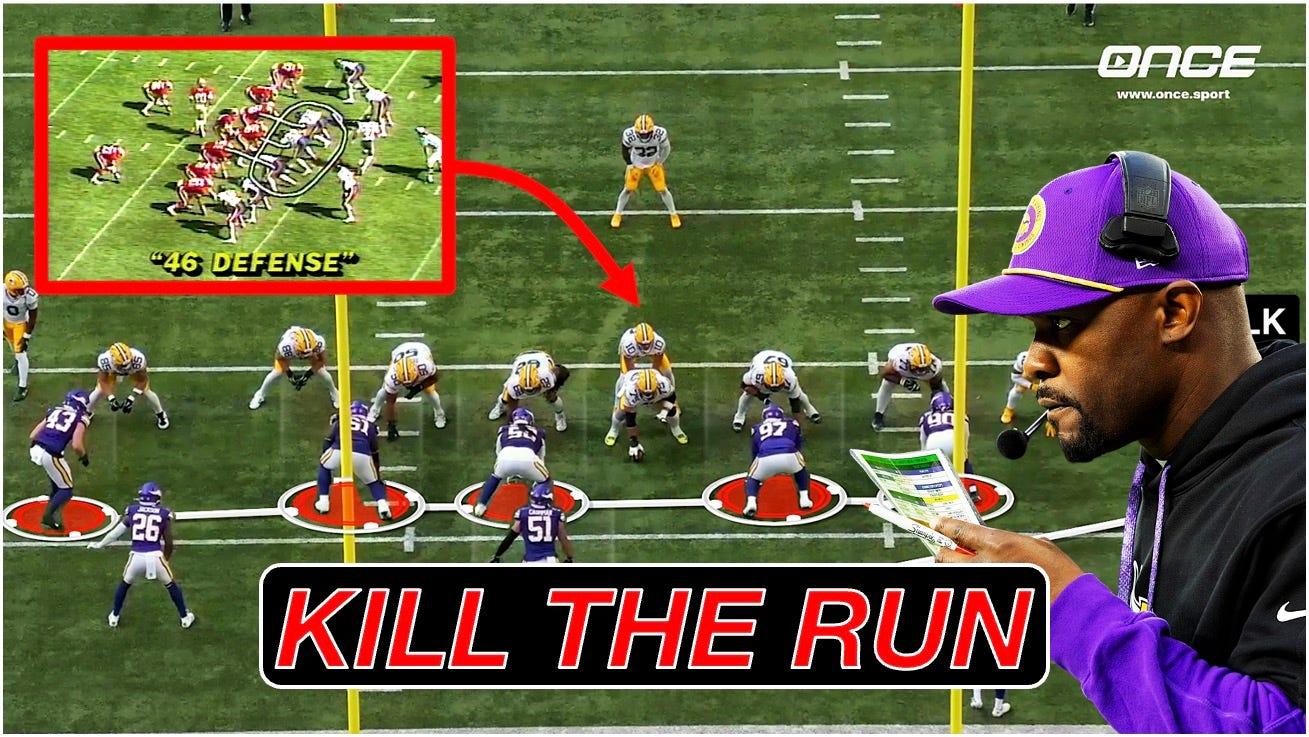
The Vikings blitzed the Packers on more than 80% of their downs in Week 1. For a defense that is already pressure-heavy, that number is still astronomically high.
The next-closest team, according to PFF, was the Commanders at 49%, whose defensive coordinator is former Vikings assistant Daronte Jones, and who just left the system in Minnesota.
Blitzing is baked into the scheme’s DNA.
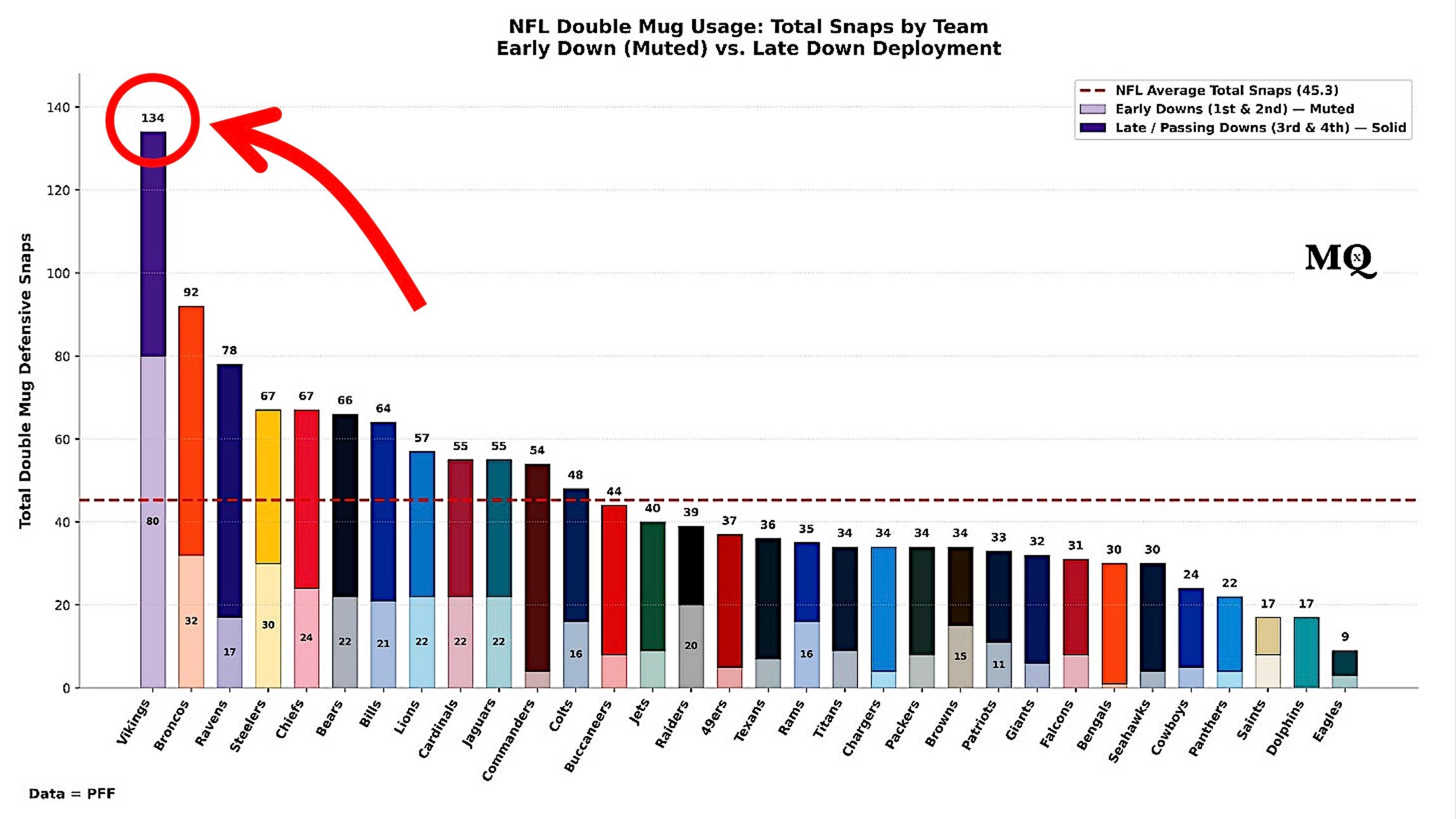
Last season, the Vikings led the league in double-mugged alignments, or defensive formations in which two or more defenders were stacked on the line of scrimmage. Most defenses use these mugged formations on passing downs to manipulate protections, but Brian Flores is indiscriminate in his use of them.
Coach’s Note: Most people think of double A-gap alignment when they think of double mug, but as the graphic above shows, Flores uses these formations more on early downs than he does on 3rd down. In fact, last season, Minnesota ran more double-mugged alignments on early downs (80) than 30 of the 31 other teams on any down. Flores wants to gap out the run game while applying constant edge pressure, which accelerates reads on play-action. He’s forcing the offense into a vise.
Most analysts (and fans) will see the Blitz Rate number and imagine exotic pressures, with defenders moving towards the line of scrimmage while others drop out. That just isn’t the case.
Flores will be the first to tell you that many of these “blitzes” are more structural than scheme. These pressures are not exotic 3rd Down calls, but highly structured “cutoffs” built to kill an opponent’s run game or quickly disrupt any play-action passing concept.
The defense’s main goal is to apply pressure on every down and in every gap to create a “flinch effect.” It’s an extreme fight to constrain space:
Pre-Snap Paralysis (Alignment): “All-Up” mugged fronts force the offensive line into locked man-protection rules and require offenses to keep skill players in the box to chip or pass protect.
Point-of-Attack Penetration (Movement): Instead of playing passive “sit-and-get” two-gap football, Minnesota drives defensive linemen across blockers’ faces and blitzes to disrupt run lanes and create early negative plays.
Structural Disruption (Execution): By shutting down early-down run efficiency, Flores puts offenses behind the sticks, forces third-down passing looks, and eliminates play-action boots.
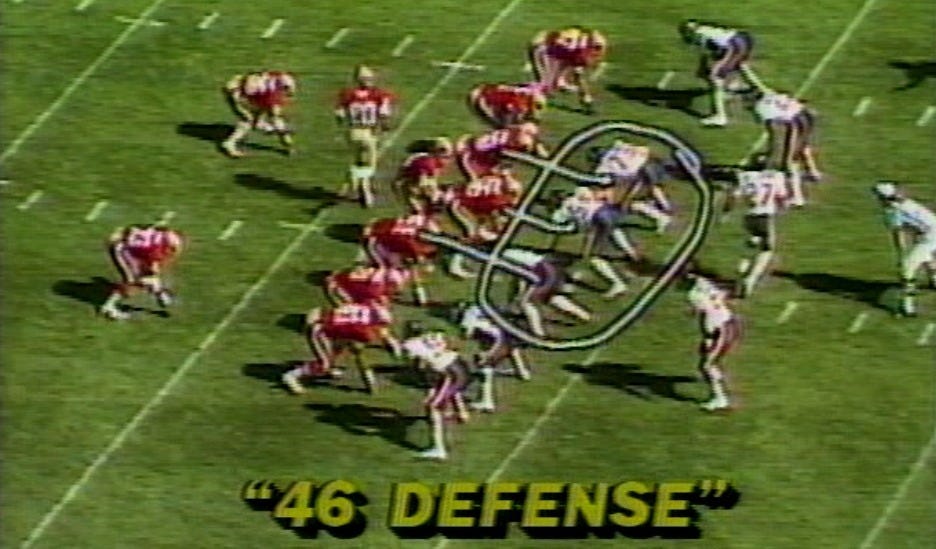
The defense is a throwback to Buddy Ryan’s Bears’ “46 Defense,” which featured up to six defenders on the line of scrimmage. Ryan’s defense wanted to create one-on-one matches for his elite defensive line. Flores, like Ryan, is trying to do the same, but also to shrink the field.
Minnesota’s defense is a paradox: it pressures more than anyone in the league while also playing the most zone in the NFL. Flores wants eyes on the ball, and the large number of defenders near the line of scrimmage forces a quick time to throw. The ball is essentially funneled into “kill zones” behind the line of scrimmage (run) or into predictable low-zone areas (<10 yards) that are easy to tackle (pass).
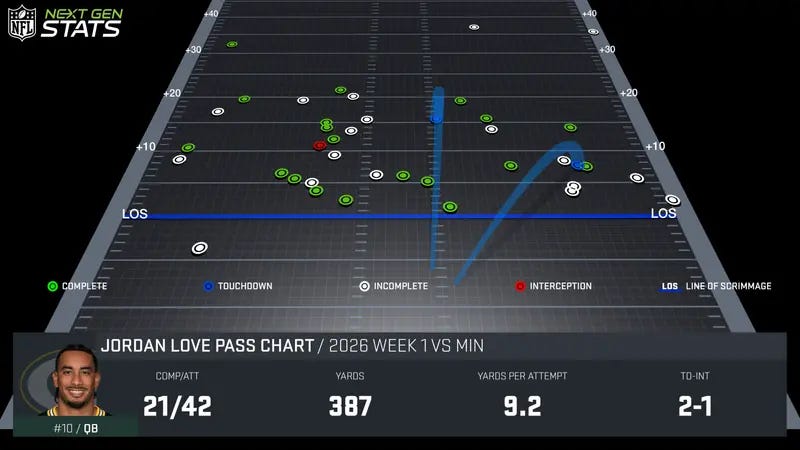
Jordan Love got out to a fast start against the Vikings in Week 1, going 8/16 with 189 yards and both his passing TDs in the first half. In the second half, Love was sacked four times, one being a strip-sack, and threw an interception, all while being blitzed.
Love finished the day with a 50% completion rate and the lowest Time To Throw (TTT) in Week 1 at 2.45 seconds. The disjointed nature of Love’s performance is exactly why Flores leans into his pressure-centric style.
An offense may win a few early battles, but over time, Flores wears down his opponent with the constant threat of an overload blitz. It’s football’s version of the full-court press. Eventually, the offense can’t withstand the siege and succumbs.
Most importantly, Minnesota shut down the Packers’ run game. Over the last two seasons, the Vikings have finished in the top ten in Run DVOA (FTN). Against Green Bay, Flores doubled down on a “heavy” identity that runs counter to the modern defensive meta of a Nickel-based system.
PFF charted Minnesota in Base on 51% of snaps in Week 1, the third-highest rate in the league, continuing a trend from 2025, when the Vikings ranked third overall in Base usage at roughly 53%.
Minnesota’s structure creates lapses in the offense’s blocking and protection, and its use of run blitzes and stunts prevents many running backs from getting going. The Vikings deploy Base to build heavy walls along the line of scrimmage, then aggressively attack run paths with interior line stunts and second- or third-level blitzes.
Green Bay finished the day with 61 total rushing yards, including 48 against a blitz (3 YPC). Running the ball efficiently is game control, something Flores tries never to relinquish.
Flores is entering year four of his tenure with the Vikings and is coming off back-to-back years finishing in the top three of FTN’s Defensive DVOA. They have some tremendous players, but the scheme amplifies their abilities by creating consistent, sound pressure.
There is no air for an offense. Minnesota uses quick pressures and movement to stay ahead of the chains on early downs by creating negative plays. Flores weaponizes his pre-snap alignments to make the offense completely predictable.
Against the Packers, Flores's philosophy for stopping the run was on full display. Without balance or early-down efficiency, the Packers’ offense wore down and was forced into the exact predictability Minnesota’s pressure system is designed to exploit.
Flores has entered 2026 with a purpose: kill the run and let the pressure handle the rest.

Help your coaching staff eliminate hours of manual film organization. The Cutup Generator automatically creates custom cutups, charts, and title slides directly from your tagged data.
