


In 2023, Kansas City’s Super Bowl run relied on an elite secondary (5th in Passing DVOA) that masked a poor run defense (27th). By 2024, defensive coordinator Steve Spagnuolo corrected course, leveraging hybrid personnel to raise the level of the run defense (9th in Run DVOA), but dropped to 17th against the pass.
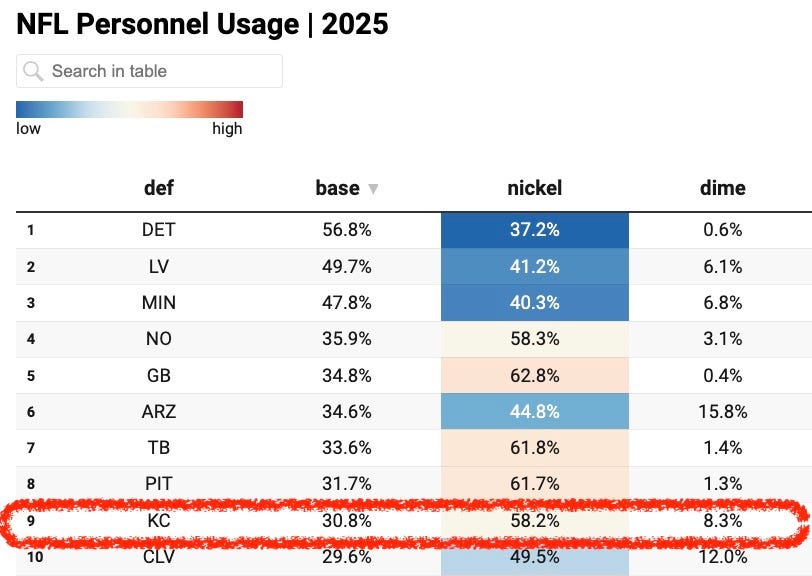
The structural constant across both seasons was heavy Dime usage (~24%), anchored by a Safety room of Bryan Cook (Bengals), Chammari Conner, Jaden Hicks, and Justin Reid (Saints). When Reid departed for New Orleans ahead of the 2025 season, Spagnuolo dialed back the Dime usage to ~8%.

Most pundits focus on the pressures “Spags” brings to the table each week. Rightfully so, over the last three seasons, KC ranks ninth in Blitz Rate at 30%. Under his leadership, Kansas City has been at the forefront of modern pressure design.
Prior to Brian Flores heading to Minnesota, it was the Chiefs that led the league in Quarters or split-field pressures. But it is his use of personnel and a mixed bag of defensive formations, coverages, and pressures that make this defense hard for opposing coordinators to figure out.
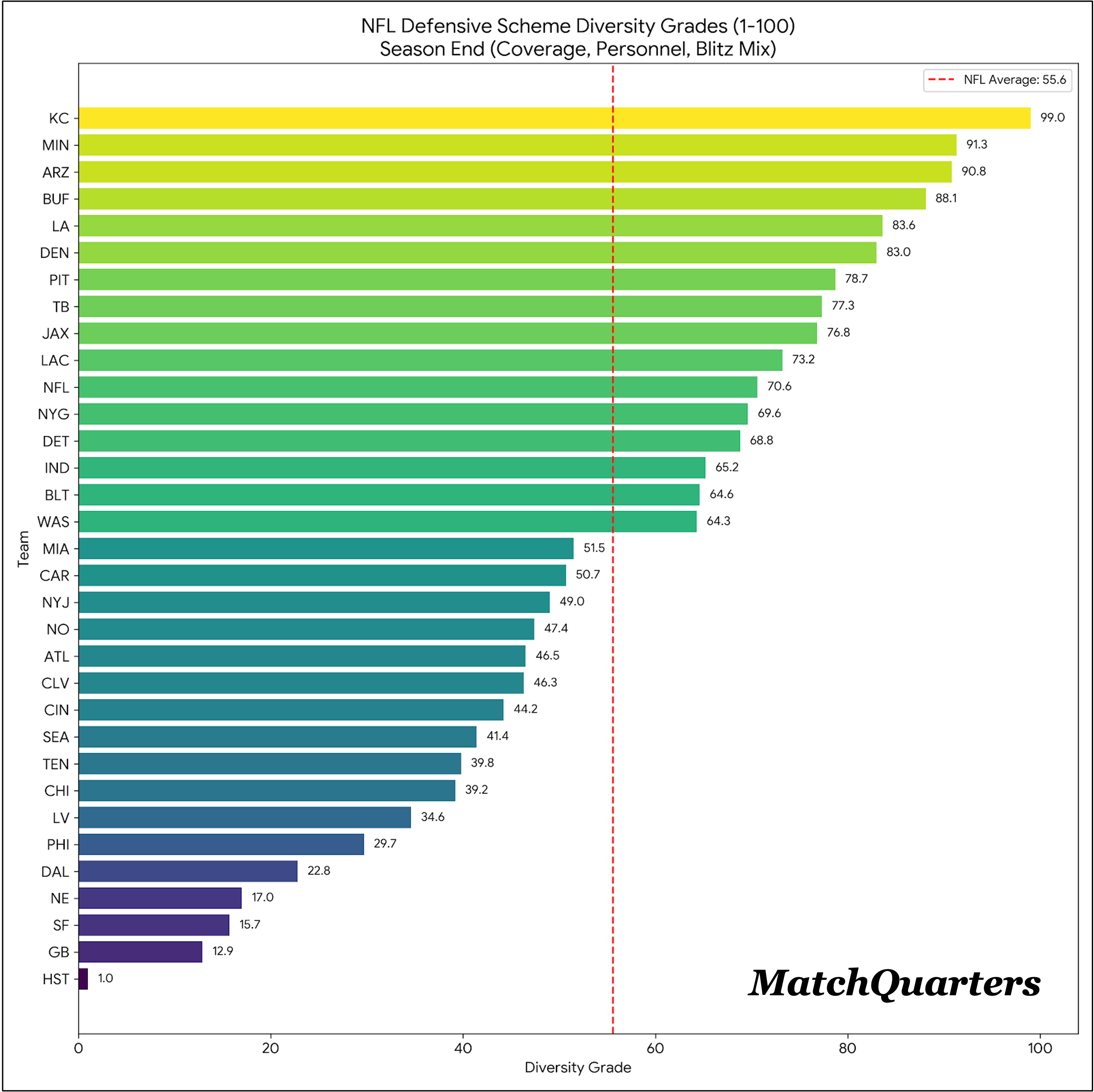
Kansas City runs the most diverse scheme in the NFL. No other team runs as many calls and looks as the Chiefs. Above, the NFL’s “diversity” of scheme is illustrated through Shannon entropy, a mathematical measure of randomness. Spags is willing to use any tool necessary to stop an opponent, and though it doesn’t always produce an elite unit, the defense plays well in complement to the Chiefs’ usually elite offense.

2025’s Odd Stack Evolution
With Reid gone, Spags evolved into a more traditional Nickel defense. Typically, the split between a traditional 4-2 Nickel and his 3-3-5 isn’t that large, 30% versus 24%. But in ‘25, the numbers shifted overwhelmingly into more traditional looks with a 42% to 13% split.
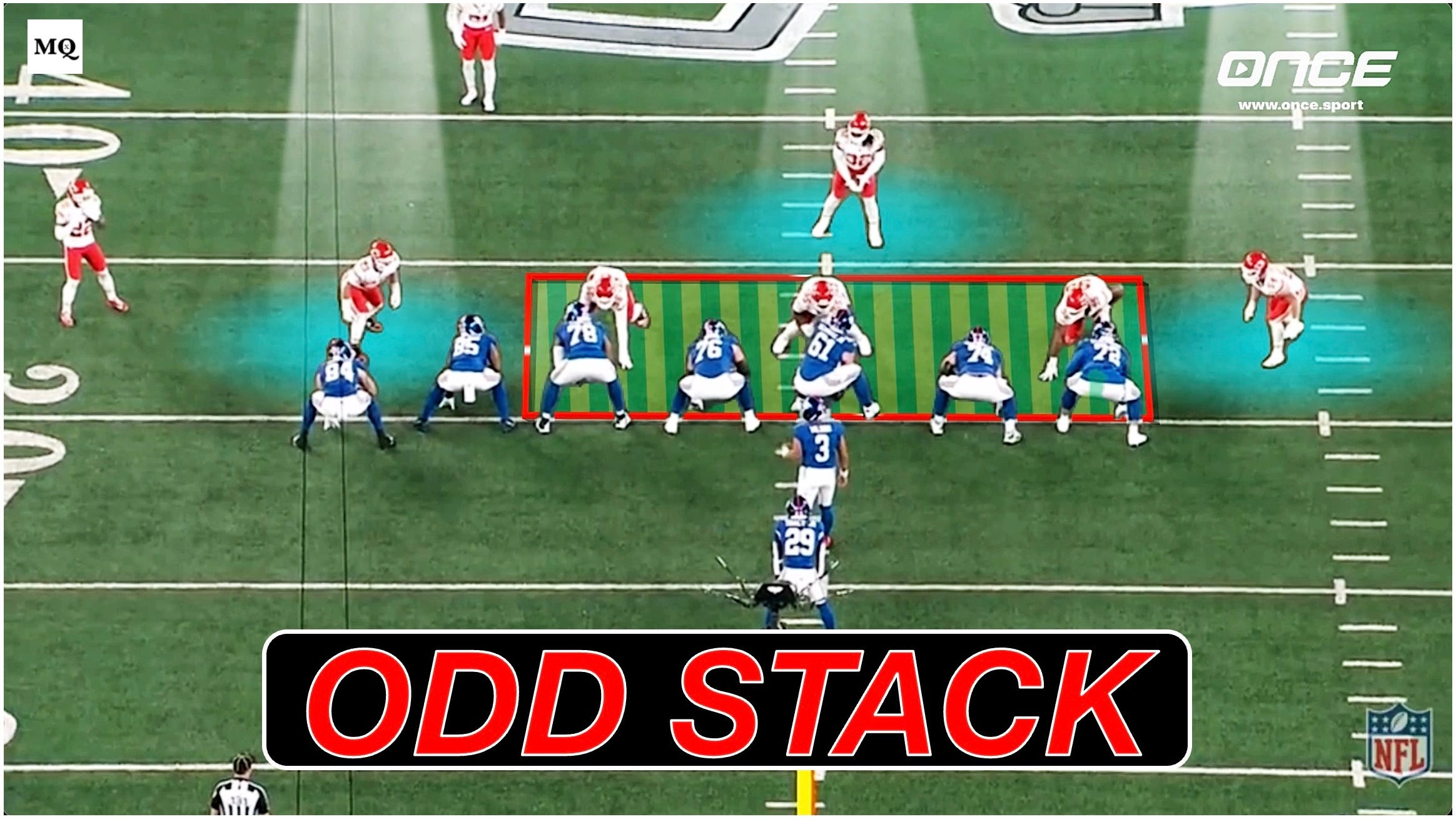
2025 was a year of transition for the unit, but the diversity within the Odd Stack package remained. Though it was used in limited numbers, the Chiefs were very targeted about its use. The Giants, Jaguars, and Broncos all saw high numbers of the 3-35 package, primarily to counter their spread-run offenses.
The catalyst for this system was Leo Chenal (Commanders), who could line up anywhere from a Wide-9 to a “flex” 3-technique in any given package. KC’s Odd Stack carried PFF’s second-highest run grade and run Success Rate, using Chenal and Drue Tranquill as leverage defenders near the line of scrimmage.
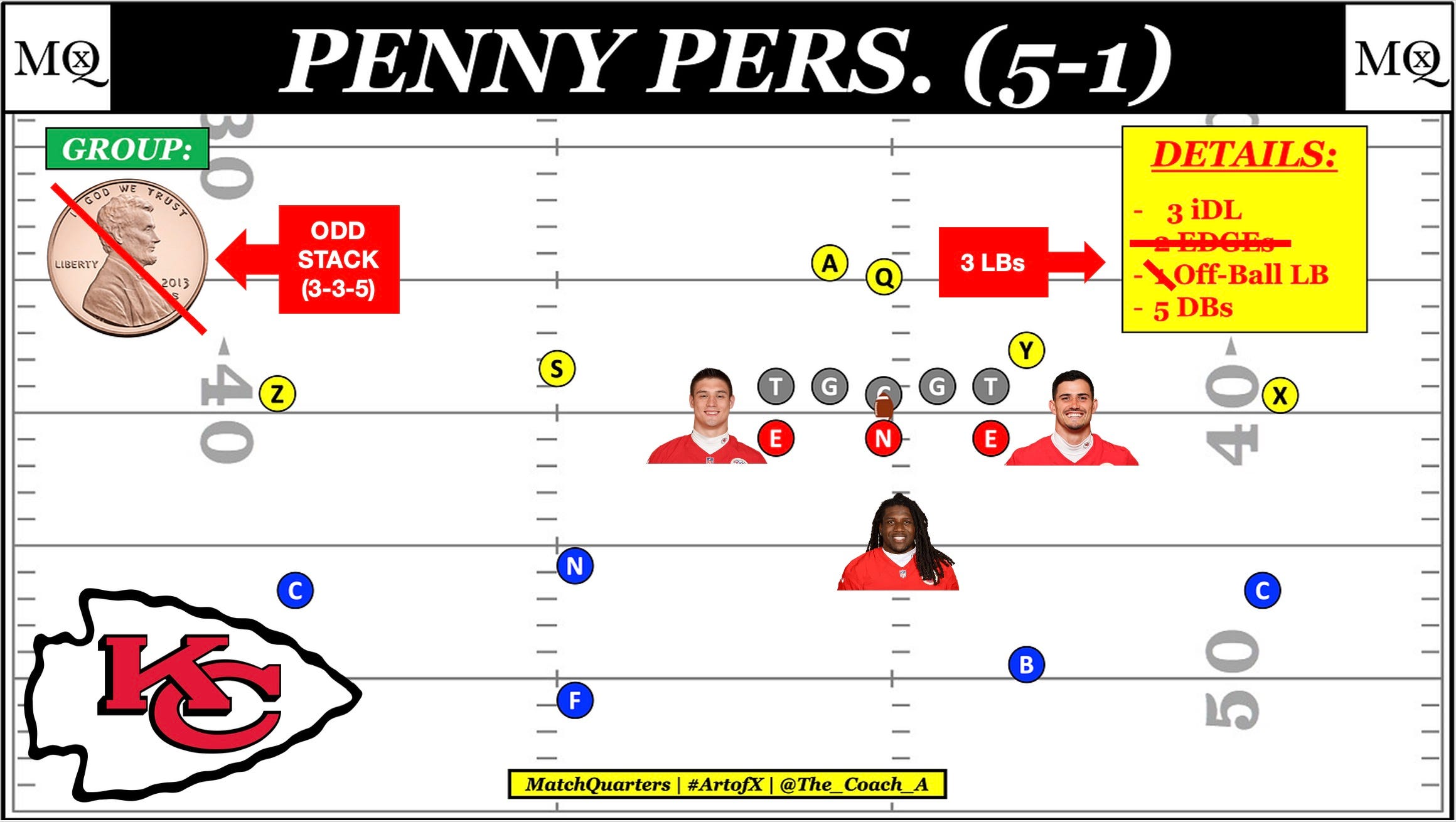
With no fourth Safety, Kansas City had to transition to more traditional looks, even in their Odd Stack package. Typically, the Chiefs on early downs, when implementing the package, used a “Penny” or 5-1 alignment, as illustrated above. Unlike other high-volume Penny users, the Chiefs use their off-ball LBs as the Edges.
Spagnuolo’s Odd Stack package in ‘25 ranked eighth in Blitz Rate, matching KC’s overall blitz volume. 20% of those were Quarters pressures. Only the Cardinals and Vikings exceeded 10% usage.
Though 2025 was not a successful season for any KC unit, Spags demonstrated how he uses non-traditional packages to get into traditional looks. These “curveballs” can throw coordinators off when presented with different defensive formations. Then, on 3rd Downs, switch again, running “standard” pressure paths, but from an Odd Stack look.
—
Offenses use spread formations to force light boxes and isolate a defense’s personnel. If a defense cannot change front structures post-snap, it is giving away the leverage advantage. Unlock the full breakdown to see how Spagnuolo uses Odd Stack mechanics to cancel gaps on early downs below.

