


Across the NFL, there is roughly a 60/40 split between zone and gap run concepts. Over the past several years, the use of gap schemes has increased due to league-wide defensive trends. The two main culprits were a shift to more Odd or five-man fronts and the continued use of Nickel.
Currently, in 2025, four of the best offenses in DVOA all come from the same tree: Rams, Packers, Seahawks, and 49ers. Outside of San Francisco, which has always used heavier personnel packages, the other three have also pivoted to more 12- and 13-personnel groupings. The Shanahan-McVay scheme is based on play-action passing from Wide Zone looks, but recently, there has been a shift.
To stop the Wide Zone, defenses began shifting to five-man fronts. This pivot allowed defenses to wall the perimeter of the box with speedy Edges while clogging cut-back lanes with three interior defensive linemen. For teams like the Rams and Packers that preferred to base in 11 personnel, the Penny Package (5-1) became a schematic favorite.
The cat-and-mouse game of who can defend the run utilizing Nickel has come full circle this season. 2023 was arguably the pinnacle of the NFL’s Spread era that started in 2018 (though you could argue the ‘17 Eagles Super Bowl team lit the fuse).
But where was the offense? That year, 67% of all downs in the league were played with some variation of five defensive backs on the field, or “Nickel” defense. Last year, that number dipped by only one percentage point, but there were warning signs. Early in the season, analysts and pundits were in a tizzy as passing and scoring numbers were at all-time lows.

Why? Offenses were running the ball, and the pendulum was beginning to swing back towards heavier personnel. Only two teams in 2024 utilized Base personnel on more than a third of their plays: the Lions and Rams, with Detroit closing in on 50% usage. For context, “Base” in 2023 accounted for only ~21% of defensive play calls, and it was only ~23% in ‘24.
Fast forward to the closing weeks of the 2025 season, and Nickel usage across the league is falling toward 60%, while Base usage is rising to about 27%. In 2024, four teams (WAS, HST, PHI, BUF) ran Nickel over 80% of their snaps.
Currently, not one team in the NFL is over that mark. San Fransico and Seattle are the closest at over 75%. A few teams have shifted to Dime usage, such as the Rams and the Ravens, but even those teams' numbers are down overall. When digging into the numbers, one team stands out for its unique approach and efficiency in defending the modern offensive meta: the LA Chargers.

Personnel vs. Structure
A lot of the way the Chargers are allowed to play defense is because of their personnel. Last year, LA had Teair Tartt and Poona Ford playing in the interior of their four-down Nickel. In the past offseason, Ford moved across town to play for the Rams. Interestingly enough, the Rams' use of the Dime (six DBs) under defensive coordinator Chris Shula has risen from ~25% to almost a third of their plays!
The main difference between Shula’s approach and the Chargers’ DC, Jesse Minter, is in their structural approach. Last year, the Chargers used a four-down front with two massive bodies in the middle and stout Edges (Mack, Bosa, Tuipulotu). The front four, for the most part, handled their opponents' run games. Shula prefers a five-man front led by Jared Verse, Braden Fiske, and Kobie Turner (and now Ford), and a volume of stunts (~30%), which they lead the league in.
But the key factor in developing the Chargers' scheme has been All-Pro Safety Derwin James. Outside of the Ravens’ Kyle Hamilton, there might not be a more diverse and effective hybrid Safety in the league. Minter uses James near the box on ~85% of the Chargers’ snaps.
The addition of hybrid Safety Elijah Molden in ‘24 and rookie RJ Mickens (Clemson) has allowed Minter to keep James down near the box. The Rams, Ravens, and Chargers run the most Dime in the NFL because of personnel. Shula and the Rams are outliers because of their five-man front and Nickel Quenton Lake playing Safety.
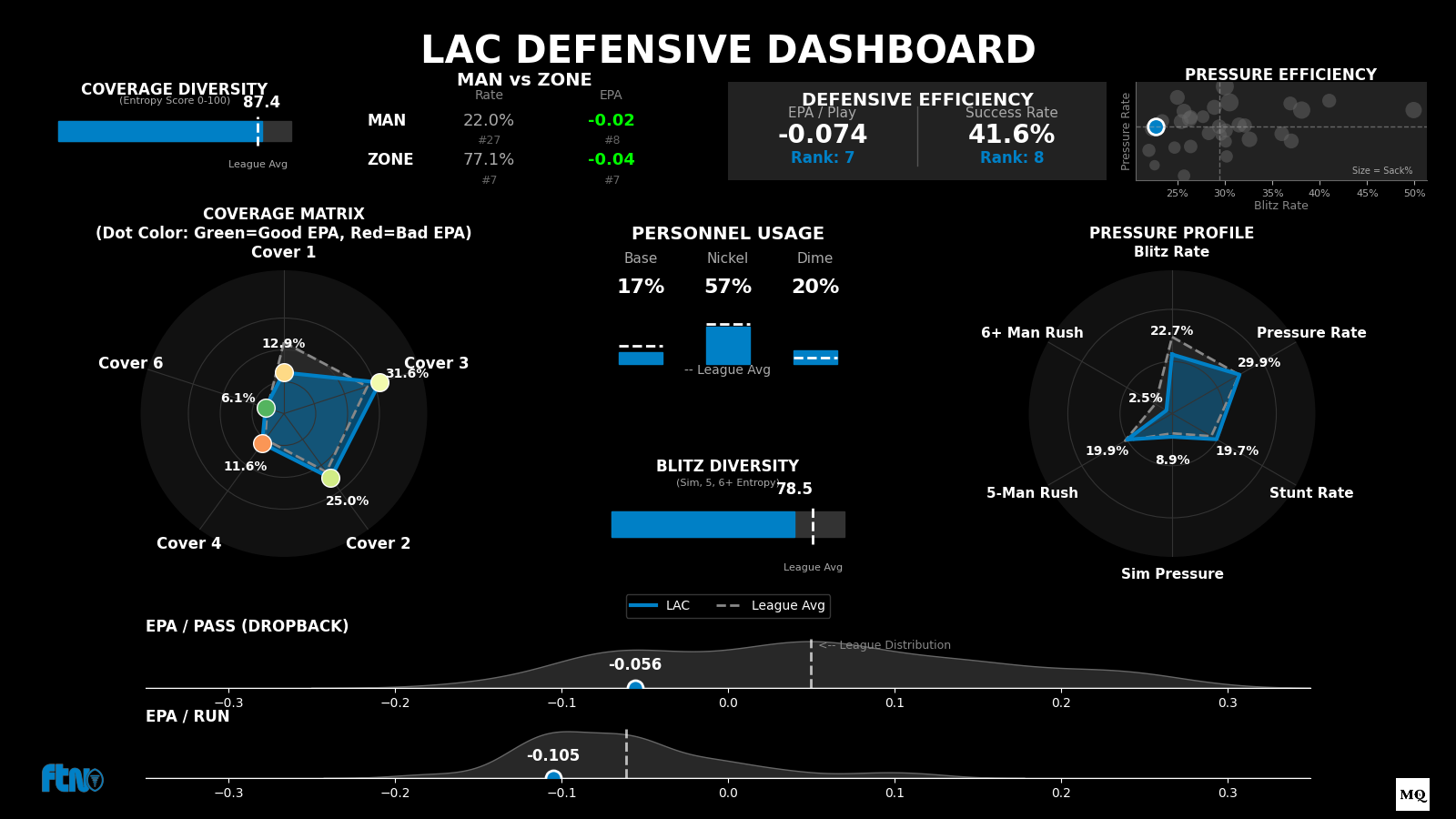
Examining the Ravens, who are also schematic cousins to the Chargers, it is clear that the ability of the Down Safety, or “Big” Nickel, has allowed the defense to go light as offenses around the league shift to heavier personnel groupings. Minter has LA 28th in Base defense usage (~17%) and 28th in Nickel usage (~57%). They are clearly a Dime outlier. Again, this is all by design.
The Bait-and-Switch
The prominent run family in the NFL is the zone, and the Chargers play both Wide Zone and Inside Zone extremely well, holding opponents to below-average results on horizontal runs. With ample speed on the field and a Nickel that can fit the box like a linebacker, offenses struggle to go horizontal on the LA.
When offenses face the Chargers, many pivot to gap schemes, which they see at the fifth-highest rate in the league at almost 50% of their runs faced. Minter is still keeping his philosophy squarely in the anti-Spread world by staying “light” in personnel, but there is a reason for that.
Overall, the Chargers’ defense is pedestrian at stopping the run, ranking 26th against gap schemes and surrendering nearly 4.5 yards per carry. They are below average in efficiency (DVOA) and middle-of-the-road when examining EPA. Teams know they are light and choose to run right at them with gap schemes. But that is the point and an example of Minter’s classic bait-and-switch philosophy.
Gap scheme play-actions are risky in the NFL, especially against the Chargers, who rank in the top five in Sack Rate. By pulling an offensive lineman, the offense exposes the perimeter and assumes the interior of the O-line will handle their block-back. The difficulty level is why most teams operate with zone-based run-action and protections, or use quarterback Dash/Boot movement.
Essentially, the Chargers are playing the long game each week. Minter is forcing opponents to turn into power-run teams. The shift creates fewer opportunities for early down play-action unless it is zone-based, which feeds back into the Chargers’ lighter personnel with James near the box. Combined with an elite Pass Rush Efficiency (Top 5 in the NFL), the Chargers have become the ultimate “bend-but-don’t-break defense.”
Most defenses aim to be balanced in stopping the run and the pass. With teams like the Rams and Seahawks getting into “big” packages only to throw the ball, the Chargers have continued to double down on staying light in the box, something they have excelled at since Minter joined the organization.
The philosophy is akin to Vic Fangio’s low-blitz-volume, high-rush-efficiency approach and the ideology of creating plodding offenses that will inevitably grow impatient. The design is to force offenses to waste time running the ball, and when they do pass, it is predictable and easily matched by their Nickel and Dime personnel.
The Chargers gave us two great examples of this philosophy in action against the Eagles and the Chiefs. Let’s dive into the tape!

