

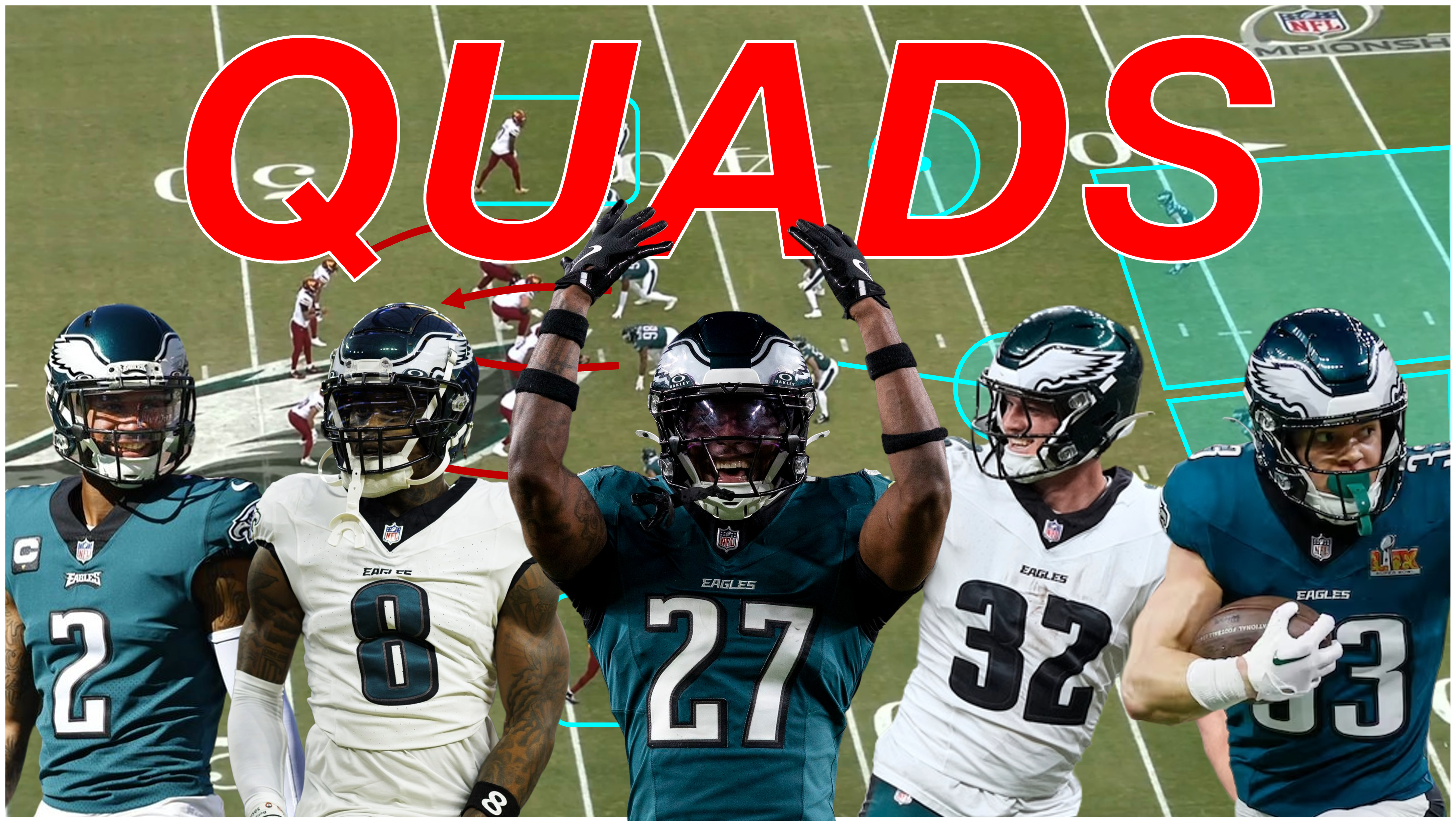
Since 2019, the use of Quarters has steadily risen in the NFL. Along with the Quarters, other split-field variations have also been on the rise. Starting in 2020 with the Eagles' Vic Fangio and current Saints defensive coordinator Brandon Staley, the NFL was ushered into a new era of defense.
Fangio and Staley both began to run their defenses from an almost exclusive two-high shell. But, this wasn’t Tampa 2 or some collegiate trickle-up. It was an adaptation; a change in the meta.
The thought process behind the move was that it allowed for more coverage disguise against early down play-action passing, and gave the Safeties more time to read and react to what the offense was doing. In essence, Fangio devised a way to mesh Quarters and weak rotation (away from the Nickel) Cover 3.
Both the quarterback and the offensive coordinator had to guess pre-snap what the defense might ultimately be in post-snap. If the quarterback ran under center play-action, he would lose sight of the Safeties, forcing him to recalibrate post-fake.
The combination of weak rotation Cover 3 and Fangio’s Cover 6 (Stuff) and 8 (Half-Quarter-Quarter) made it much harder for quarterbacks to identify the post-snap coverages. They all appeared the same.
When running a play-action pass from under center, the quarterback must turn his back on the defense, then whip back around to find a completely different coverage structure. For unseasoned quarterbacks, this can be very confusing.
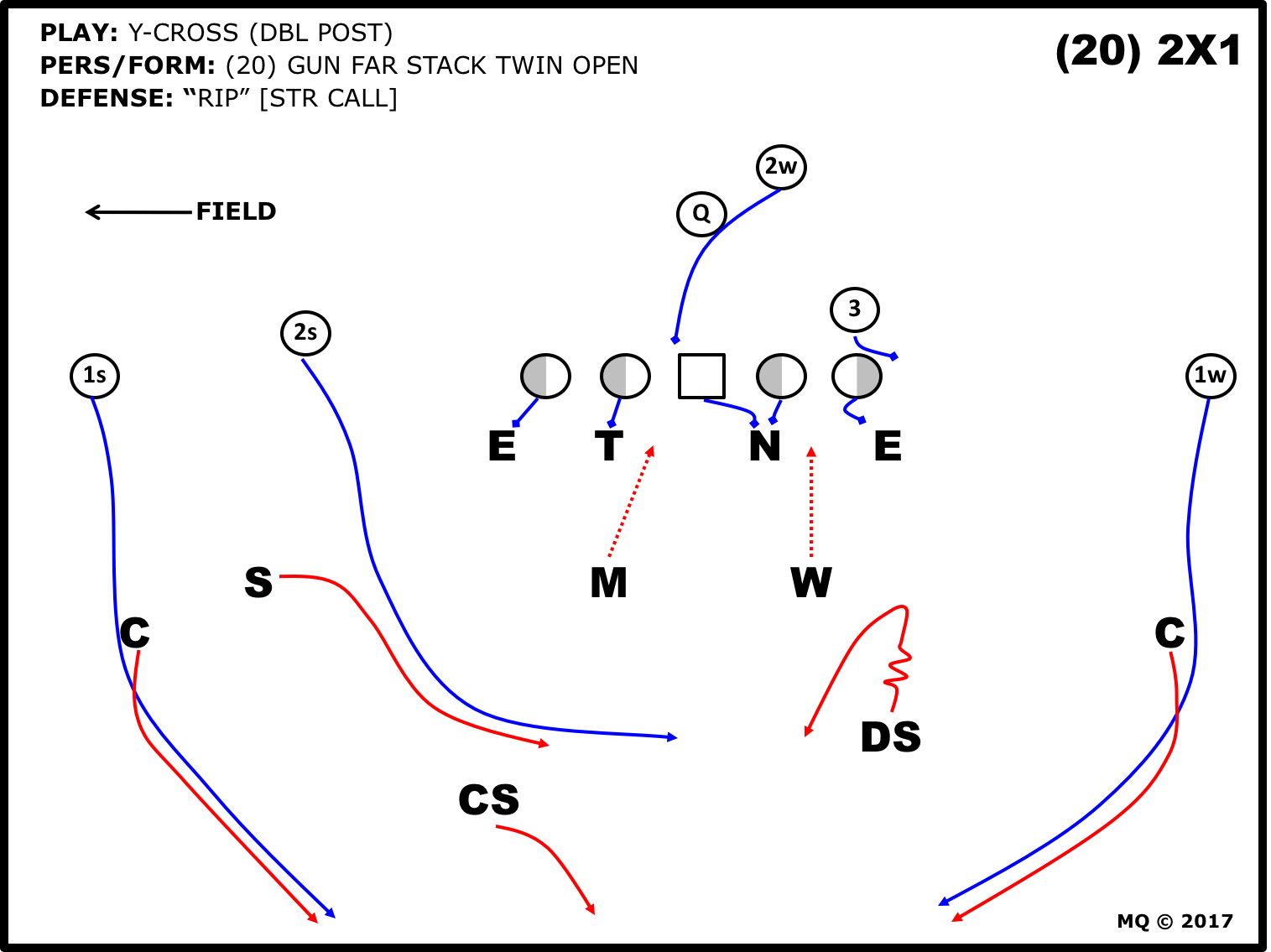
Even seasoned veterans struggled to adjust. Ultimately, the ability to play top-down allowed defenses to compress the field and create natural backstops for vertical attacking plays, such as Cover 3 ‘beaters’ like Y-Cross (above).

Last season, the usage of middle-of-the-field coverage disguises rose to nearly 30%. That’s almost 5% growth in one off-season. Teams across the NFL landscape are utilizing more two-high shells to rotate into Cover 3 and showing closed-post pre-snap looks to transition into Tampa rotations on passing downs (NTTs).
Quarters rates dropped slightly to 14% usage as well as Cover 6 (and 8) counterparts (8.5%). Eating up those reps was Cover 2 (14.8%), as more teams are leaning into coverage disguise. Non-traditional Tampas are easier to install and lend themselves to single-high pre-snap looks.

Two primary trees within the NFL utilize coverage disguise: the Fangio-adjacent and Ravens 2.0 crews. The Rams and Eagles led the league in coverage disguise rates, with the Cardinals (#4), Panthers (#5), and the Falcons (#9) also in the top ten. The Ravens 2.0 crew of Zach Orr (Ravens), Anthony Weaver (Dolphins), and Denard Wilson (Titans) were scattered across the top ten, with the Ravens sitting #3 behind LA and Philly.
The Bills (McDermott/Babich) and the Raiders (Patrick Graham) rounded out the top ten. Buffalo has been one of the top split-field coverage units in the league under Sean McDermott and transitioned to more of a disguised Cover 3 system in ‘24 to hide injuries and issues at Safety. Graham, who will now be the coordinator for Cover 3 ‘king’ Pete Carroll, adjusted to playing in the AFC West by shifting his pre-snap contours to more two-high shells.
Cover 3 remains the dominant scheme, and with more teams running the ball from 12- and 21-personnel formations on early downs, the slight shift back to ‘normal’ was to be expected. Still, Quarters coverage is being discussed and on the radar of most NFL teams.


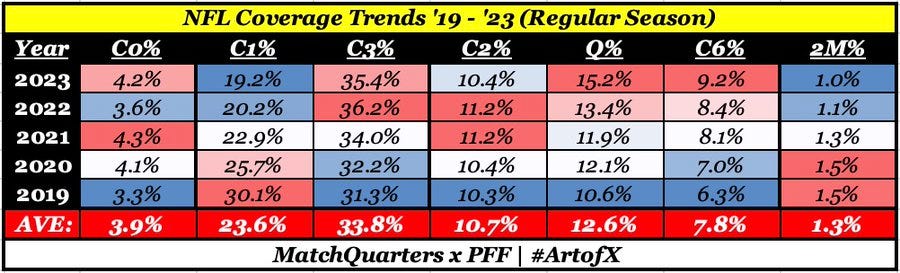
Quarters rates dropped slightly to 14% usage in ‘24, as well as Cover 6 (8.5%). Eating up those reps was Cover 2 (14.8%), as more teams are leaning into coverage disguise. Non-traditional Tampas are easier to install and lend themselves to single-high pre-snap looks.
One of the major trends in the NFL right now is the use of non-traditional Tampa 2 coverages on passing downs. However, that doesn’t provide teams with answers on early downs, which is why many teams are still exploring Quarters.

The issue with “Match” Quarters as a volume coverage stems from its highly teaching-intensive process. Most NFL defensive coordinators have ascended to their title by learning and implementing closed-post dominant systems. Quarters, traditionally, have been a simple long-yardage passing coverage. Modern offenses are changing the way teams approach coverage.
The Spread and its elements disrupted traditional defenses at the lower levels by spacing defenders out and creating mismatches with more athletic players. Defenses adjusted by playing more Nickel and matching offenses with width. At the NFL level, the game is now being played mainly from Nickel and condensed formations.
Though it may sound counterintuitive, playing from a two-high shell can assist in defending play-action passing and other standard concepts by leveraging the Safeties from depth. Quarters helps this even more by allowing the Safeties to stay on the hashes and leverage crossing routes from the other side. The argument from most offensive coaches (and some defensive) is that the depth allows them to run the ball more effectively.

In Fangio’s typical split-field coverages, there is a ‘high’ (Cover 2) and ‘low’ (Quarters) side, creating a natural layering effect. The Quarters side can either cap a vertical or act as a backstop to a deep crosser, depending on the call. The Eagles often leverage the best or most dangerous receiver by switching which side the Cover 2 and Quarters is played on.
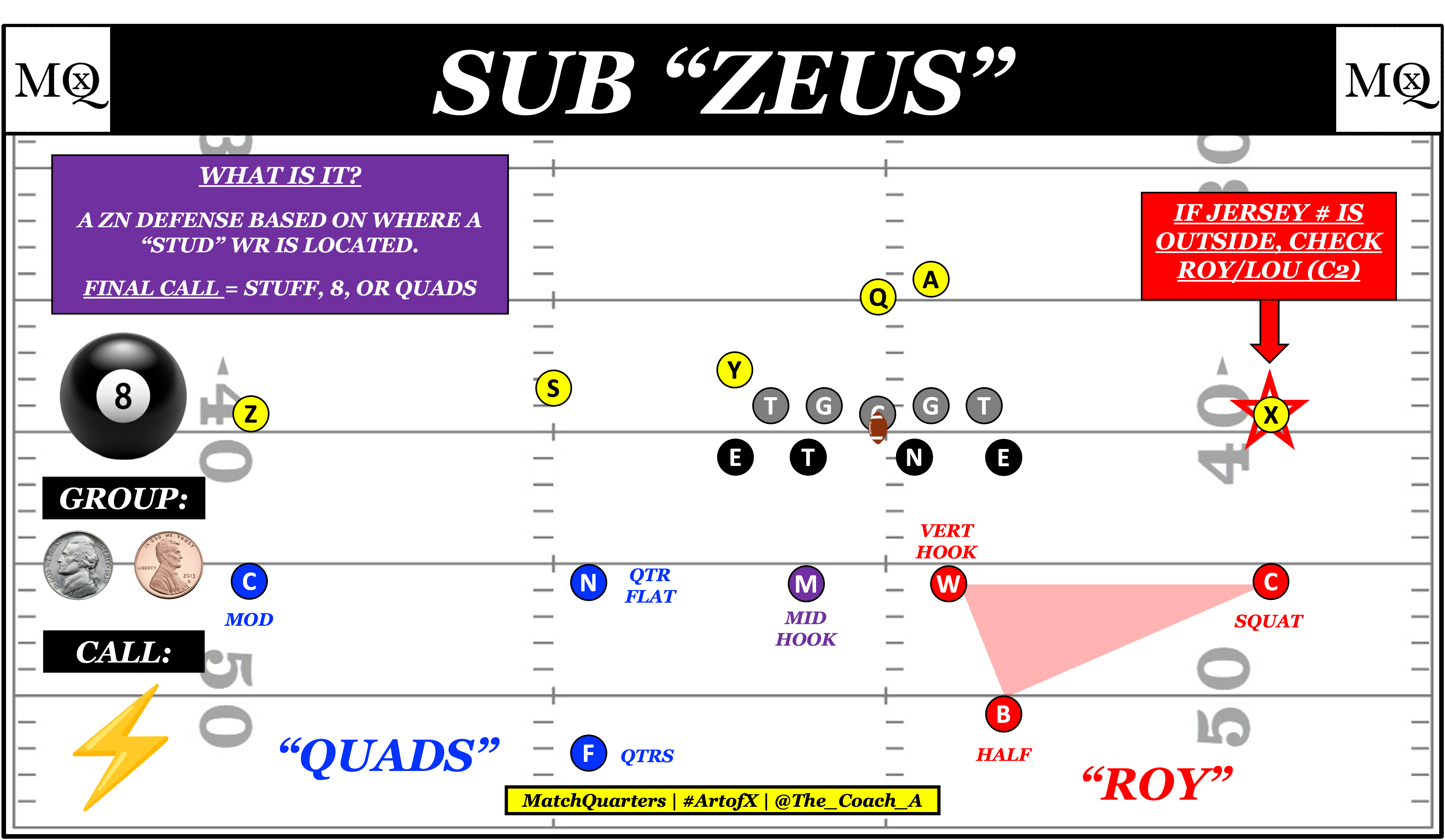
Traditional Cover 6 is Quarter-Quarter-Half (above), with the Cover 4 side being placed to the passing strength. The backside Cover 2 has primarily been used as a way to get a zone ‘double’ on the X-receiver. Modern offenses now move their best receiver around, and the slot position has become one of the most important in the game.
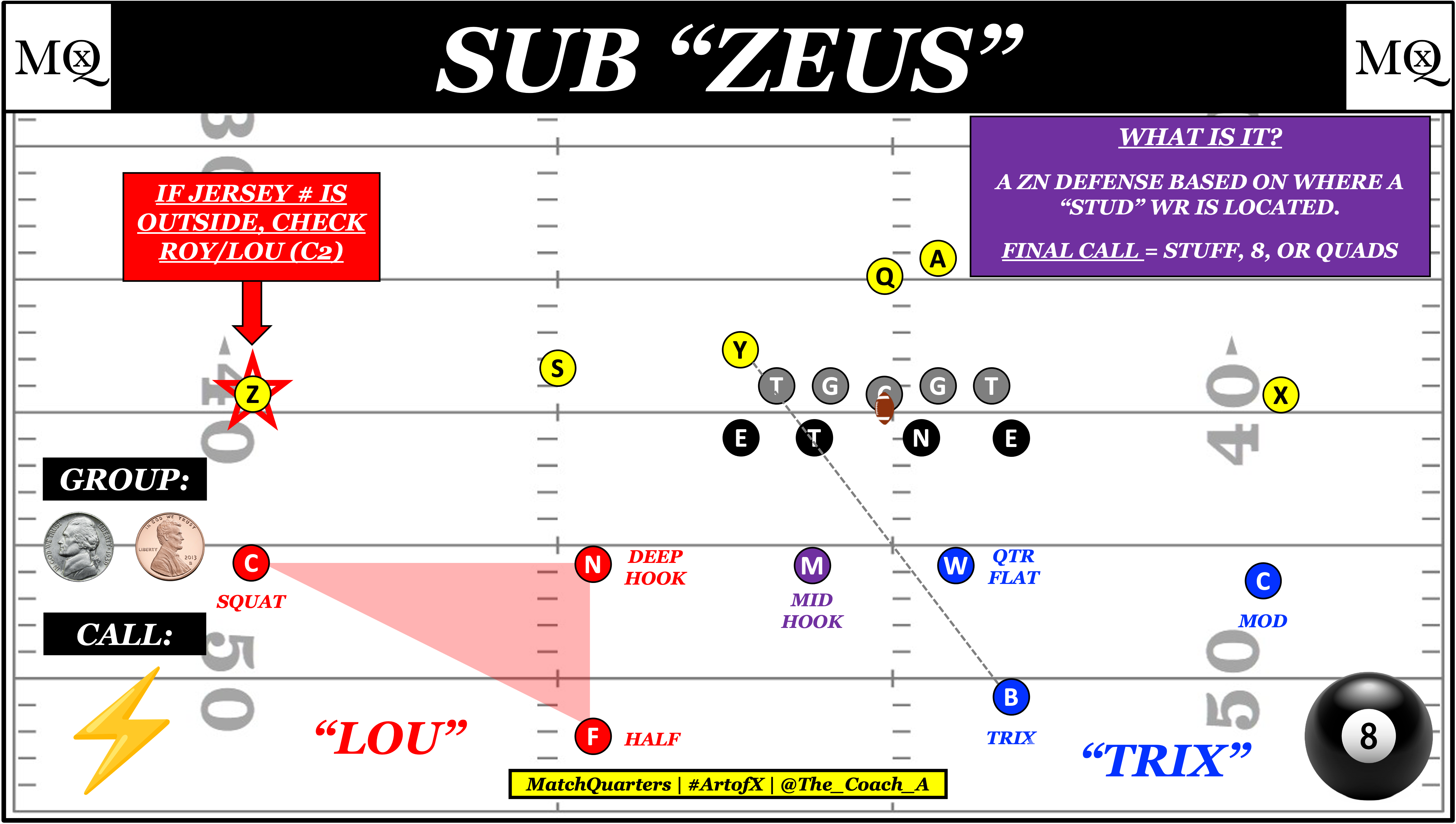
The ability to play Cover 2 to the front side, and Quarters (Poach) away allows the backside Safety to ‘hang’ on the hash, cutoff crossers, or assist in doubling the ‘X’. These ‘targeted’ coverages have become popular around the league and mesh well with two-high Cover 3 rotations.

—
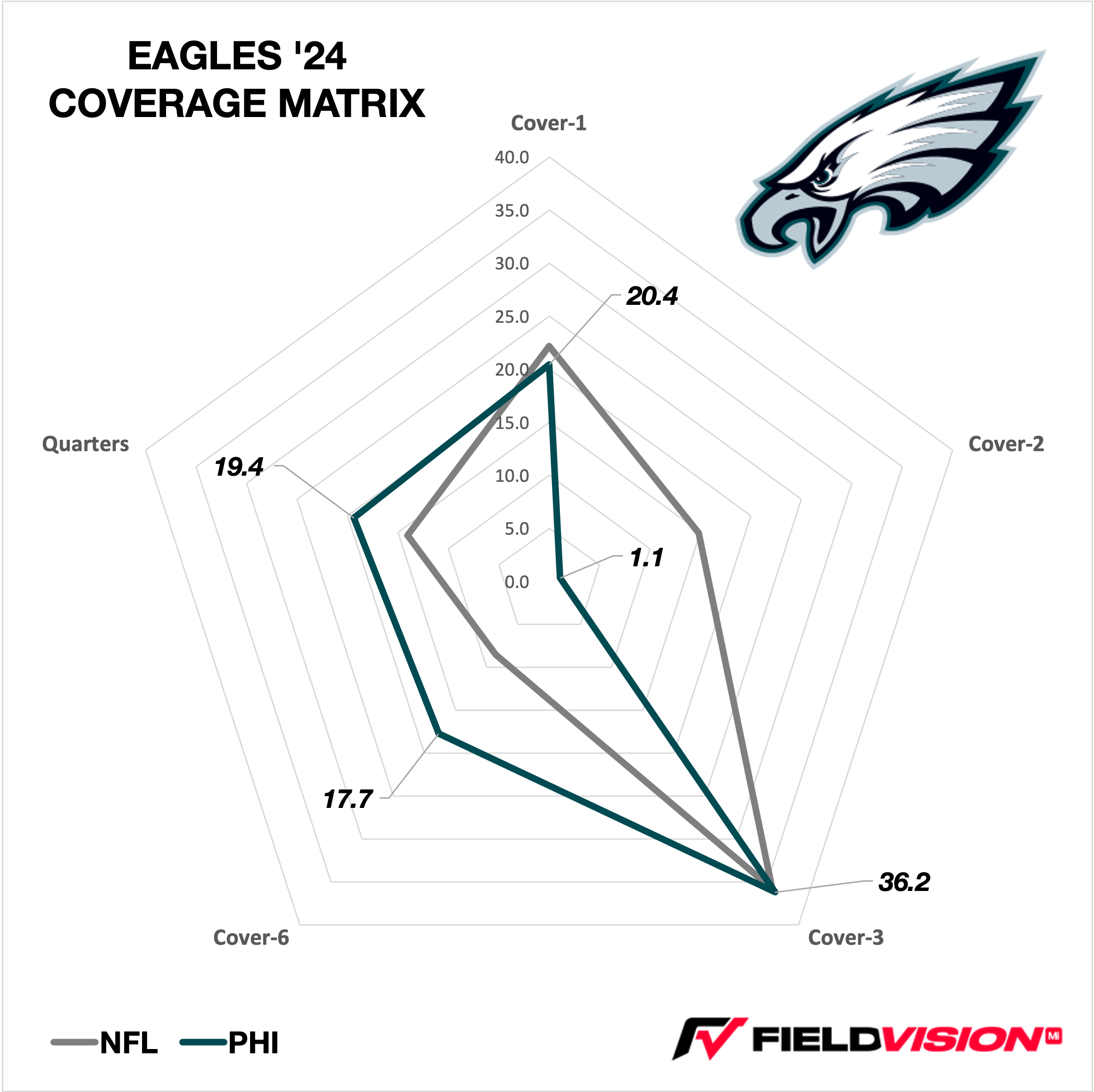
Fangio has not been a ‘Quarters’ coordinator, instead opting to play Cover 6 (Stuff) and Cover 8 (HQQ). Last year, that changed. In 2023 with the Dolphins, Fangio ran Quarters (Quads) on 12% of his calls. Cover 6/8 made up 21% of his calls. In 2024, his Quads rate rose to almost 20%, placing him fifth in usage in the league. Subsequently, his Cover 6/8 rate dropped 17.7%.
So, why is Fangio running more Quarters? In condensed formations, offenses often run meshing routes, and many times at the intermediate level. Quarters allows the cornerbacks outside to work in vertical columns, matching the outside routes. Inside, the Safeties can then cross-key to the opposite side to pick up any deep crosser. Instead of layering, the defense now has two functional backstops.
Concepts like the Wave and Cross-Country (Yankee) use play-action with deep crossing routes. The Quarters coverage not only allows the Safeties to play the run from depth, but it keeps them in the intermediate zone where they will need to pick up a Dover (Deep Over) coming from the other side (above).
The coverage also allows the defense to pack the middle of the field with numbers. In the Super Bowl, the Eagles used Quarters to cap verticals, while packing numbers between the hashes (doubling Kelce) to a devastating effect. The Eagles were one of two teams, along with division rival Cowboys, to not give up explosives when running Quarters (FTN).
When teams have two corners that can play man, Quarters gives the defense better answers in the middle of the field and more support for the linebackers. It can also help defense better fit the run against Spread-to-run teams that are emerging in the NFL.
One of the best examples of the Eagles using Quarters in a game came against the Commanders in the NFC Championship. Let’s dive into the tape!
