


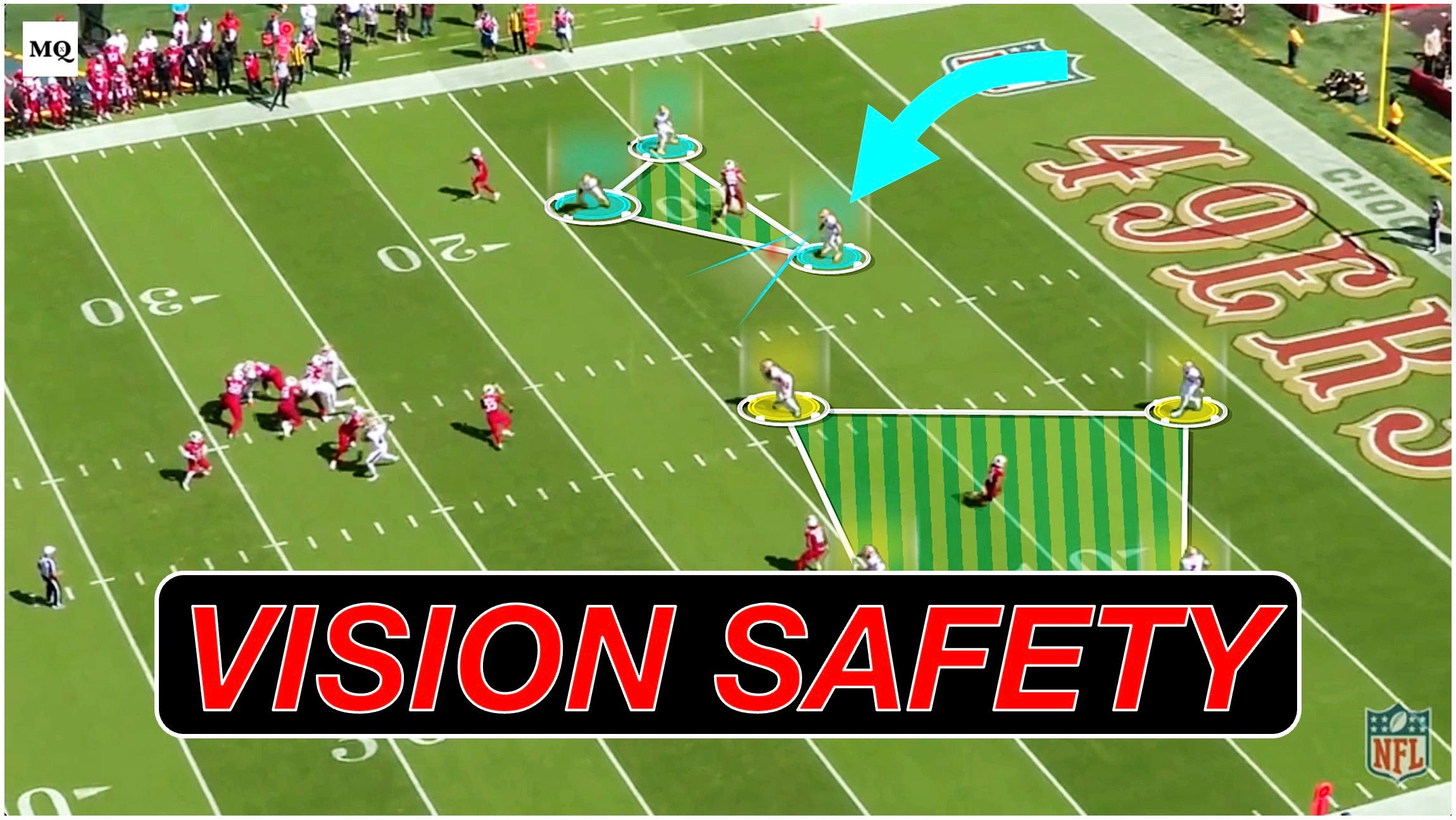
In 2018, Robert Saleh had a schematic revolution.
After working in the Pete Carroll system for a better part of a decade, he had come to a breaking point with the strategy. Kyle Shanahan had hired him as his defensive coordinator in 2017, and after a season of abuse from his boss and offenses around the league, the pair decided to redesign their defensive structure.
Before 2018, Saleh had only run Quarters on ~3% of his snaps. By 2019, that number had risen to over 20%. Over the past five years, Saleh’s defenses have ranked among the top in Quarters usage, as split-field coverages have assumed a major role in modern defenses.
In New York, Saleh evolved his Quarters structures, implementing more Cover 6 or Quarter-Quarter-Half coverage. Once back at the helm of the defense in San Francisco, the Quarters structures didn’t disappear.
The 49ers opened the 2025 season with a clear objective: marry weak-rotation Cover 3 with their Quarters coverage. The shift is consistent with the current NFL zone-centric meta, which uses two-high shells to muddy quarterbacks' reads and restrict explosives on early-down play-action attempts.
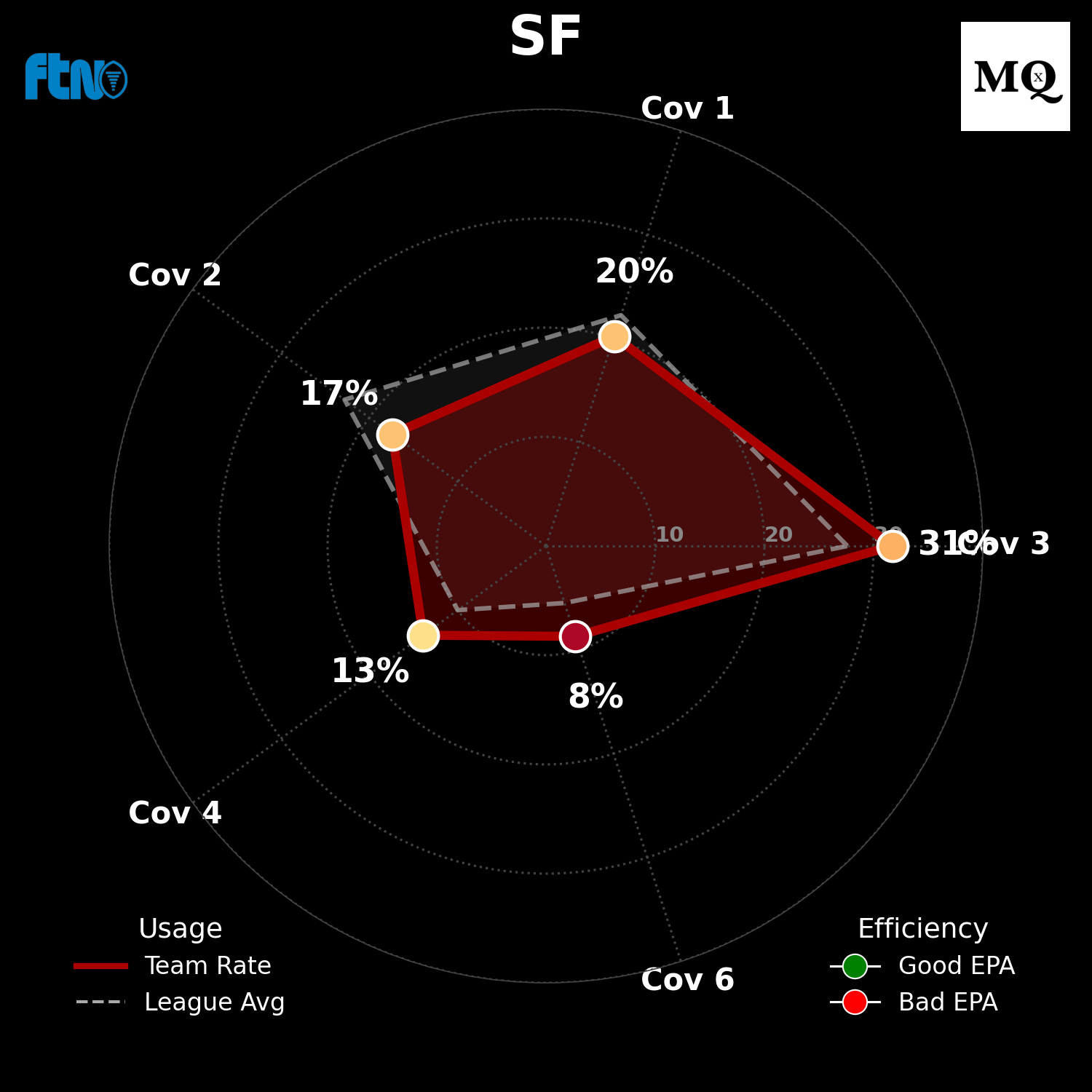
Over the season, San Francisco maintained a ~14% Quarters usage, which was enough to finish fourth overall in 2025. Through Week 6, the philosophy was holding up, and the secondary was playing the split-field coverage relatively well. Then the injuries began to accumulate.
The Personnel Production Cliff
In Week 3, Nick Bosa was lost for the year, essentially killing any pass-rush “juice” the 49ers had left. In Week 4, Brock Purdy was lost for six weeks, and the offense slumped until Purdy’s return in Week 11. Week 6 saw zone coverage guru Fred Warner out of the lineup as well. By late October, over $96-million of active salary was located on the injured reserve.
Part of the overall offensive slump was a shortened field. San Francisco opponents consistently operated on less grass. The 49ers ranked 30th in Drive Start Yardage (32.2). The result was a 27th-ranked Points Per Drive of 2.6, meaning opponents didn’t have to work hard to get at least a field goal. Injuries and a stagnant offense through the middle part of the season exacerbated the defensive issues.
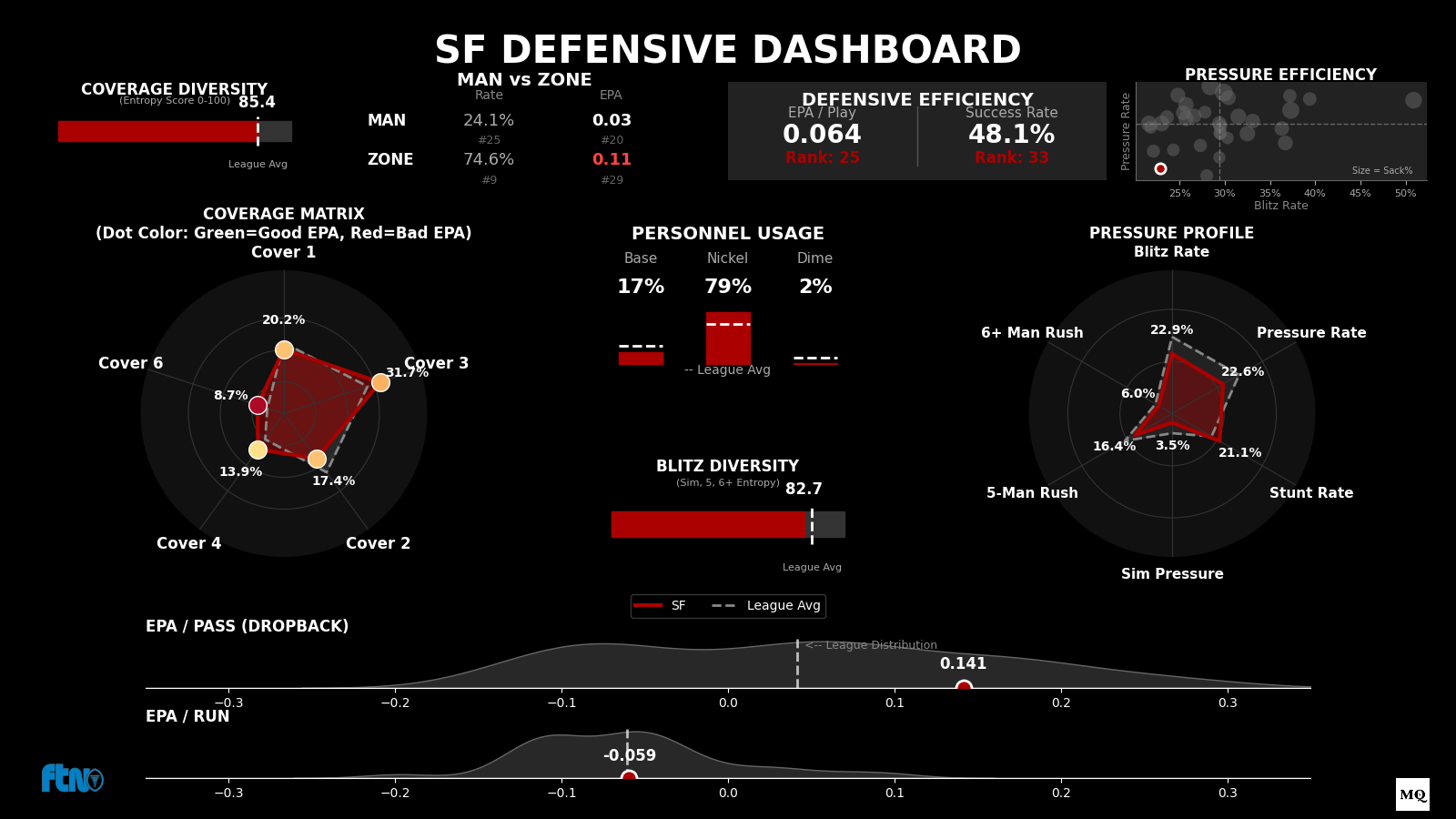
Without a pass rush, the bend-don’t-break philosophy of Saleh’s two-high marriage of vision Quarters and weak-rotation Cover 3 fractured. The 49ers’ defense struggled across almost all primary metrics, finishing as a bottom-10 unit. It is a miracle they finished the year 12-5.
Saleh’s intermediate eraser in coverage was gone in Warner; the execution of Quarters, which compresses the field and floods the intermediate zones, began to collapse. One key area of regression was against vertical stemming routes.
The 49ers gave up a 47% completion rate to balls thrown over 20 yards. When San Francisco was able to “cap” verticals, the ball was still thrown into the deeper intermediate, with an Average Depth of Target (ADOT) over 7 yards. The linebackers weren’t showing up in coverage.
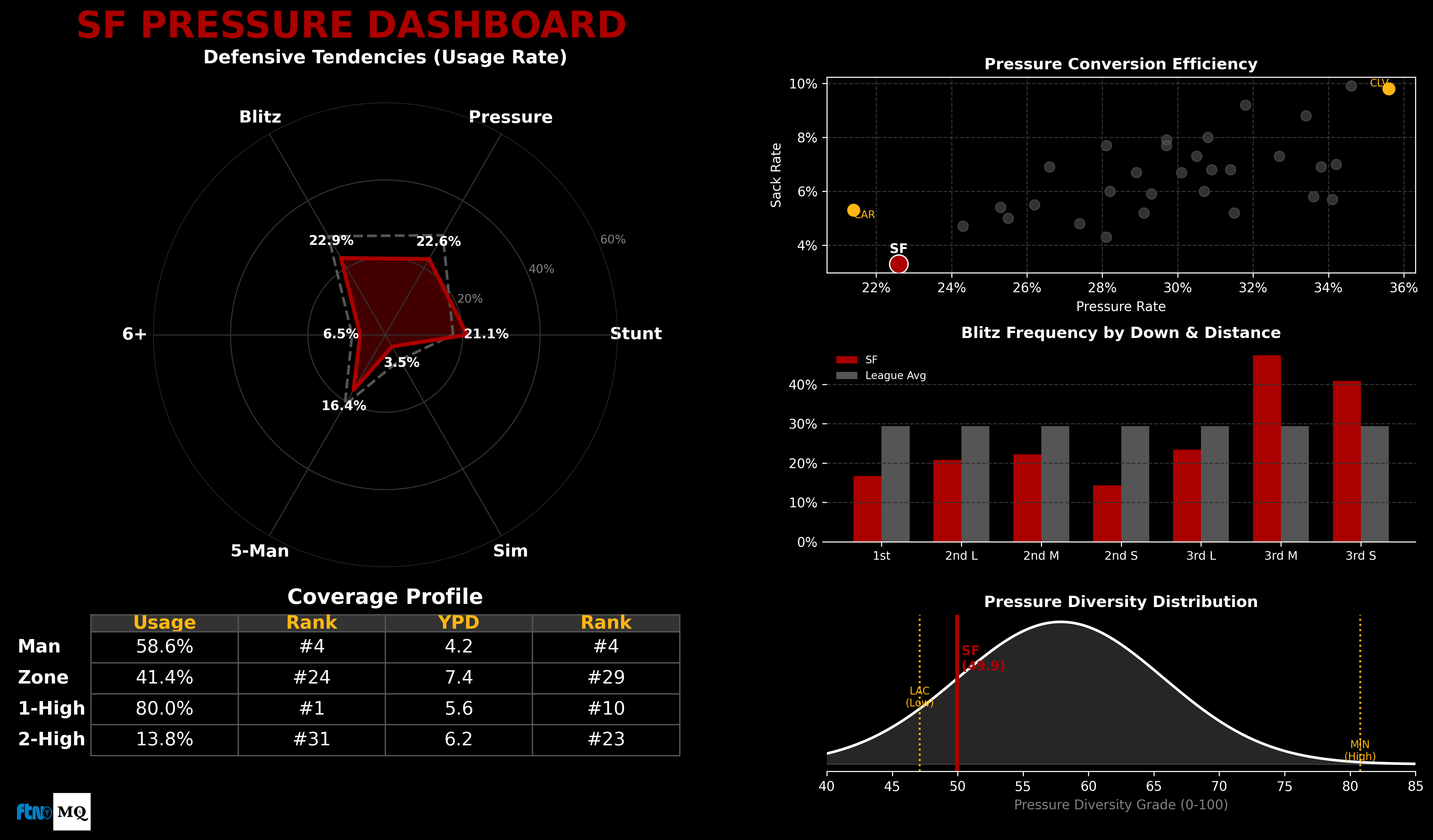
Opposing Quarterbacks had an average Time to Throw (TTT) of 2.76 seconds, ranking the 49ers 30th in the league. The 49ers had a toothless pass rush, no effective blitz package, and ran zone coverage that kept the top on the defense but allowed over 8 yards per play across all schemes. When in Quarters, a Sack Rate of 2.1% was bottom in the league.
By mid-season, the 49ers were in schematic hell. The offense stabilized by Week 9, but it was missing its catalyst in Purdy, who wouldn’t be back for another two weeks.
Defensively, the unit was toothless, and their main philosophy heading into the season needed some tweaking. One of the major shifts was a more closed-post mentality. In the back half of the year, split-field usage was slashed by almost 15%.
Quarters is a foundational concept within the Saleh Wide-9 defense. The coverage is used to mitigate the risks of early downs in the McVay-Shanahan offensive approach, which has taken over the league and is now part of every team in the NFC West.
Much like the 49ers’ sister-scheme in Houston, the San Francisco defense shifts between closed-post to Quarters from down to down, attempting to preserve the nuance of how the coverages are taught rather than relying on disguise or raw aggression from blitzes. The 2025 tape for the 49ers shows a defense in flux, shifting toward structural mitigation.
The “Vision” Safety
One of the trends in the NFL over the past five seasons has been the increased use of a two-high shell to confuse quarterbacks and to leverage deep crossing routes in play-action. Saleh’s unique approach to Quarters begins with how he teaches his Weak Safety to play as a vision defender instead of strictly on the hash.
Though Saleh doesn’t run the Fangio-adjacent Cover 8 and “Stuff” (Cover 6) targeted rotations, he does run a mix of split-field coverages. He has adopted the “Trix” or “Poach” style for the Safety away from the Nickel. Instead of making the Safety reliant on backside route choices, which often don’t attack vertically, defensive coaches have started to shift the Weak Safety’s vision to the front side.
The technique is not “active” in the sense that, post-snap, the Safety moves directly into the high intermediate. Instead, he is reading the Slot-to-Quarterback triangle to gain information and then attack accordingly.
In the NFL, the X-receiver is often condensed and easily funneled inside. Rarely is the backside Fade, which is so popular at the High School level, a viable option in the NFL.
The backside Safety can play as a poach player, shoving the coverage when facing single-receiver sets or slotted TEs (non-vertical threat). The ability to “shove” the coverage allows the front-side Safety to stay high in his zone, providing support to the slot defender or outside cornerback. When combined with weak-rotation Cover 3, where the Safety is in the Weak Hook, the coverages can look almost identical, even allowing the Post Safety to stack the strong-side route distribution.
The fluidity of schemes makes it difficult for offensive coordinators and quarterbacks to determine what the defense is actually in. This shift in the meta is why offensive coaches are arguing about pure progression reads versus split-field or leverage reads. The backside Safety, which was once the key optic for the modern quarterback, is now failing to help decipher coverage.
On paper, the 49ers’ defense doesn’t look like it does that much, but it does.
The “passive pressures” of coverage disguise and static alignments only to shift the mental load to the quarterback post-snap. The problem in 2025 was that the quarterback had plenty of time to sit in the pocket and figure it out. With injuries piling up and key players out for the season, Saleh and his staff had to transition to more closed-post coverages.
Cardinals Film Study
One of the best examples of what Saleh had in mind for his 2025 defense, and of his use of Quarters and weak-rotation Cover 3, came against the Cardinals early in the season. Arizona’s unique 12-personnel-based offense was an ideal scheme to highlight Saleh’s marriage of his two-high philosophy and vision Safety mechanics.
Let’s dive into the tape!

