


The 2025 New Orleans Saints defense might have been some of Brandon Staley’s best work. Once seen as a defensive contemporary to the wonderkids of Sean McVay and Kyle Shanahan, Staley crashed and burned in LA, as the Chargers could never get off the ground under his leadership.
Staley took a year's “sabbatical” from calling defenses and worked under Shanahan in 2024 as an assistant head coach and defensive assistant. The move gave him a fresh perspective on what went wrong in LA, reset his ego, and gave him a front-row seat to what makes a modern offensive genius uncomfortable.
Staley, along with his mentor Vic Fangio, is credited with starting the NFL’s Two-High Revolution in 2020. With limited experience, McVay hired him in 2020 to raise the floor (and ceiling) of the Rams' defense while providing a daily challenge as LA retooled its offense.
With a “second chance” in New Orleans, under the bright offensive mind of Head Coach Kellen Moore, Staley would again attempt to implement one of the most influential schemes in football. With a refreshed mindset, Staley approached an aging front seven and a young secondary with an install strategy ultra-focused on individual techniques.
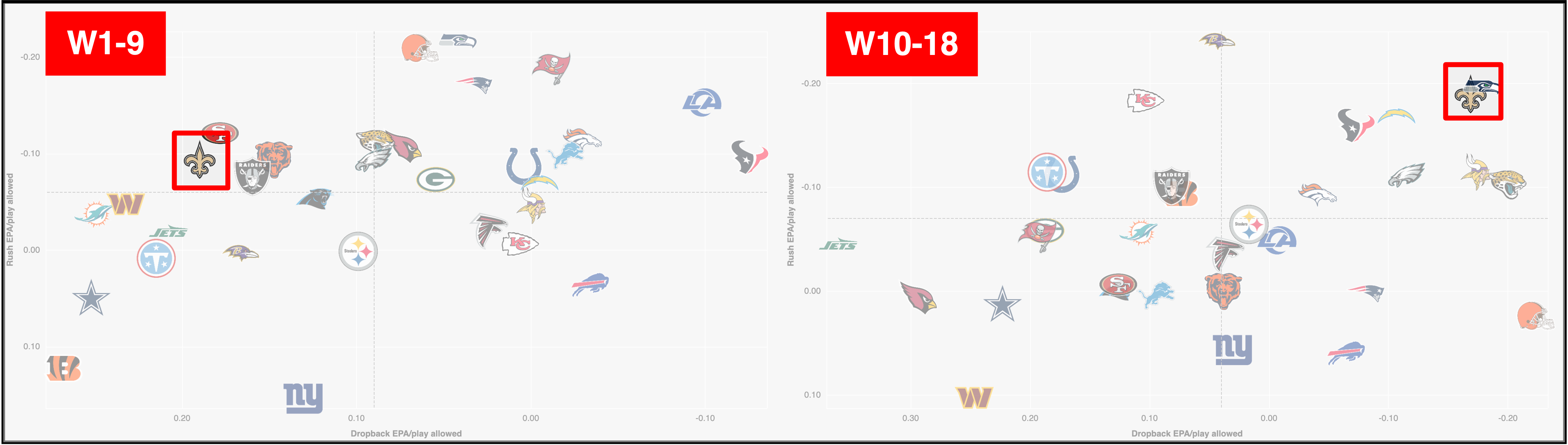
Unlike his tenure in LA, where a common criticism was his overreliance on scheme, Staley focused on building a solid technical foundation rather than massive playbook volume. That focus is what created one of the best defenses in the back half of the year.
After a Week 14 win against the Buccaneers, Staley explained his year-long “slow burn” process, and in reflection, everything worked out the way it was supposed to:
“[W]hen you're trying to install a philosophy and install a scheme... and you're not getting the results early... Have you learned over time to be like don't try to just put a quick band-aid on it? We're installing something for the long term and it's going to play out in month three, month four.”
One of the hallmarks of the Fangio system is a reliance on sub-packages that feature complicated coverage checks. The philosophy within the system is that coverages are used to solve problems, not pressures or front structures.
To be complex in the backend, a defense needs a stable of DBs; thus, the reliance on Nickel. But the package can run most of its structures from Base, which is a force multiplier in today’s offensive climate, as teams “cosplay” heavy packages only to pass the ball.
A Pivot to Base
Last season, the Eagles finished fourth in Nickel usage at 75% of their plays; New Orleans finished 23rd at 58% (FTN). That departure from a stylistic philosophy was mostly focused on matching personnel to the Saints’ opponents.
For context, in Staley’s last year with the Chargers (‘23), he only ran Base personnel on ~23% of his plays. That year, the league average was 21%. In ‘25, that number jumped to 27% league-wide, and Staley more than doubled his Base usage this past season.
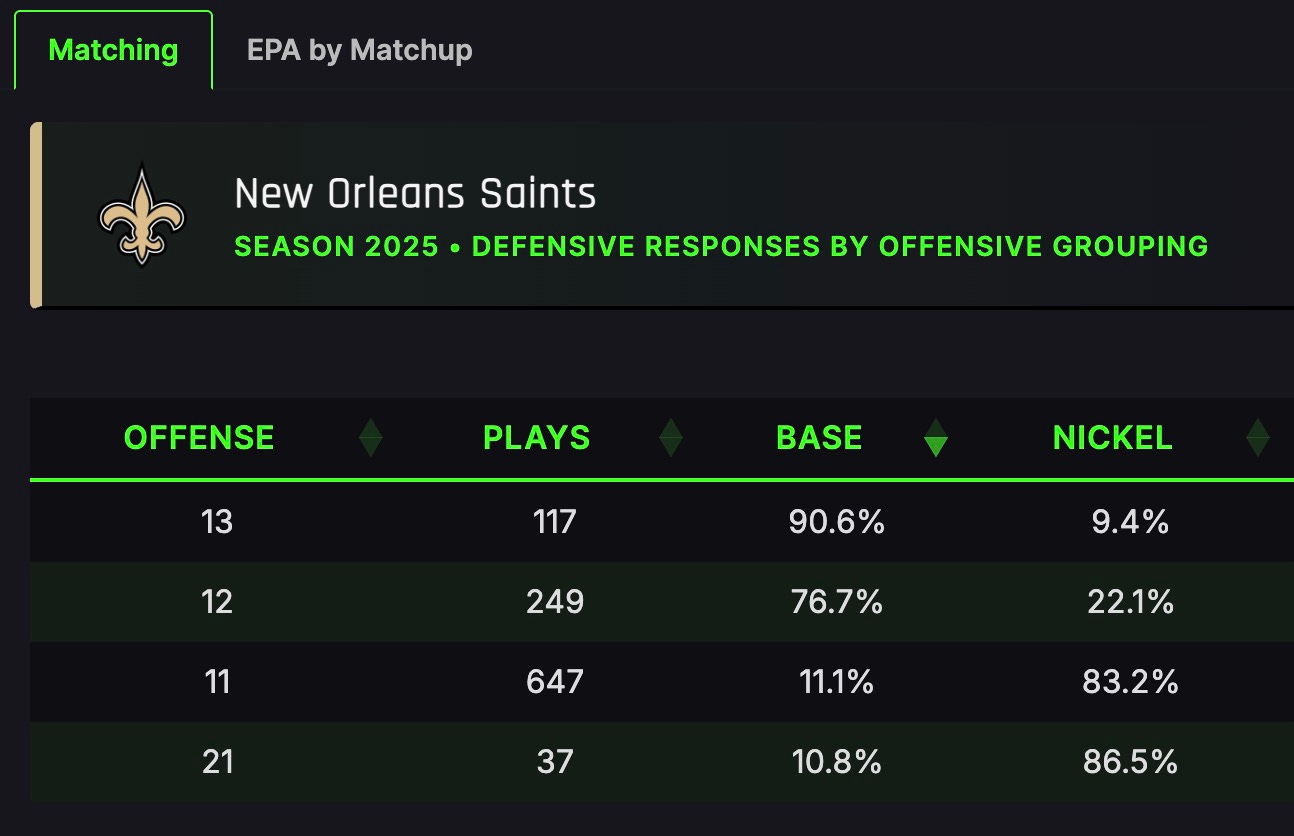
When teams used 11-personnel, the Saints mostly responded with Nickel. Alontae Taylor (Titans) moved inside, and rookie Quincy Riley took over at Field CB.
Against 12- and 13-personnel, Staley chose to stay in Base (3-4), a decision that runs counter to what NFL defenses typically want to do, as more teams look to live in Nickel. But for most teams, the problem is personnel; there just aren’t that many “Star” Nickels who can line up near the box and cover premium receivers in the slot.
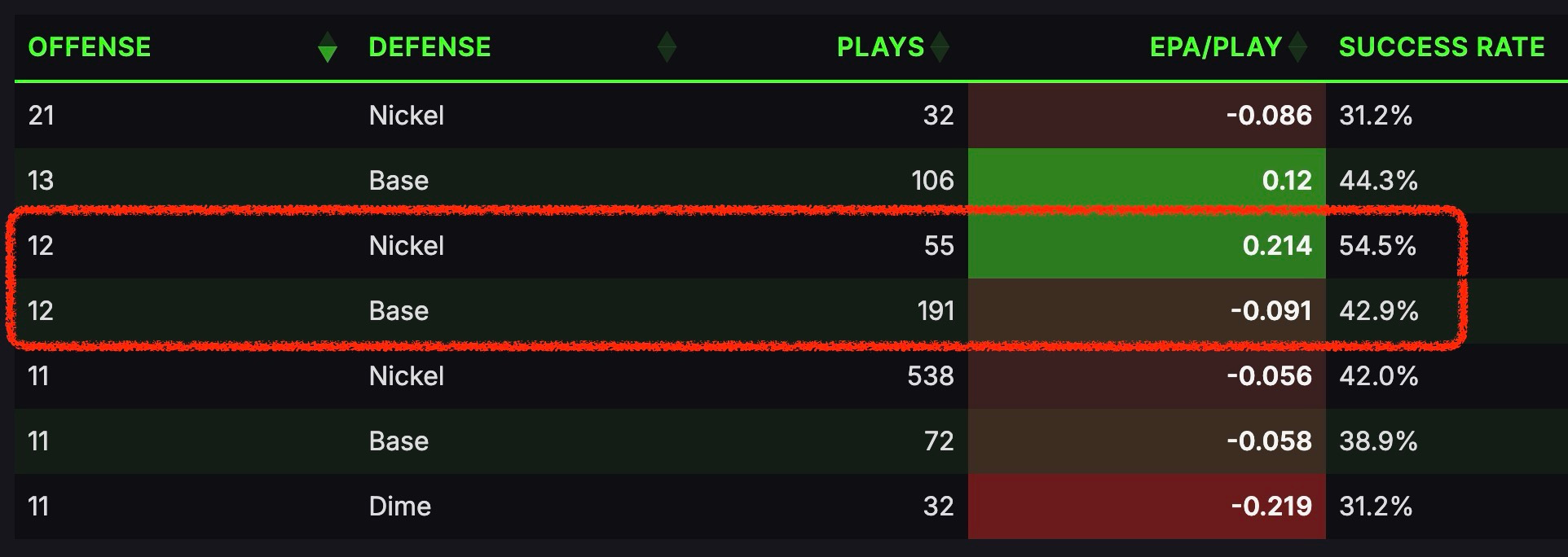
Staley used his Base personnel to counter early-down, heavy-personnel run games. For the Saints, the pivot to more “Base” was a stabilizing force against heavy personnel. Against 12-personnel, the difference in EPA/rush was wide when compared to Nickel. Staley wasn’t willing to pay that “Nickel Tax” often conceded by modern defenses.
Success Rate Allowed (+EPA%): 35.8% | Rank: 15th
Defensive Stops: 86 | Rank: 5th
Tackles for Loss or No Gain (TFL+NG): 24 | Rank: 5th (PFF)
While the overall run metrics hovered near the middle of the NFL, their execution metrics were elite due to the volume at which they played Base personnel. The Saints finished the season ranking fifth in Stops (zero or negative plays) and net TFLs. Being able to stop the run efficiently allowed Staley to focus more time on the coverage aspects of his defense, which are the literal engine of the system.
Defending the Pass
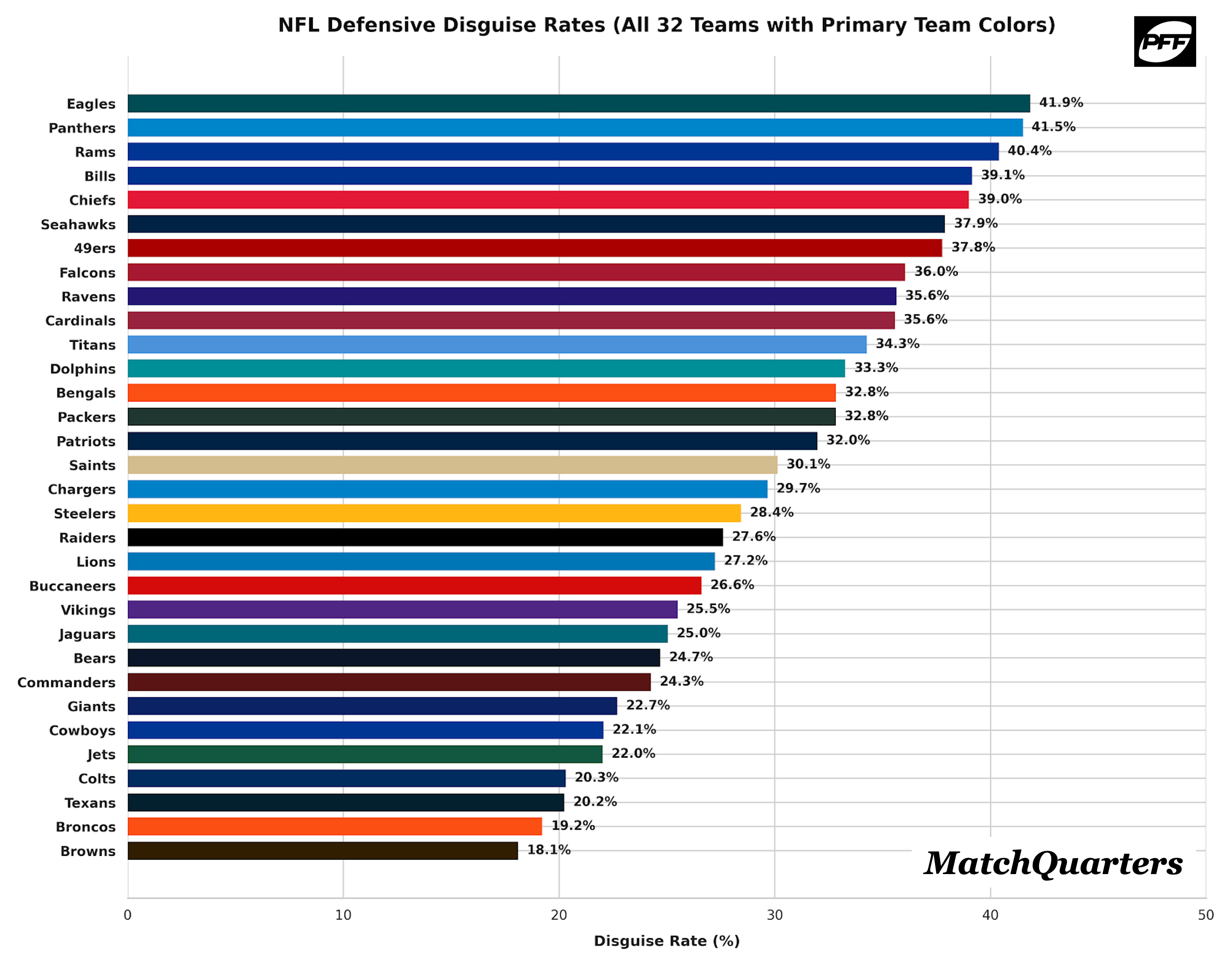
The Fangio coverage system is designed to counter the modern passing attacks across the league. The system focuses on playing from a two-high shell. The Eagles, Panthers, and Rams typically lead the league in disguised-coverage rates, with rates over 40% (PFF). All are “sister” schemes to the one in New Orleans.
Staley has branched away from this part of the Fangio scheme since being in LA, though. In his last season with the Chargers, he featured coverage disguises on only 26% of his snaps. The Panthers (61%), Rams (55%), and the Fangio-led Dolphins (39%) were all near or over 40% that season.
Still, split-field coverage is a major part of the defense and, along with Base, a growing early-down philosophical trend for countering heavy-personnel play-action passes across the NFL landscape. One of the Saints’ biggest bright spots this past season was their play-action pass efficiency, which this system was built to handle.
EPA/Play Allowed: -0.102 | Rank: 7th
Success Rate Allowed (+EPA%): 44.6% | Rank: 7th (PFF)
Play-action is the modern offense’s engine and accounts for roughly 55% of all passing plays against Base personnel. For context, among all early downs (1st/2nd), pure dropback passing accounts for ~65% of plays. Play-action versus Base defense also increases yards per reception (YPR) from 10.4 to 13.1.

Though play-action can increase efficiency, pure dropbacks still account for 45% of Base defensive snaps across the league. Offensive coordinators use heavy groupings to get defenses into Base because, for decades, that meant a reduced playbook, a pattern still reflected in efficiency numbers.
One of the main reasons “Fangio philosophies” have been exploding across the league is their ability to provide schematic fluidity, carrying calls throughout the system regardless of personnel. Staley was able to carry his “answers” for the modern passing attack and split-field coverage rotations in his Base defense, making it one of the league’s better units against even dropback passing.
EPA/Play Allowed: -0.022 | Rank: 6th
Passer Rating Allowed: 84.9 | Rank: 5th (PFF)
Though the Saints allowed a higher completion rate (~78%/16th) and also ranked 16th in Success Rate, the defense rated in or near the top five in both EPA/play and Passer Rating. Staley was able to utilize his extensive split-field coverage toolbox to cap vertical explosives and layer the intermediate passing zones. The young secondary got better over the season, finishing fifth in EPA/dropback in the second half of the season (RBSDM).

A Two-High Base
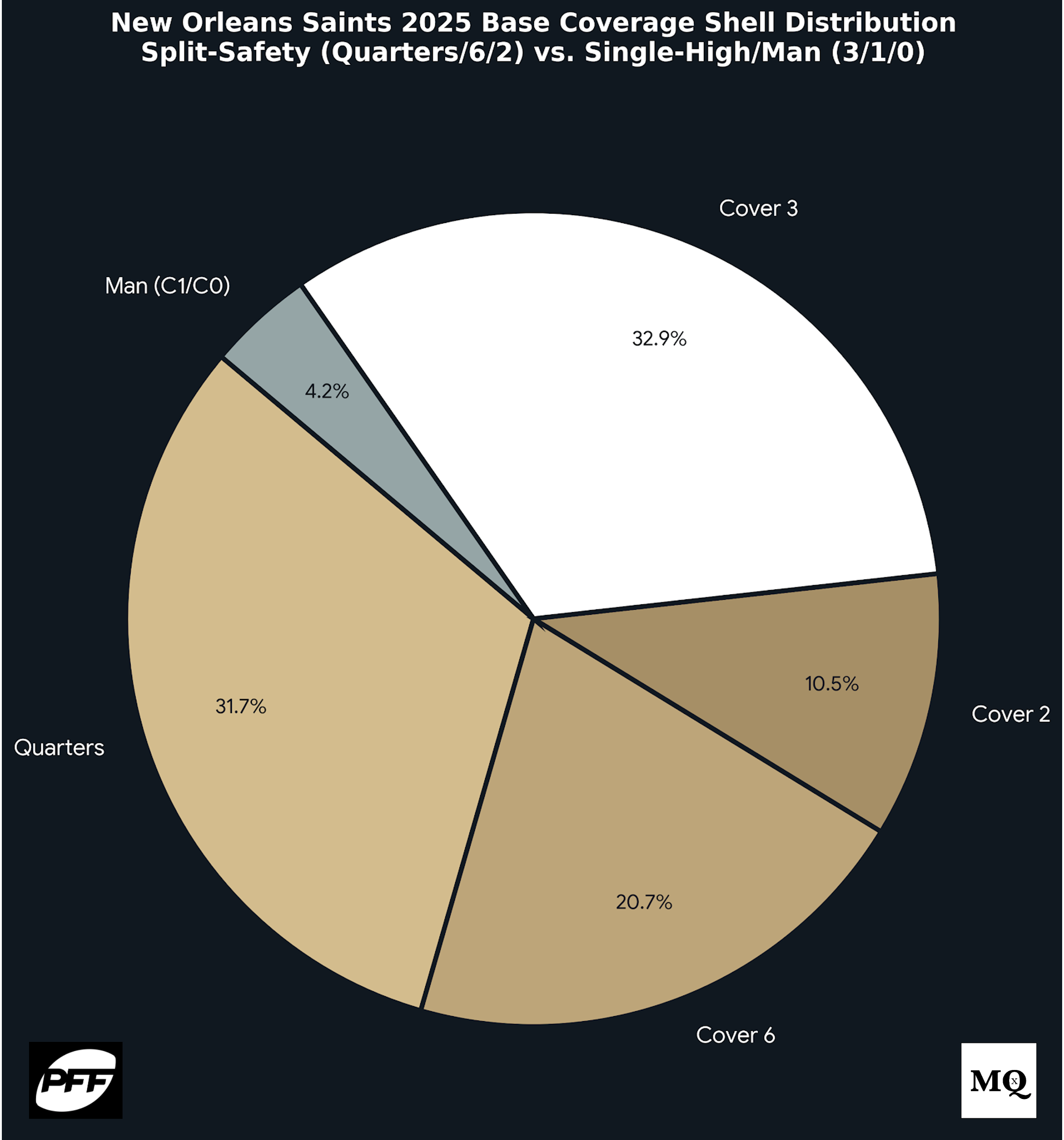
Cover 3 was the dominant scheme in the NFL when playing Base, accounting for ~43% of all snaps. The Saints limited their Cover 3 usage to a third of their plays, utilizing Quarters and Cover 3 at similar rates. In fact, New Orleans Quarters usage was almost double the league average (17%).
Man coverage was only ~4% of their total Base personnel play calls, meaning split-field coverages accounted for 63% of their calls when in Base defense. For context, the league average for split-field coverages in Base was 40%.
The Saints’ ability to carry split-field coverages in Base is a rising trend in the NFL, and Staley is at the forefront. Compared to Nickel, the Saints’ usage of two-high coverages plummeted when a fifth DB was introduced (26%). With more DBs on the field, Staley felt more comfortable “matching” routes and isolating his secondary.
Coach’s Note: Quarters rates across the league have leveled off, but that doesn’t mean usage is shrinking. More NFL teams are dabbling in Cover 6/8 rotations, and Quarters, as a coverage, is being shifted into a larger role in early-down Base philosophies.
Split-field coverages are being used more on early downs to counter the play-action meta, and match Quarters schemes allow defenses to still fit the run while creating backstops in the high intermediate. Cover 6 allows the defense to “zone double” primary receivers in 12- and 13-personnel.
Heavy use of split-field coverages allowed the Saints to maintain excellent pass efficiency regardless of the pass concept. New Orleans was able to clog the intermediate windows that modern offenses feast on in their heavy personnel play-action passing concepts.
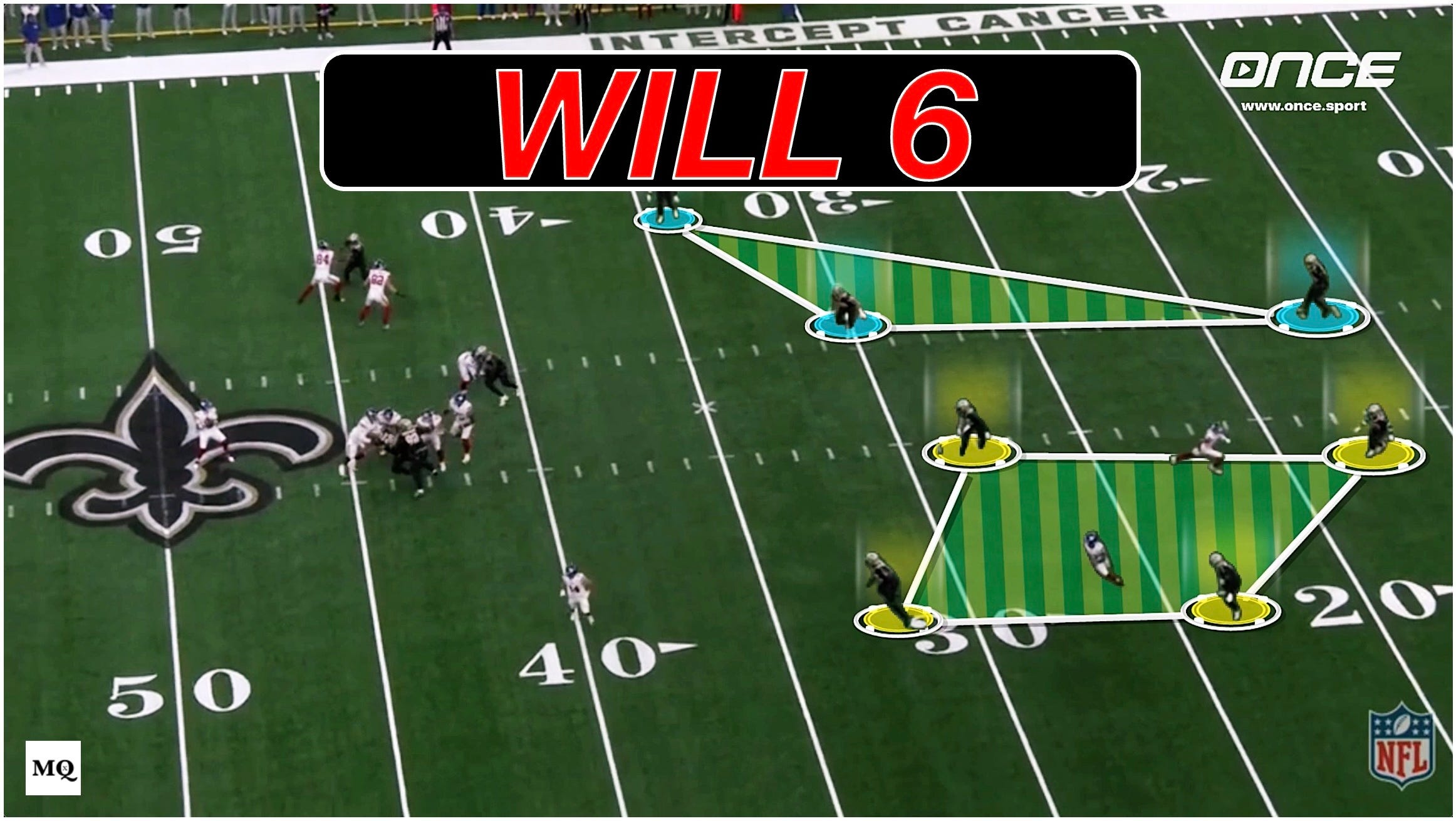
The foundation for this structure lies in their “Will 6” rotational scheme, which uses boundary reduction and Cover 6 or Quarter-Quarter-Half coverage to blanket the offense, while also providing adequate run support. Let’s dive into the tape!
—
Below the line, I break down exactly how Brandon Staley protected his 3-4 front from early-down play-action concepts without sacrificing run fits. Unlock the full article to access:
The schematic rules of the “Will 6” toolbox (boundary reduction, Cover 6, and Quarter-Quarter-Half mechanics).
The exclusive film room features 3 pass distributions and 2 run fits.

