

Saban System: Cover 7 Concepts and Rules
A Breakdown of the Man-Match Principles, Key Calls, and Adjustments

One of the most comprehensive coverages in all of football is the Saban Cover 7 man-match split-field system. That seems like word salad, but it is a living, breathing system with built-in answers to almost anything an offense can throw at it.
The Saban system is notoriously difficult; ask any coach who has been in it, and they will tell you it generally takes four to five years to master. The Cover 7 system, specifically, is Saban’s way of defending modern spread formations through man-match principles. Man-match coverage is a hybrid defense in which players have initial zone assignments but switch to man-to-man coverage based on the receivers' routes.
‘Pattern matching’ is coach-speak for this concept, meaning defenders are taught to recognize and match up against offensive route combinations. Players follow a precise set of rules to establish these matchups across the field. There are Quarters and Cover 2 elements built in, but each coverage can have slight tweaks to its responsibilities.
While many coaches use pattern matching, most systems outside Saban's rely on zone matching principles. In zone-matching, defenders react similarly at the start of the play but ultimately do not lock onto receivers across the field or on deep vertical routes. Typically, only the Corners and Safeties end up in man-to-man, and only against routes that attack over the top of the underneath defenders.
At the other end of the spectrum are pure zone, or ‘country,’ coverages. In these basic concepts, players drop to a designated spot on the field and react to the quarterback's vision, a practice known in coaching circles as “defending grass.” In zone-matching schemes, defenders will match receivers to a point, then fall off and play through the vision of the quarterback’s eyes.
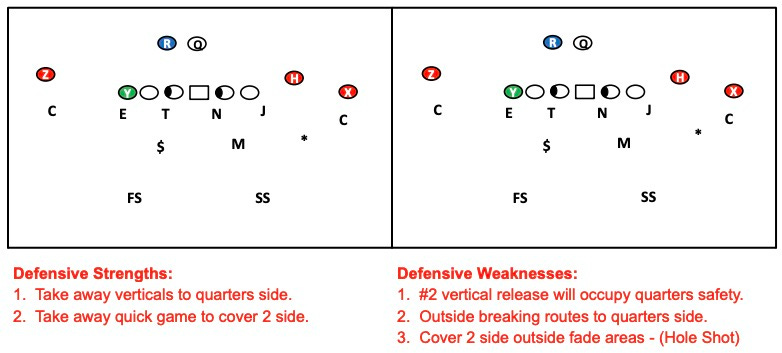
There are strengths and weaknesses in all these philosophies. For example, one of the main issues with Cover 7 is that defenders play man-to-man at times. Defensive lines have to be very aware of their rush lanes. Against running quarterbacks, the underneath defenders can have their backs turned and miss a scramble. Ultimately, Cover 7 can (and will) turn into a quasi-2-man, leaving the defense vulnerable.
Recently, Cover 8 concepts, such as Seahawk, have become more popular as offenses increasingly use condensed formations, motion, and mobile quarterbacks. In Saban's terminology, Cover 7 is known as the man-match coverage system, while Cover 8 involves zone-match principles. Below are brief overviews to help you understand how the Cover 7 system is designed and the most important (and popular) calls within it.
Coach's Note: This guide is built on information sourced directly from coaches with experience in Nick Saban's defensive system. While coaches who have branched off from the Saban tree may use slightly different terminology or variations, the following breakdowns not only distill the foundational principles of the Cover 7 system but also illustrate them using diagrams sourced directly from the system.
—
