


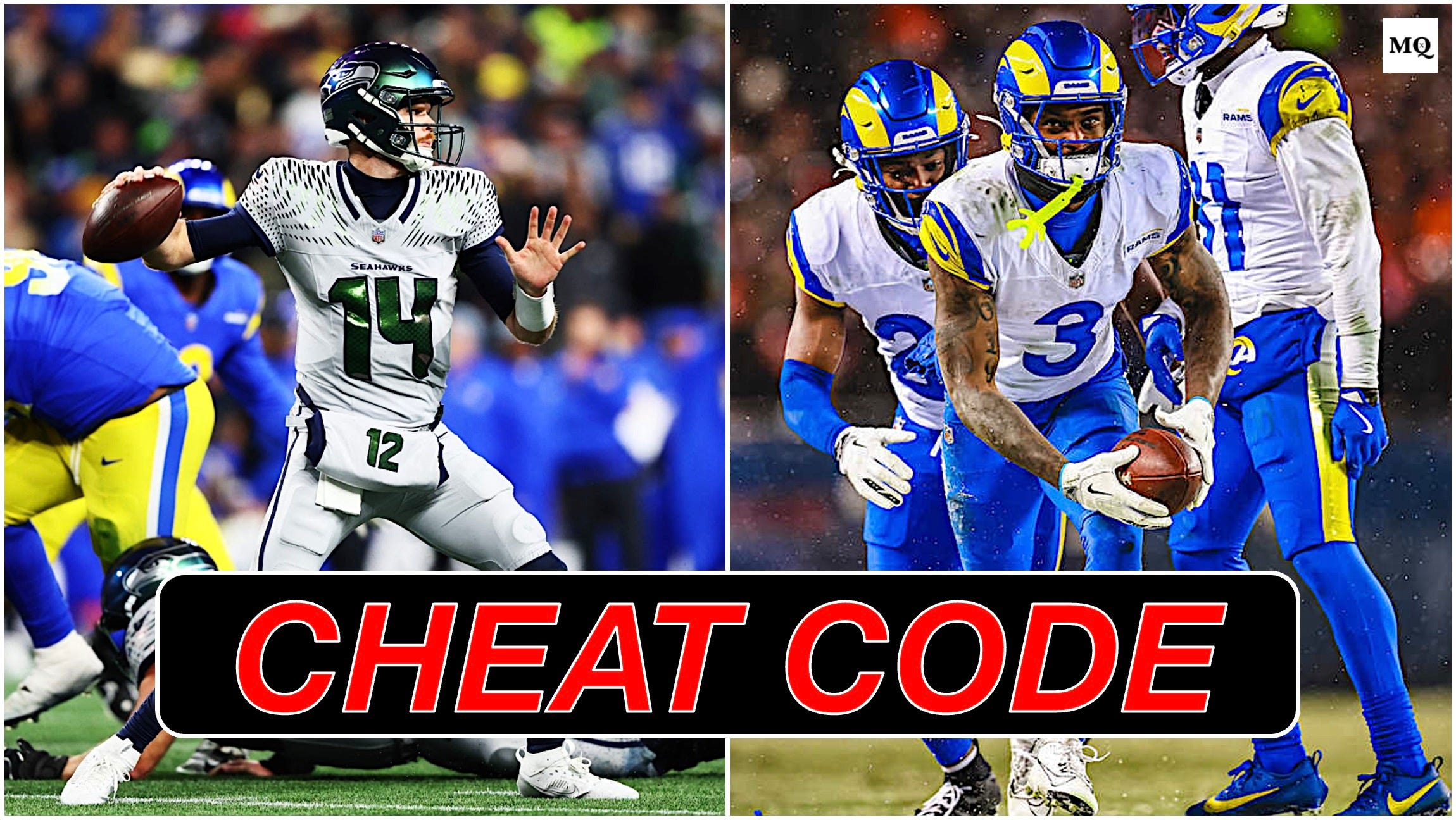
Turn Sam Darnold into a pocket passer, and the Rams likely win the game.
The cliche that the NFL playoffs are a completely different season is there for a reason. For the entire season, the Rams led the NFL in stunt usage (~30%) while fully leaning on their talented defensive line. During the season, the Rams posted a Blitz Rate of 25%, ranking 24th in the league and below the league average. Their early down (1st/2nd) Blitz Rates were even lower (~22%).
For the playoffs, Carolina and Chicago spent much of their time preparing for the movement up front. But when LA arrived in Charlotte, they changed their DNA in a critical way.
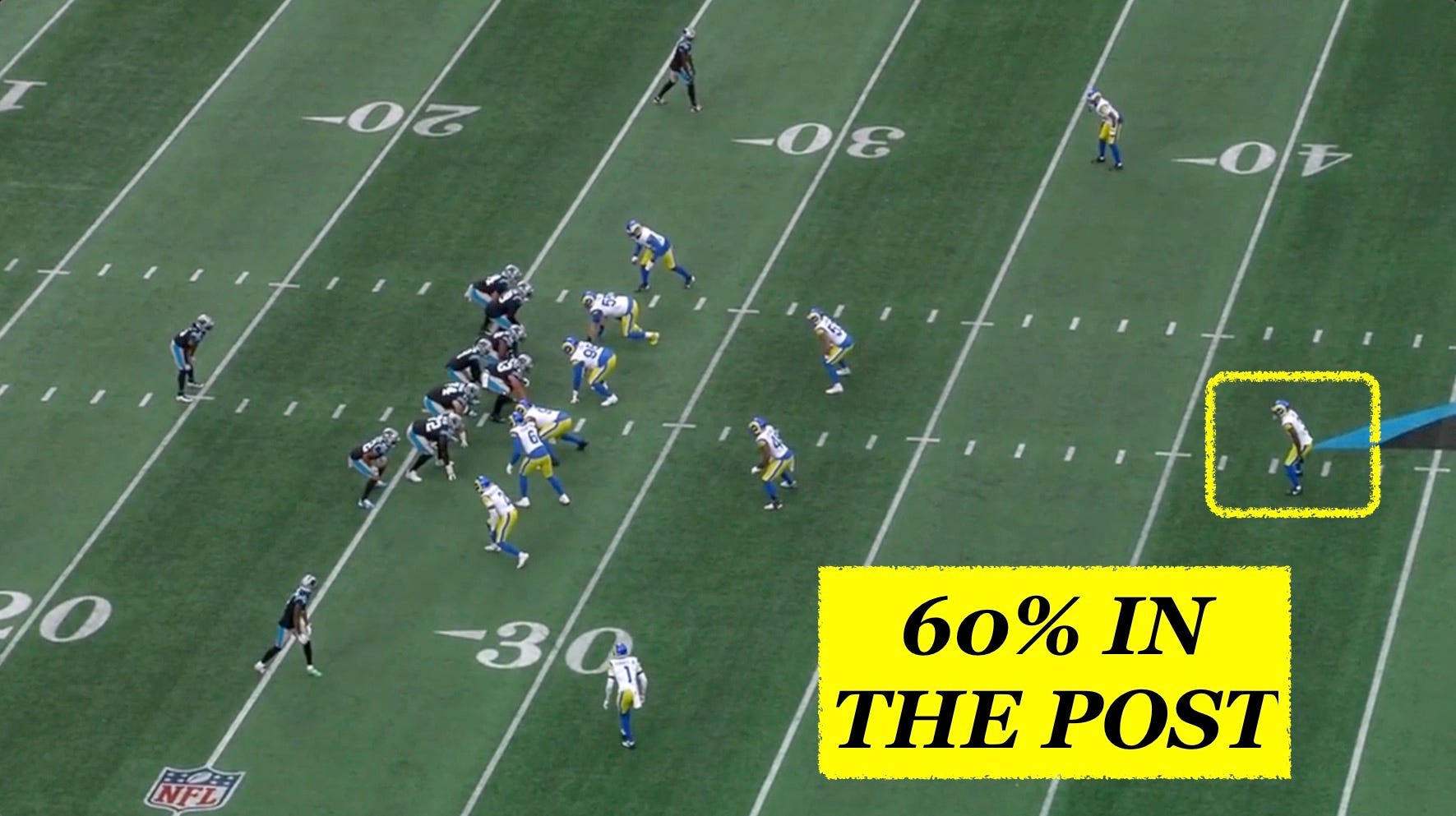
During the regular season, Safety Kamren Curl (3) aligned in the Post on about ~60% of his plays; he was the de facto Center Field Safety. In the playoffs, the Rams shifted his alignment more towards the box, with a 50/50 split.
Curl has had a monster playoff run, finishing with a team-leading 13 tackles against Chicago. He even secured the game-winning interception from his typical Center Field position (above).
Playoff Stat Line: 23 tkls, 1.5 STFs, 1 INT, & 2 PBUs
Against both the Panthers and Bears, LA’s blitz numbers increased, but there was nuance. During the second half of the Panthers game, Shula began to apply more pressure, primarily with Curl near the box. Against the Bears, he did the opposite, heating up Caleb Williams in the first half, then peeling back the pressure as the game went on.
Still, in both games, the Blitz Rates rose to around 30% against Carolina and 27% against Chicago. One of the targeted ways they have utilized Curl in the playoffs is his ability to blitz from the box. Shula essentially began using Curl as an assassin, sent to attack specific schemes.
Against the Panthers (above), this meant attacking the edges of the box on 1st Downs, accelerating Bryce Young’s reads in play-action, and attacking RPOs. In the Divisional round, the Rams shifted their blitz focus to 2nd Down to accelerate the clock for Caleb Williams in an attempt to force long 3rd Downs.
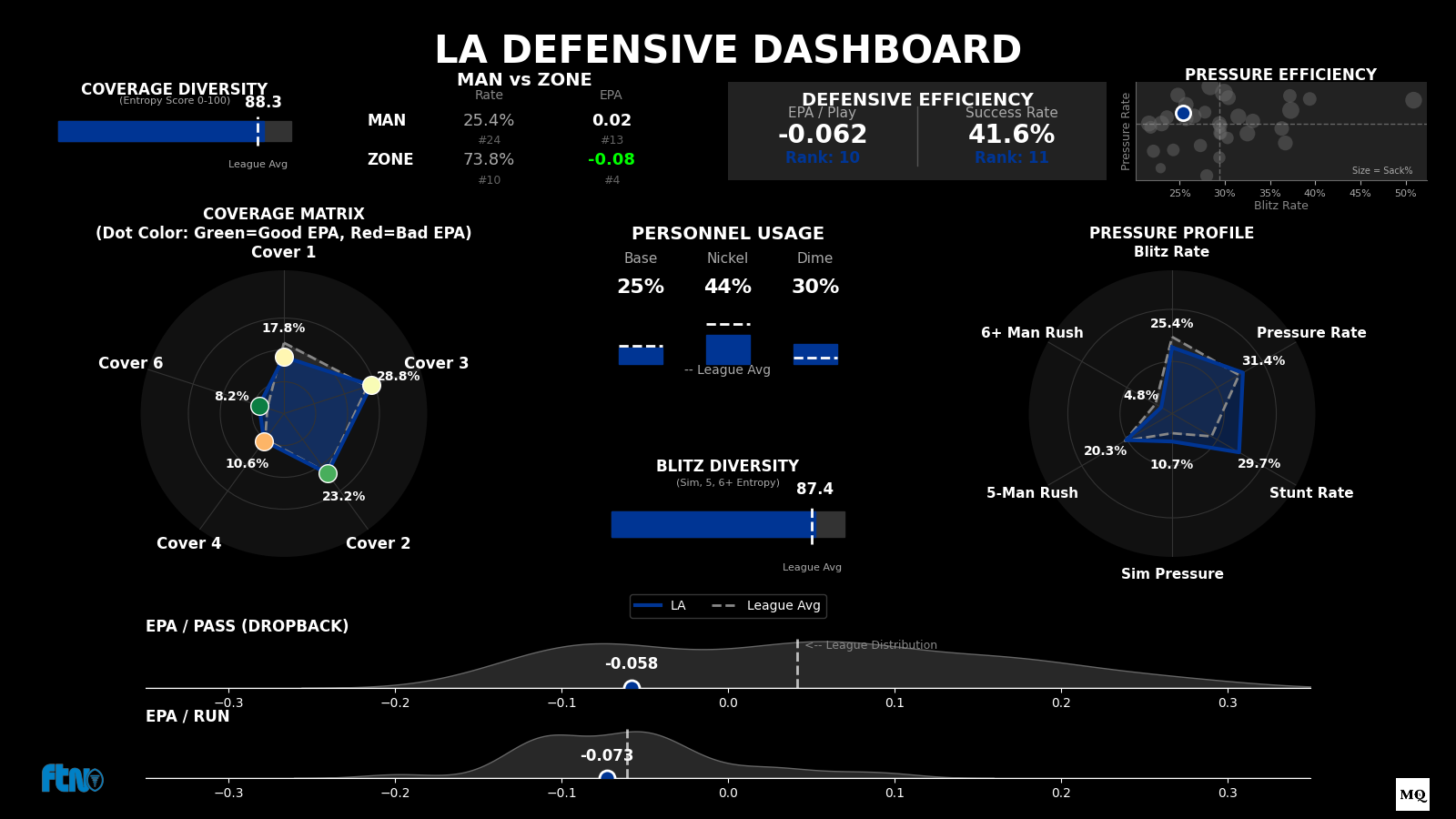
Though the pressure menu (and frequency) have changed in the playoffs, the defense's structure has not. With Quenton Lake, LA’s Nickel, back from injury, the Rams have leaned back into using Dime, a grouping they led the league in usage (~30%) and prior to Lake’s injury in mid-November had been as high as 35%.
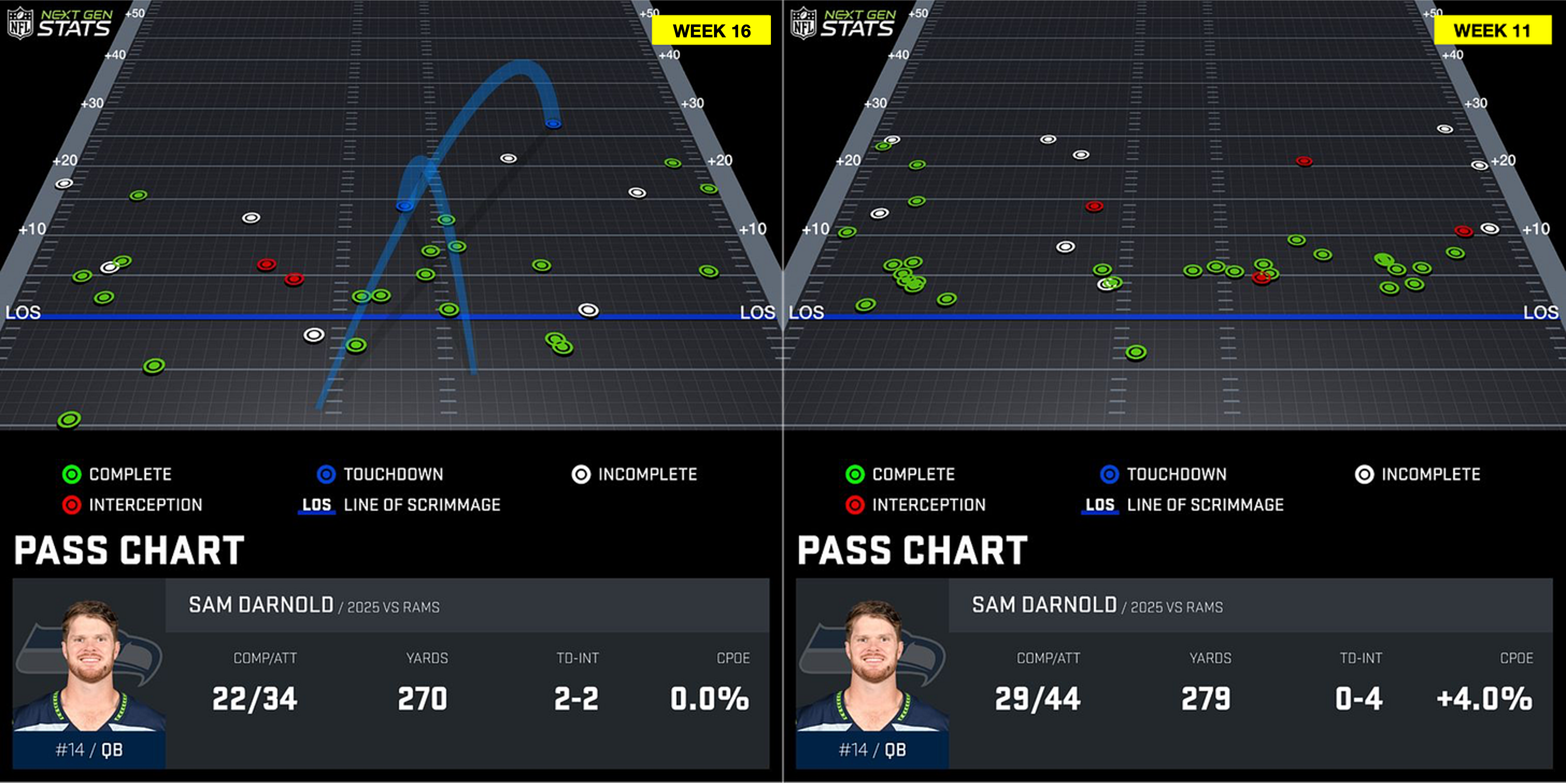
It would be easy to argue that the Rams will return to their previous game plans against Sam Darnold, who has thrown 6 interceptions in their two meetings. In the first game, Shula used coverage disguises to force Darnold to hold onto the ball. The Rams Blitz Rate fell to 13%, well below their season average.
Shula focused more on playing Cover 1 on 1st Down to create tighter windows for Darnold to throw into. Incompletions led to longer 2nd Downs, allowing the Rams’ elite front to pin their ears back.
On 2nd Down, Shula pivoted to his Cover 6 calls, placing the zone-double (Cover 2) on Jaxson Smith-Njigba (JSN). The Fangio-style split-field coverage rotations were a staple in both games against Seattle.
On 3rd Down, and especially near the Red Zone, Shula ran more max blitzes (Cover 0) or Cover 2 in the open field to either accelerate his internal clock or force the quarterback into a check down. Darnold would throw four total picks, and LA won the game.
In Week 16, the Rams picked up the Blitz Rate (20%) and played much more Cover 3 on 1st Down. The 2nd Down game plan was still consistent, and Shula again leaned into the “Hot or Cold” schemes on 3rd Down (above). Darnold threw two second-half interceptions, but the Seattle offense was able to pull out a victory in overtime to win the game.
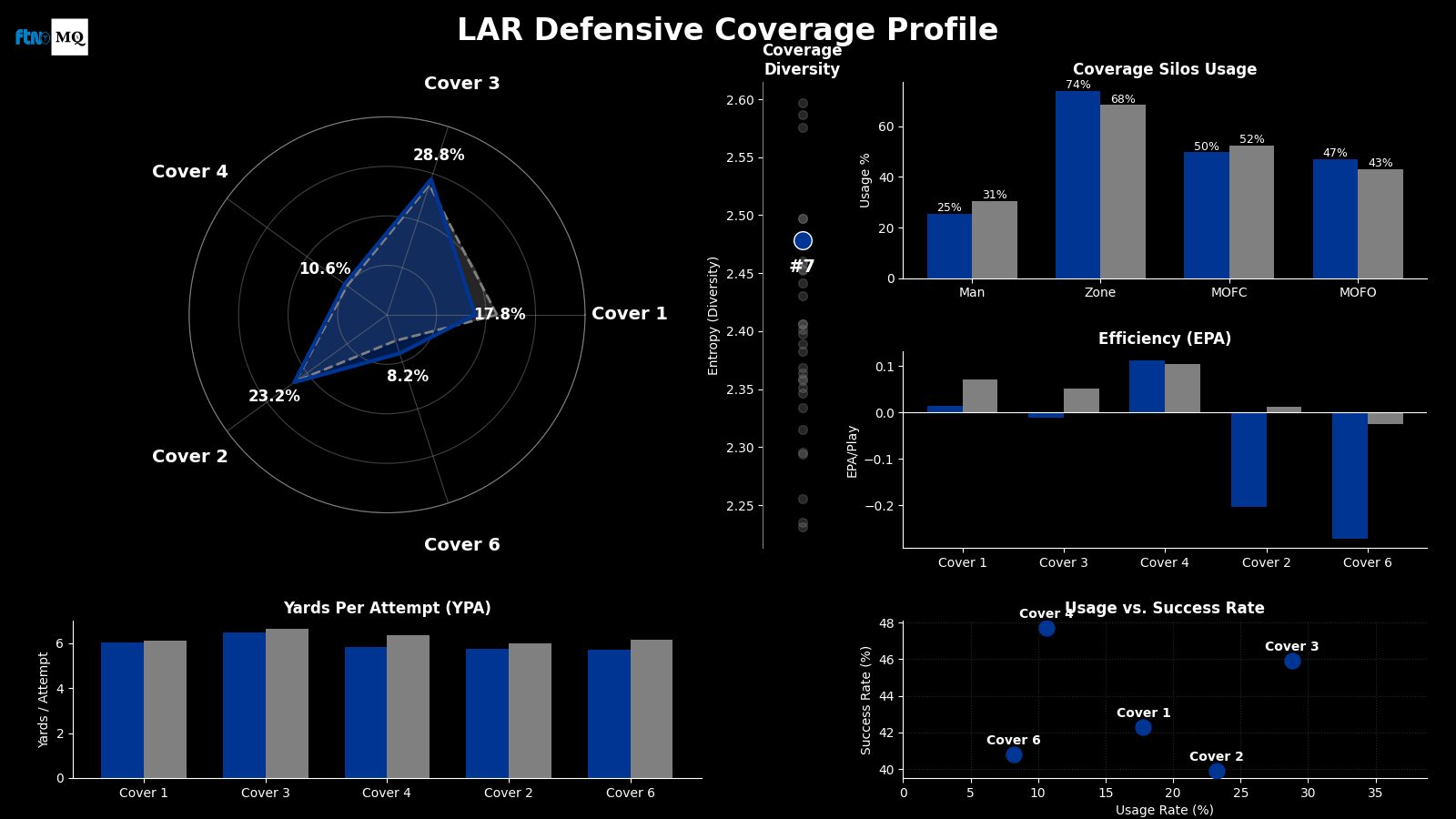
In both games, Shula abandoned his balanced coverage and pressure approach to “attack” the early down tendencies of the Seahawks. In Week 11, it was man coverage and stacking the box with numbers; in Week 16, it was more passive, with heavy doses of Cover 3, but the box was still loaded with bodies.
Shula’s pivot to use “passive pressure” in the form of coverage disguise to affect Sam Darnold worked—and the data suggests they were right to change their tendencies. Shula was specifically trying to avoid a statistical anomaly that makes Darnold one of the best quarterbacks in the NFL.
When the Seahawks run play-action against a blitz, Darnold becomes a cheat code of sorts. In those specific situations, he averages a league-leading 13.7 yards per attempt and posts an EPA nearly four times higher than his standard dropback.
When coordinators bring the heat, they leave voids behind the linebackers; if Darnold fakes the run, he holds those backers long enough to hit those deeper openings in the intermediate for massive chunks. This is the engine of this offense, fueled by JSN.
Afraid of these explosives, Shula shrank his blitz rates in the regular season. But this created a different problem. By sitting back in coverage, the Rams forced Darnold to take the underneath options or hold onto the ball, where he averaged a pedestrian 6.1 yards per attempt on play-action; they died a slow death.
In Week 11, the passive approach worked; in Week 16, it came back to bite them, allowing Seattle to climb back into the game and eventually win.
This is the dilemma in Round 3: Do you blitz and risk the 13.7 YPA explosion? Or do you sit back and die a slow death by 6.1 YPA efficiency?

