

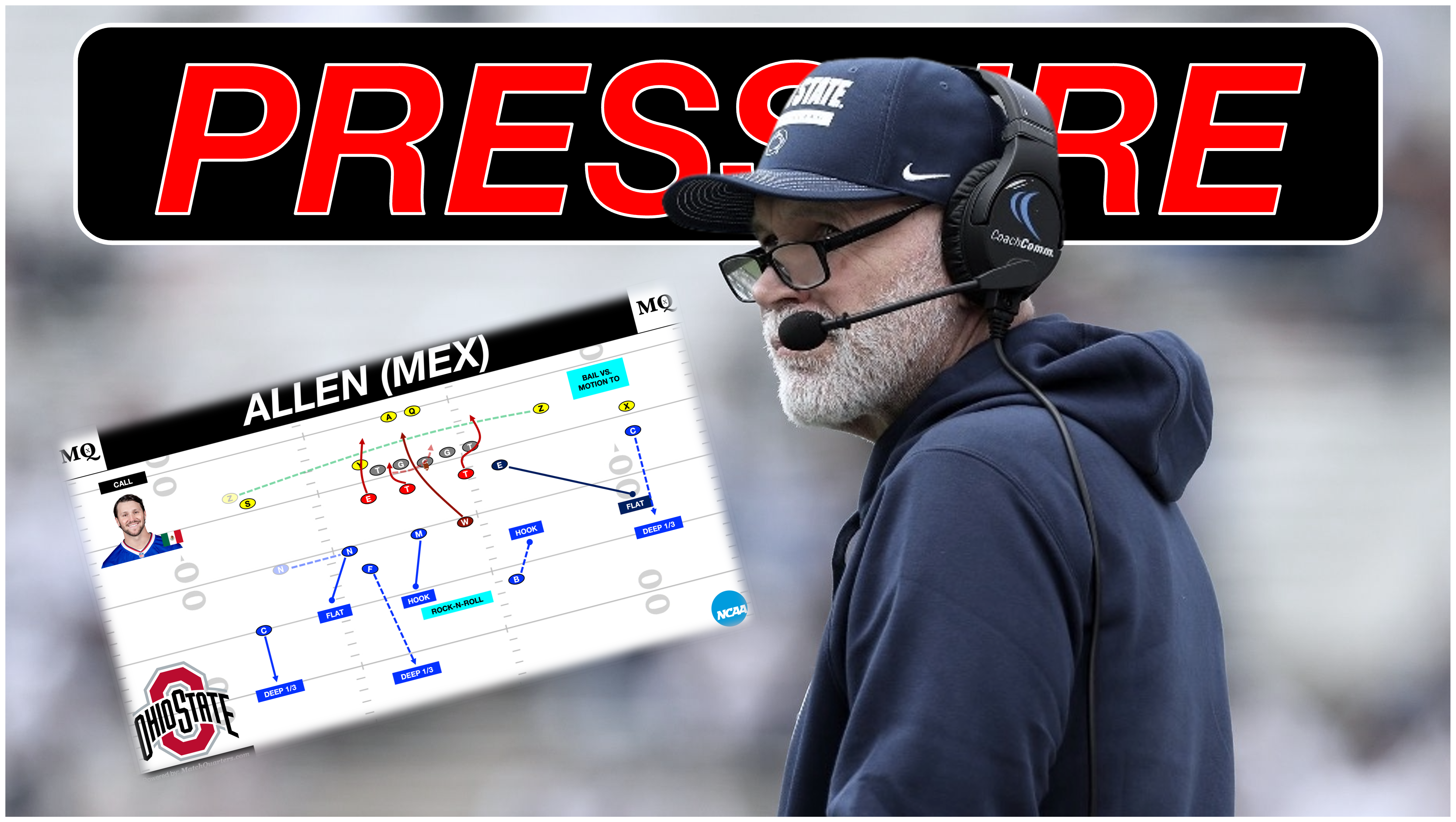
Jim Knowles, who bolted for State College, devised one of the more unique schemes in college football during his time with Ohio State. The four-down (“normal”) three-high (not-normal) system over the past three seasons has set the coaching world and schematic nerd community on fire. Since 2018, the college ranks have seen an explosion in Tite Front and Odd Stack structures, but what Knowles was doing in Columbus was different.

At Oklahoma State, like many defensive coordinators who wade into the offensive waters of the Big 12, he morphed his defense into an Odd Front-based 3-High system. But the defense was unlike the Iowa State clones that were popping up across the country.
Ironically, it was Glenn Spencer who first tried the four-down three-high structure in Stillwater that Knowles would become famous for. Knowles was a 4-2-5 coach before moving to Oklahoma State, but the schedule and offensive variety in the Big 12 forced him (as well as others) to lean into the Odd Stack culture being built in the conference.
Knowles’ Leo package (Jack Sawyer played the moving 3 technique for the Buckeyes) created four-down fronts, but used an Odd alignment pre-snap. The same ‘flex’ front mechanics have been used by other successful teams like the Marcus Freeman-led (Notre Dame) Cincinnati defenses.
When needing to get into four-down fronts against bigger sets. Knowles would move his Leo into a traditional ‘Jack’ alignment and play a Bench or Under Front (above). More than anything, Knowles wants to be multiple. Typically, this term, multiple, is part of an introductory soliloquy by most coordinators. Knowles means it.

In a preseason press conference in early August, Knowles expanded on why his scheme is deemed ‘complex’:
“I think in today's game of football, it needs to be somewhat complicated because you need to have answers for everything… particularly at this level. Offenses don't run the same things in college… which is more in the NFL they do. So you better have all different kinds of answers.
College football is different from the NFL. Currently, in the NFL, you have the Shannahan-McVay tree that accumulates for nine of the current head coaches in the league. That’s almost a third of the league! The hashes are also very narrow, making the entire game played in the middle of the field. Offenses don’t have an advantage in the league by playing with formation alignment into the boundary (FIB) or width.
At the FBS level, there are numerous different iterations of all systems. What Ohio State saw from Texas (Sark is very similar to McDaniel in Miami) was completely different from the system they saw from Tennessee (Briles-adjacent) and Oregon (a derivative of Chad Morris/Clemson). Sure, they are all collegiate ‘spread’ systems, but each one does something completely different.
Knowles has built his scheme around being able to answer those problems with different tools in his toolbox. Against Penn State, which uses TEs and a more spread-to-run mentality, the Buckeyes ran more of a traditional 4-2-5 defense.
Against Oregon, and their version of the Air Raid, Knowles used more Odd Stack and Three-High alignments on passing downs. Versus Notre Dame, it was the Bench Front (3 technique to the boundary) and internal pressures.
Throughout the season, Knowles highlighted his ability to change the structure. Ultimately, the complexity is what led to him falling out of favor with head coach Ryan Day. Once Knowles moved on to Penn State, Day quickly hired Bill Belichick disciple Matt Patricia (and Josh Boyer to be an analyst), rewinding the clock on the Buckeyes' defense back to the Urban Meyer days of four-down Cover 1-dominant defenses.
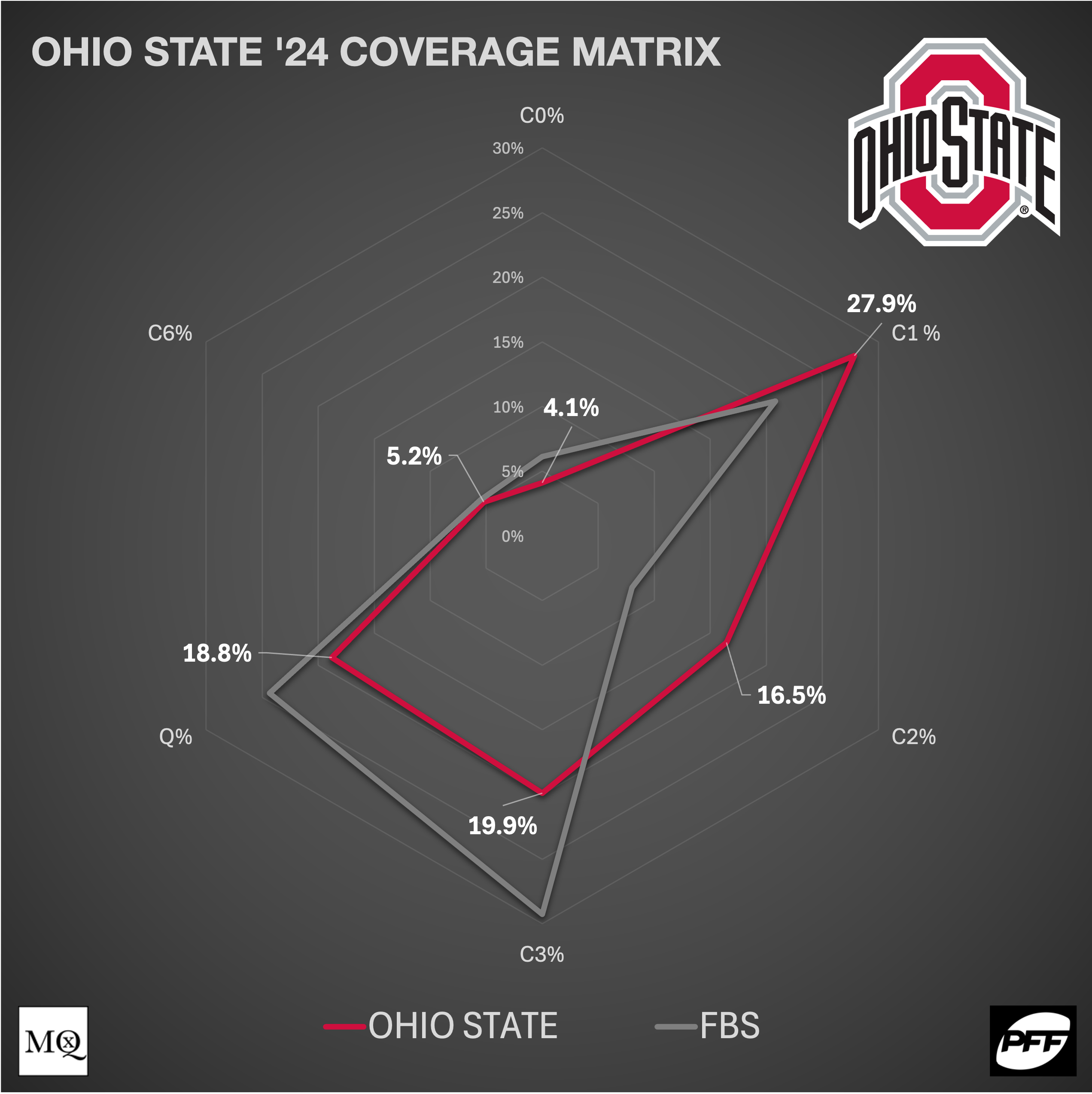
For the most part, Knowles still ran Cover 1 frequently. However, the Buckeyes ranked only 38th in the FBS for man coverage usage overall. Ohio State was 27th in Cover 1 usage, and near the middle in almost everything else. Though the ~28% Cover 1 usage seems high, there are comparable usage percentages for Cover 2 (Tampa), Cover 3, and Quarters. In short, Knowles truly is, and wants to be, multiple.

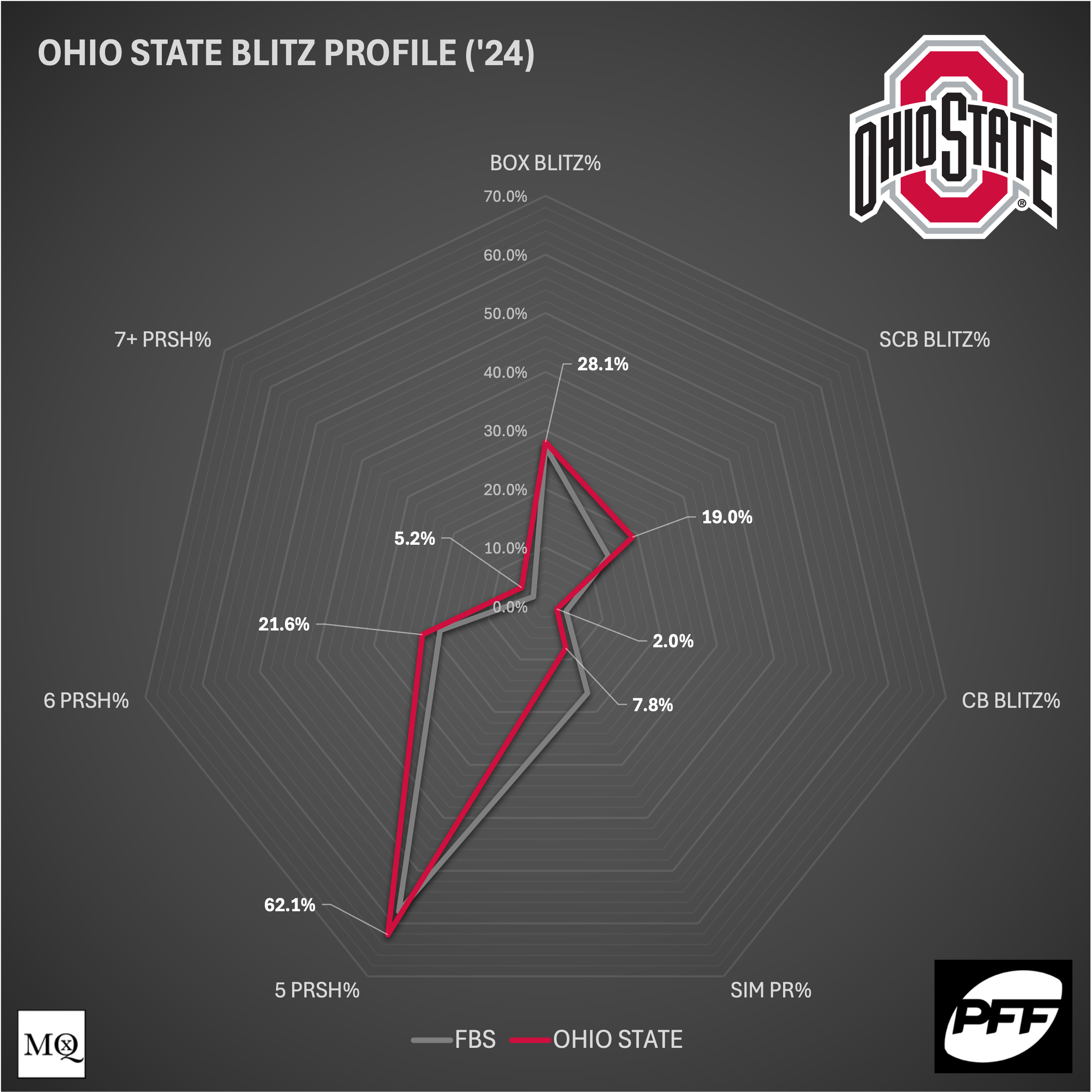
For all the fanfare surrounding the National Champion, Ohio State Buckeyes’ defensive scheme, the blitz menu is not typically towards the top of the list. Though the Buckeyes’ Blitz Rate is relatively high, 15th in the Power 4 at 37%, the concepts are not exotic. The structures may be different from week to week, but the pressure paths remained relatively simple.
Ohio State was 99th in simulated pressure (Sim) usage. They were 98th in CB blitz usage. Knowles, with three excellent safeties, blitzed the Slot defender at a relatively high amount, finishing 30th in Slot Blitz Rate (19%). Nothing exotic.
One of Knowles’ favorite pressures from the 2024 season has become one of the more popular paths at both the FBS and NFL levels. Offense is going through a ‘zone’ era on both offense and defense. The standard NCAA play is still 11 personnel Y-Off Split Zone.
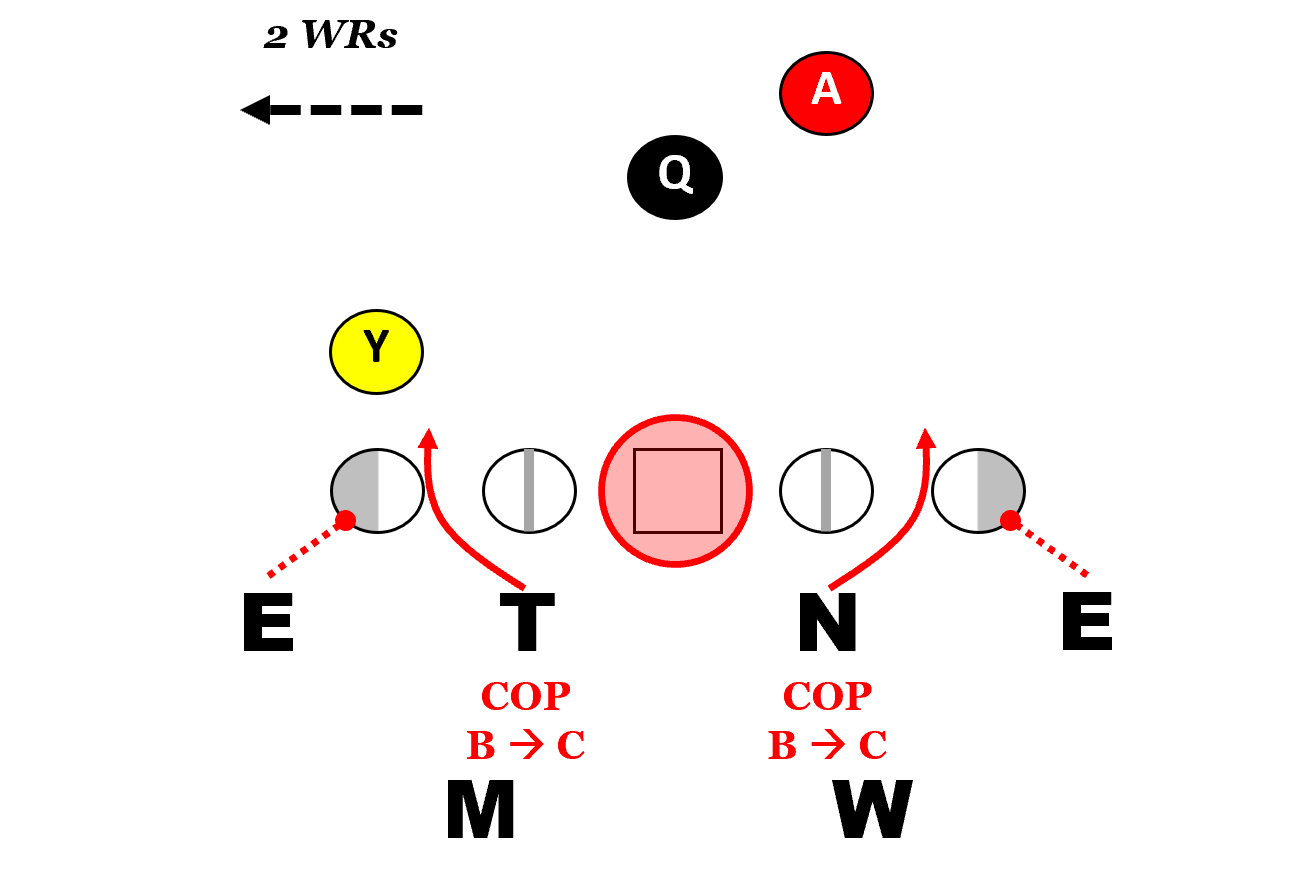
The top run concept at the college level has been inside zone and its variations for quite some time. Though the NFL is more varied, there is still a large chunk of runs coming from the zone variations. One of the easiest ways to attack these schemes is to ‘float’ the Center (above).
In zone, the Center has to choose one way or the other to go. By moving both interior linemen out into the B-gaps, the Center now has to chase or climb. Sending pressure across the Center’s face can assist in funneling the RB or getting a run-through for a tackle for loss.
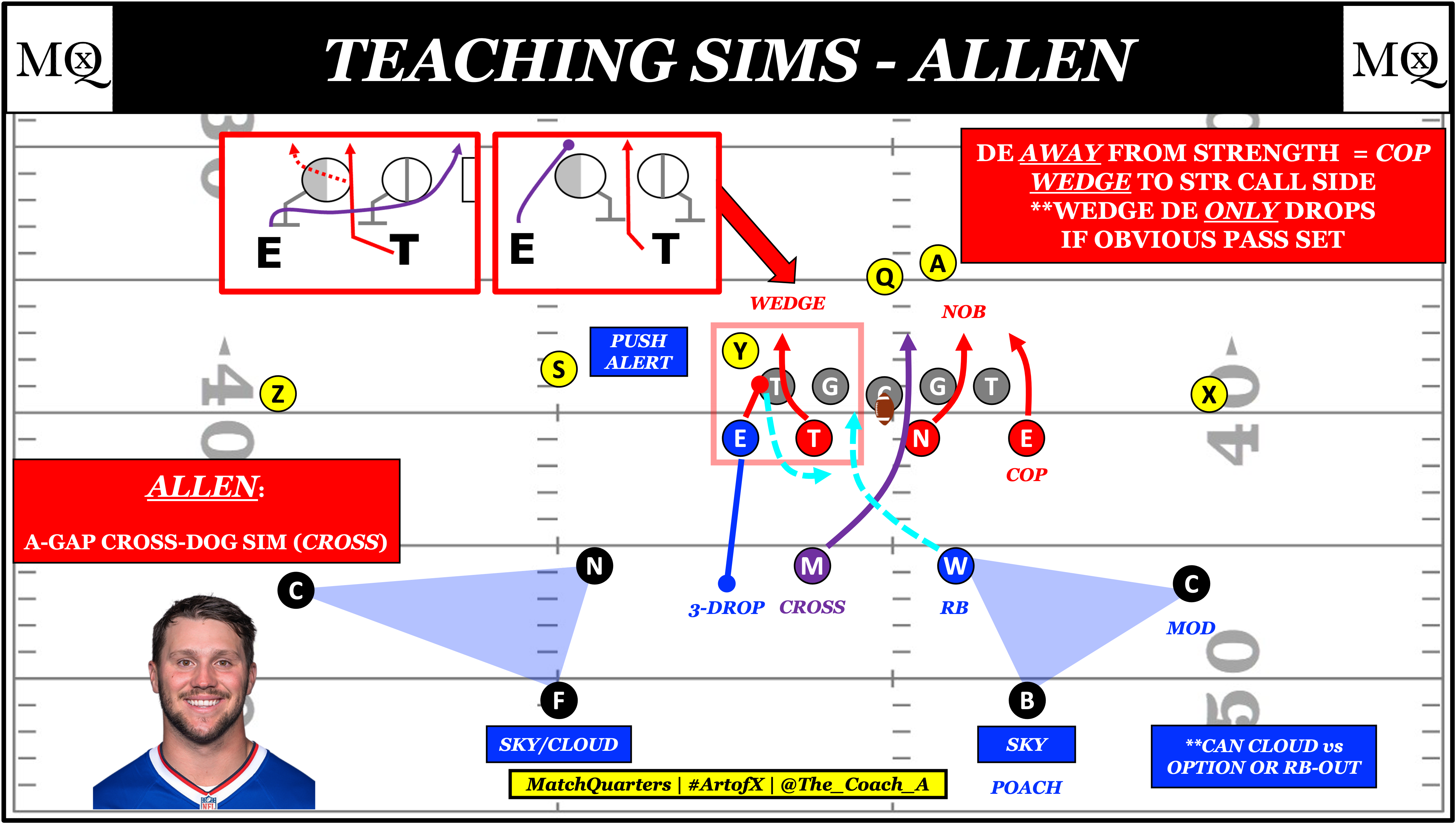
A popular pressure that has begun to pop up everywhere is one that I refer to as Allen. The internal off-ball simulated pressure allows the defense to attack the Center with a Cross (V-Tech) path by the LB opposite the RB. In ‘gun’ runs, the Center determines the run scheme. If he works away from the RB, it is typically a zone. If he works back to the RB (down block), it is usually a gap scheme or Insert (man blocking).
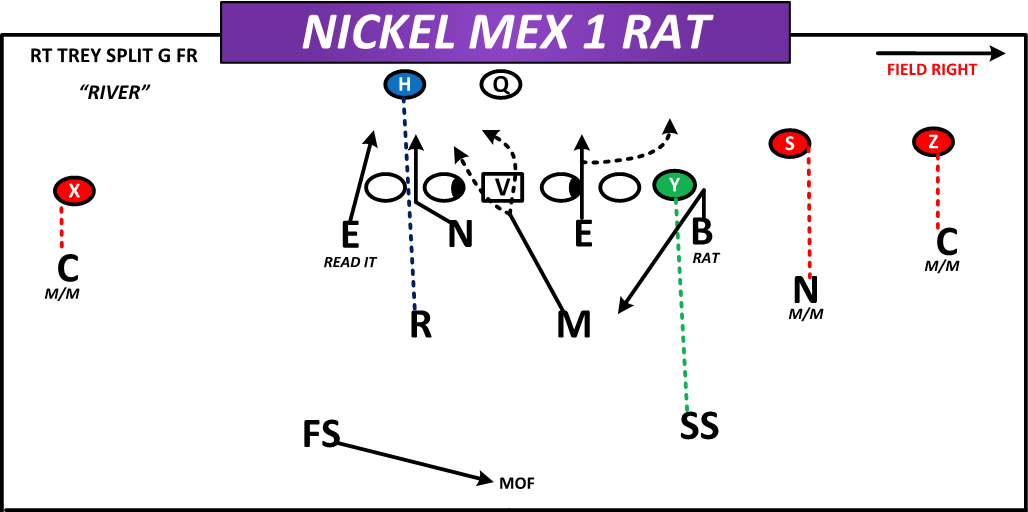
The pressure is featured in many four-down playbooks; above is Mex from the Aranda tree. Some coaches, like Alabama’s Kane Womack, prefer to run the blitz to the RB, and ‘chase’ the Center (below).
