


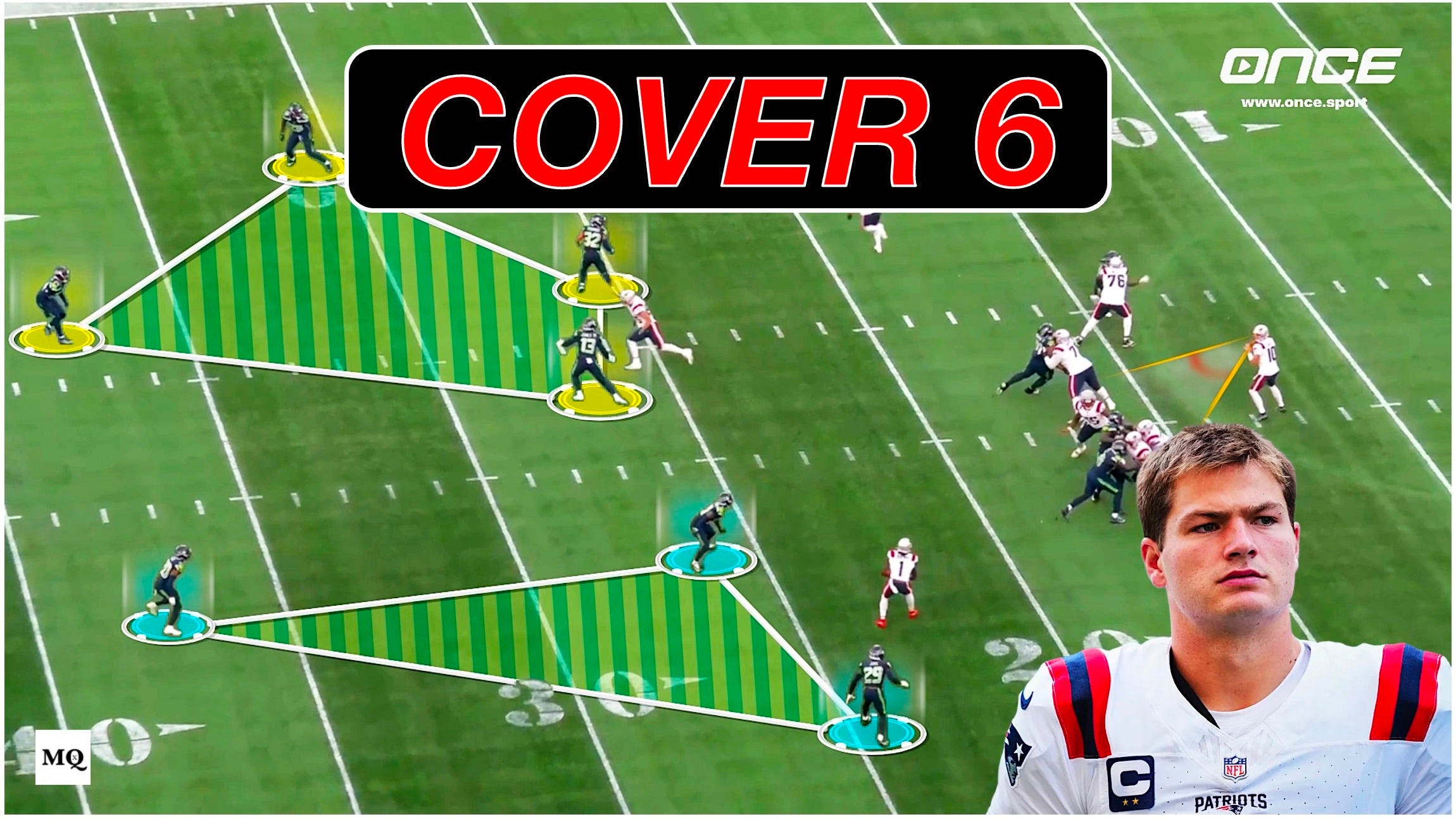
The obvious response to the “Two-High Revolution” of 2020 was always for offenses to pivot into more condensed formations and heavier personnel packages. A stronger commitment to the run game would naturally follow. Such is the ebb and flow of football.
But as offenses have gotten “heavier” over the past few seasons, NFL defenses are not so keen on relinquishing their two-high structures. According to FTN, the league’s split-field coverage rate was 43% last season. PFF had that number at 36%. Regardless of the analytics service, historical data shows that two-high coverages are up.
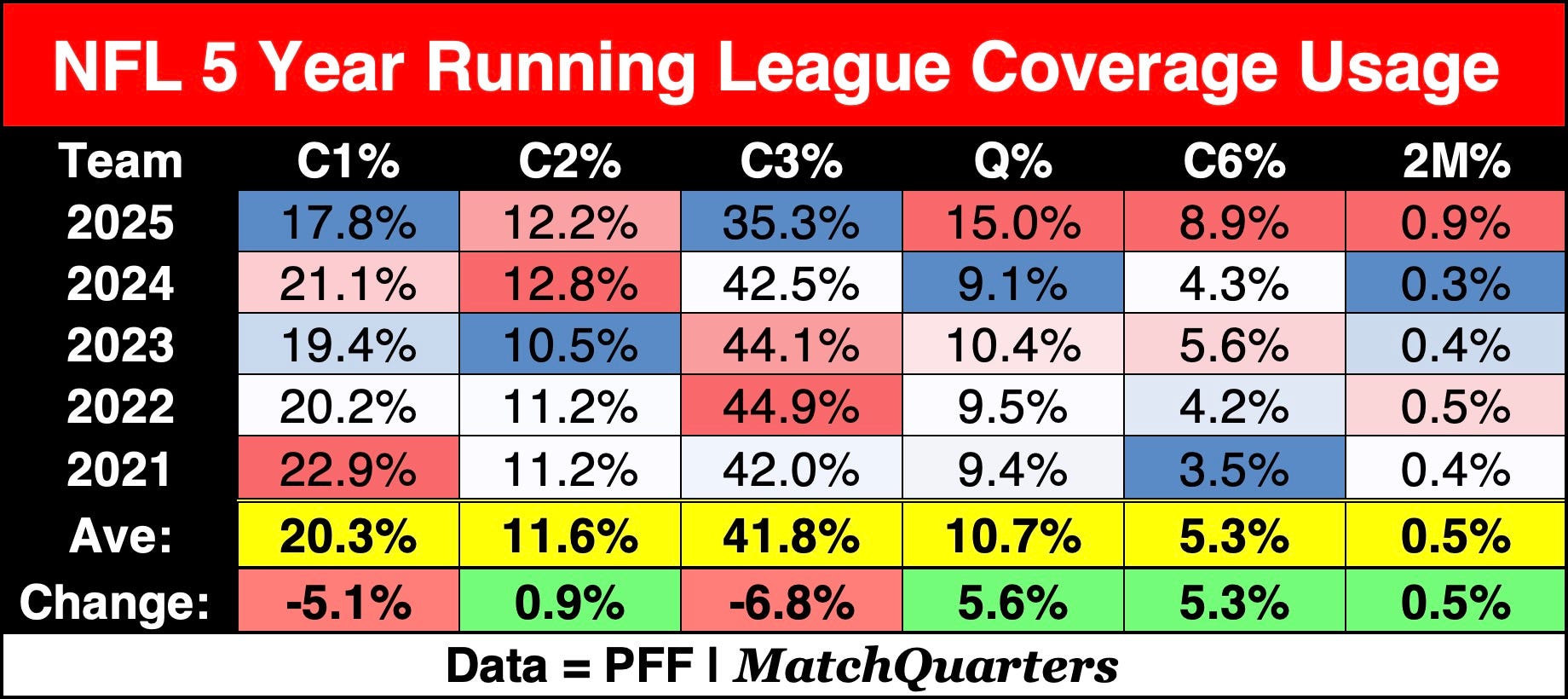
The NFL is not yet at a 50/50 split in coverage families, but the league is adding nuance and expanding its menu for open-post concepts. Week 1 in the NFL had a split-field coverage rate of 41%.
One coverage in particular is slowly gaining traction: Cover 6. Week 1’s usage of Cover 6 was at nearly 15%, almost even with Quarters at 17%.
What used to be a simple Quarter-Quarter-Half concept has expanded into a “family” of coverage schemes. The Eagles’ Vic Fangio, along with his protege Brandon Staley (now with the Saints), started the Two-High Revolution by running a majority (80%+) of their snaps from a depth, or a two-high shell.
A misnomer is that these coverages were all Quarters-based, but in reality, the Fangio system used depth as a leverage tool, still relying mostly on Cover 3 schemes from a weak rotation or away from the passing strength. Closed-post weak rotation schemes function in a similar fashion to Quarters and Fangio’s most popular split-field coverage, “Cover 8.”
Cover 6 in the Fangio tree is called “Stuff,” and it is primarily used to get a zone double to the single receiver side. “8” or “Trix” places the Cover 2 side (Half) to the passing strength, allowing for a poach Safety to the backside. At the beginning of the snap, Cover 8 and Cover 9, Fangio’s weak Cover 3 call, can look exactly the same.
The goal of this style of play is to create layers in the target-rich intermediate zones and backstops against pesky deep crossing routes that have become the main engine of the NFL’s modern offenses. For early downs, these coverages can help support the box while muddying the reads for under-center quarterbacks.
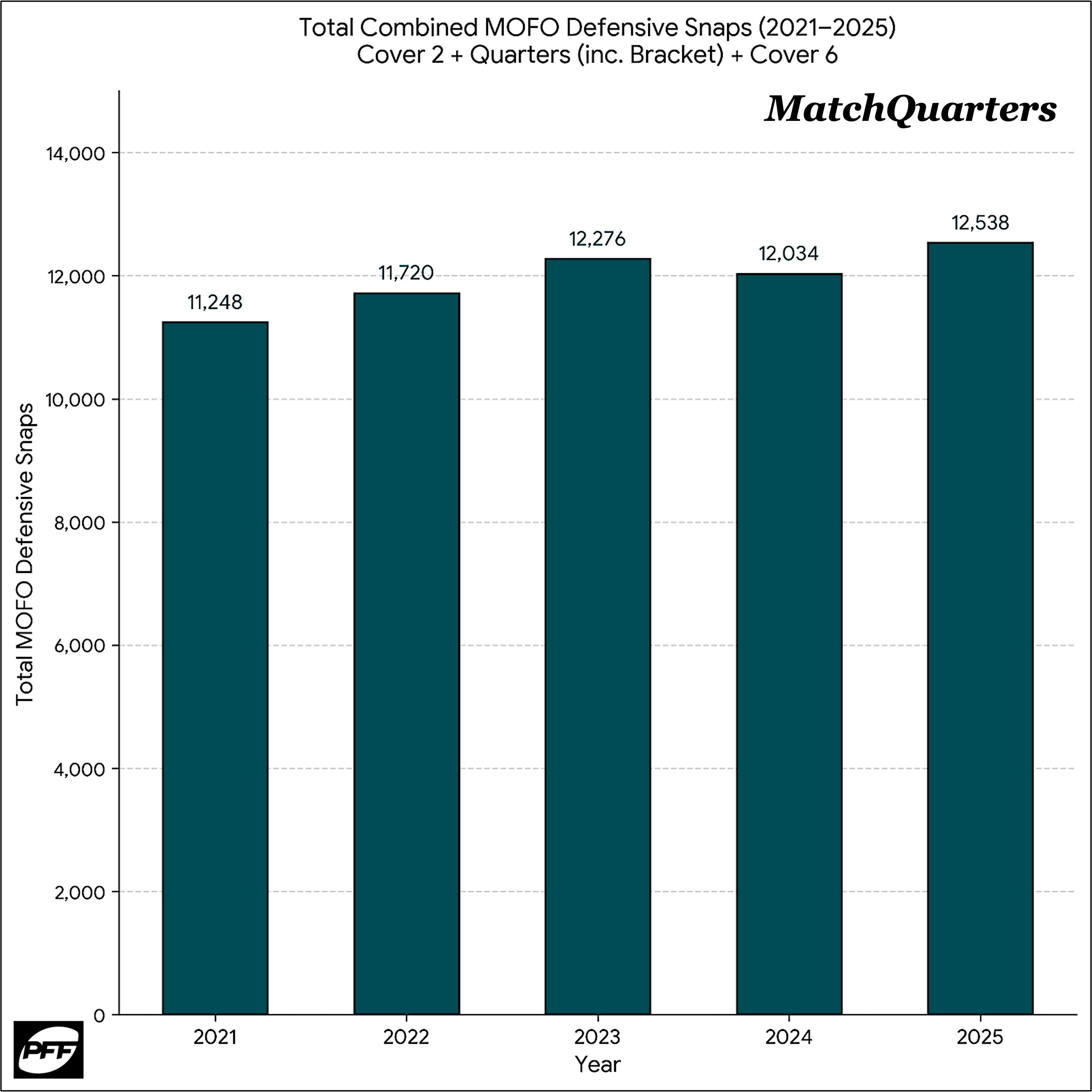
Defensively, NFL units have been slow to adopt the Fangio split-field “rotational” system because of its complexity. Last year, only the Fangio-adjacent and Ravens-adjacent systems, mainly the Seahawks, ran them extensively. But the coverage is slowly growing in popularity (above).
According to FTN, Cover 6 accounted for only ~6% of all NFL snaps in 2025; PFF reported ~9%. It was also the only concept with a negative EPA (-0.025). In 2026, usage will only climb as more defenses add the system to their toolkits.
Week 1 Usage (PFF):
Quarters | 17.5%
Cover 6 | 14.4%
Cover 2 | 9%
Total Split-Field | 40.7%
Seattle leaned fully into Cover 6 usage in Week 1 against the Patriots, utilizing the coverage on 41% of their snaps, according to PFF. The Raiders, whose DC worked under Mike Macdonald in ‘22 (Rob Leonard), came in second with 36%. The Rams (Shula) and Jaguars (Campanile), both having worked in Fangio schemes, were the only other two teams to crack the 25% mark.
The high use of Cover 6 against New England is by design, and the Seahawks' high-water mark will likely shrink back to a '25 league-leading average of 23%. Drake Maye struggles against the Cover 6 family of coverages.
Last season, Maye saw the split-field coverage over 100 snaps, which led the league. Within those snaps, the Patriots’ quarterback also led the league in:
Interceptions (4)
Sacks (9)
Scrambles (11)
Turnover Worthy Plays (4)
Along with those negative results, Maye was 30th in QB Rating and 29th in EPA/play against the coverage. So, when the Seahawks opened the NFL season against the Patriots, it was unsurprising that Mike Macdonald & Co. chose to spam the coverage. In all, Maye saw the coverage on 29 total snaps and on 21 total dropbacks. The end results: two interceptions and three scrambles against the coverage.

A complete video analysis software for any sport.
Once Sport Analyzer is a powerful, yet easy-to-use video analysis software with advanced tagging, 3D telestration, automatic tracking, and live analysis – built for coaches and analysts at all levels.
14-day Free Trial available – no credit card required!
Use promo code MATCHQUARTERS for a 10% discount!
