


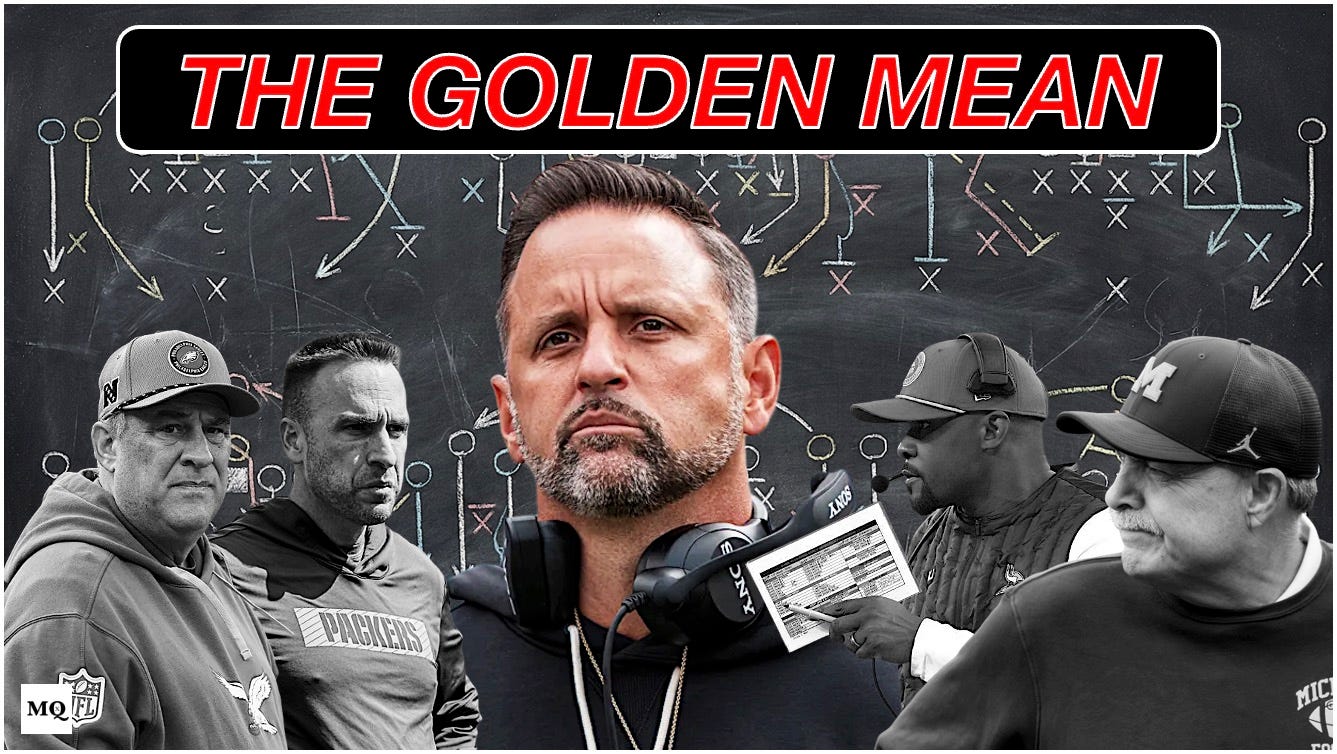
The NFL defensive landscape is currently divided between two main philosophies. On one side are those who adhere to “passive pressure,” such as Vic Fangio, Mike Macdonald, and Jesse Minter. These coaches prefer structure and disguise over outright pressure to confuse offenses or force them into long, methodical drives, often resulting in turnovers or stalled series.
On the other side are the “Chaos Agents.” Brian Flores is the obvious outlier, but Raheem Morris/Jeff Ulbrich, Steve Spagnuolo, and Todd Bowles all fall into this category. These coaches are willing to gamble the house with Blitz Rates of ~40%+.
Between the passive world of Fangio and the chaotic world of Flores sits Anthony Campanile.
If you are just finding out about the Jaguars’ defensive coordinator, Anthony Campanile, welcome. He is a “Jersey Guy” from Fair Lawn who played four years under Greg Schiano at Rutgers as a safety and linebacker. His resume also has stints with Don Brown, Brian Flores, Vic Fangio, and, most recently, Jeff Hafley.
When you turn on the tape, you see all those coaches’ signature schemes come out. The 2025 Jaguars defense is a “football nerd’s” dream. Here are a few examples:
There are snaps of Brown and Flores’ signature philosophies of “solve your problems with aggression,” including the all-up looks popularized by the Vikings (above).
The Jaguars also have a Fangio-adjacent blend of coverage disguises, too, including playing most coverages from a two-high shell (below).
And split-field “rotational” coverages, including the Fangio Cover 6/8 staples (below).
All of these concepts are built on the foundation of Hafley’s attacking 4-3 structure and simple rules, such as running a Read-Pop stunt opposite the RB on gun runs (below).
Overall, Campanile emphasizes a pared-down approach to scheme and an “irrational” belief in competition and winning. He has taken the best parts of his mentor’s playbooks and nothing more. In his opening press conference, he explained his philosophy:
“There is going to be a culture of irrational competitors and compassionate people. That's it. That's what I want. I want guys who are just totally irrational when it comes to winning and losing – and who care about people.”
Campanile set out to rebuild the Jaguars’ defensive philosophy with a more straightforward, structured approach, emphasizing players’ strengths rather than the overall scheme, which could have easily ballooned with his background.
The classic phrase “multiple” was also thrown around—a feature coaches often hit in introductory pressers but rarely deliver on in practice.
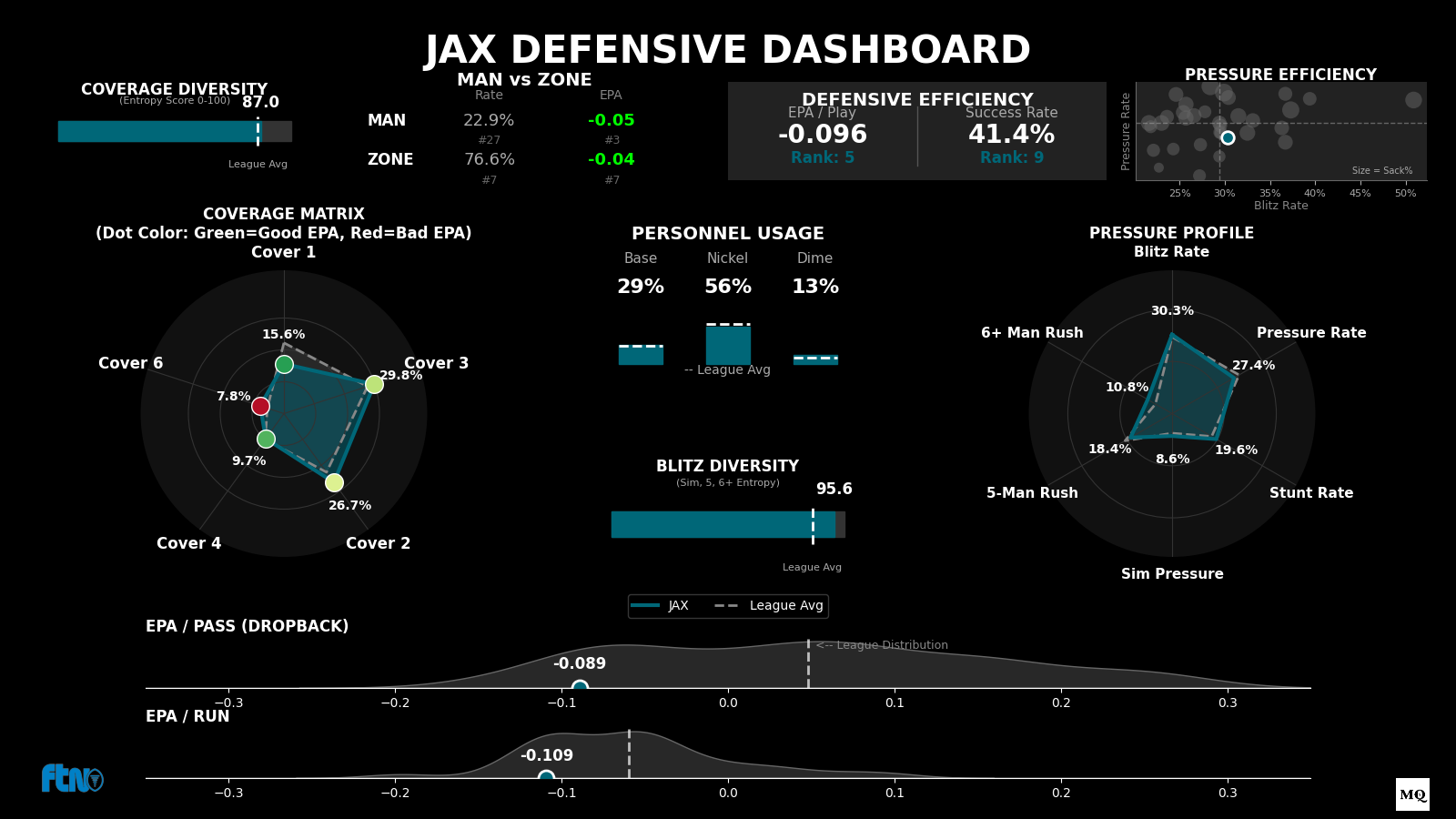
Simple in Jacksonville’s case doesn’t mean simplistic. The Jaguars run a relatively diverse scheme that features best-practice elements from major philosophies around the league. There is no better amalgamation of schemes than in Jacksonville, and with the players playing “fast,” that illustrates Campanile and his staff’s ability to teach.
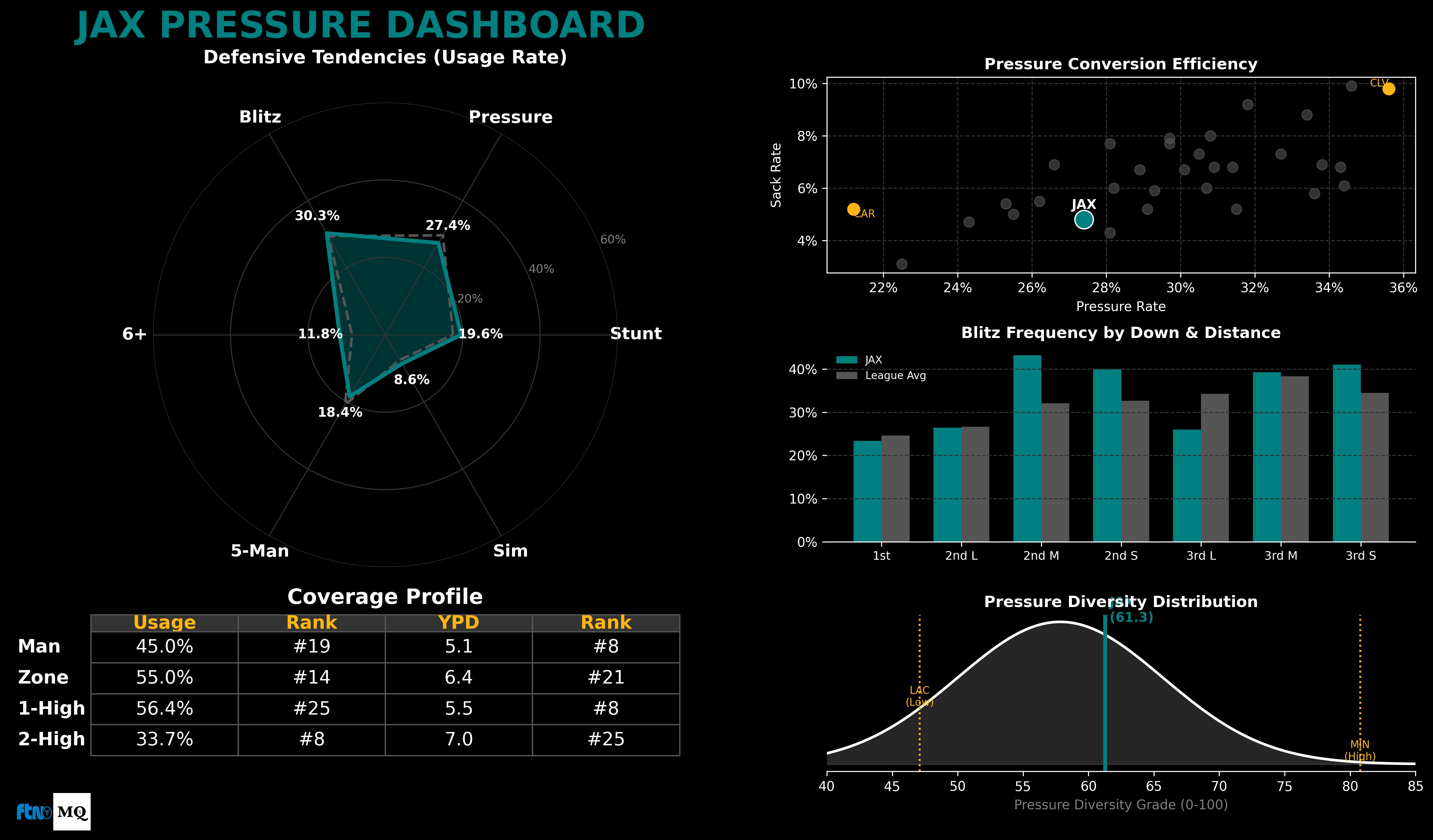
When diving into data, it becomes clear how Campanile has found the sweet spot within the massive amount of scheme knowledge he possesses. In a heavy “coach-tree” league, it is rare for a coach to illustrate the diversity that Campanile possesses, and even rarer to synthesize it into an elite unit. Here are a few examples:
Jacksonville’s overall Blitz Rate of ~30% is even with the league average, but they hold the fifth-highest 6+ Blitz Rate at ~12%
Campanile is playing some of the most zone coverage in the NFL, but isn’t playing a majority split-field like Flores (#1), or closed-post like Fangio (#3); he’s basically 50/50.
The Jaguars are 12th in simulated pressure usage (8.6%). Flores is #1 overall, and Fangio is ninth. Hafley, on the other hand, is 22nd.

Jacksonville has quickly become one of the most dangerous teams in the NFL. Head Coach Liam Coen has the once highly touted Trevor Lawrence playing his best football. What makes the Jaguars even more hazardous is their defense, which is one of the best heading into the playoffs.
The Broncos, who finished as the #1 overall seed in the AFC, lost to the Jaguars at home in resounding fashion. Illustrated in this major road win was Campanile’s pressure plan for the Denver offense, highlighting his unique approach to playcalling.
If one trait defines this Jaguars defense, it is their statistical coin flip in coverage usage behind blitzes. Typically, coordinators will have a “tell.” For instance, in 2025, Fangio is using man coverage behind his pressures at a 67% clip, with a closed-post coverage on ~75% of his calls. Flores, on the other hand, is the league leader in zone pressure (~80%) and has the highest split-field coverage rate behind it (56%).
Aligning with his “golden mean” trend, Campanile sits in the grey. Offenses have no idea week to week what the coverage structure will be on any given down, blitz, or otherwise. Campanile has designed a scheme that is structurally sound but violent in its practice. He’s amplified the Fangio system’s passive pressure with a nasty counter-punch from the “Facemelter 5000” approach from Flores.
