


The last time Georgia Tech defeated the Clemson Tigers was on November 15, 2014. For fifteen years, the Tigers have dominated this series, winning 12-3 in that time period. The bigger story here isn’t necessarily the win by Tech, which is now 3-0, but the overall decline in the Clemson program.
The Tigers are still the “kings” of the ACC and took that crown from Florida State during the late 2000s. Under Dabo Swinney, the program has risen to be one of the “blue-bloods” of college football. Miami and Florida State, though, are looking to move back onto the top of the ACC mountain. Blood is in the water.
Since 2014, the Tigers have not lost more than three games in a season until 2021. In that time, they also won every single ACC Championship. For the past three seasons, Clemson has lost three or more games, with the 2023 season ending in a 9-4 record. With the loss to Tech, the Tigers dropped to 1-2, a record that ironically hasn’t been matched since 2014.
In the grander scheme, the Georgia Tech loss is another warning sign that this is a program in decay. The recruiting rankings have remained consistent, but Dabo has consistently expressed his reluctance to utilize the transfer portal and has discussed his resistance to a “pay-for-play” mentality.
2020 and 2021 appear to be the high points of Clemson's recruiting efforts, and since then, the composite rankings for the Tigers have declined. The program is still recruiting within the top 20, and Dabo would argue that Clemson is a “developmental” program, meaning it develops high school talent.
Until this off-season, Clemson had only brought in two total transfers to the program. In 2025, they brought four, with only Purdue’s Will Heldt (DE) a current starter. There is plenty of talent at Clemson, but it just isn’t producing at an elite level. In fact, the last National Championship for the Tigers was in 2018, and though they have won ACC Championships, they’ve only finished first in the Atlantic Division once in the past five years (2022).
Georgia Tech, on the other hand, has been mediocre at best since 2014, the last time the program won more than 10 games in a season. Legendary head coach Paul Johnson was forced out in 2018, and with him went the beloved Flexbone offense. The school attempted to modernize under Geoff Collins (currently at South Carolina), but it did not achieve success. Brent Keys, Collins's offensive coordinator, was given the reins of the program midway through 2022. He finished 4-4 and retained the title.
In 2023 and 2024, the Yellow Jackets went 7-6 in both years. With the win over Clemson, Georgia Tech now sits at 3-0, something they haven’t done since 2016. There isn’t anything sexy about this year’s Georgia Tech team. After the Clemson win, the offense ranks 36th in OFEI, similar to the NFL’s DVOA, an efficiency metric, and the defense ranks 55th in DFEI (according to BCFToys).
Blake Gideon, who comes from the University of Texas, where he spent the last four years working under Pete Kwiatkowski as the Longhorns' safeties coach, is now the defensive coordinator at Tech. He employs a similar four-down hybrid system that combines coverages and looks to adapt to the multiple formations used by modern offenses.
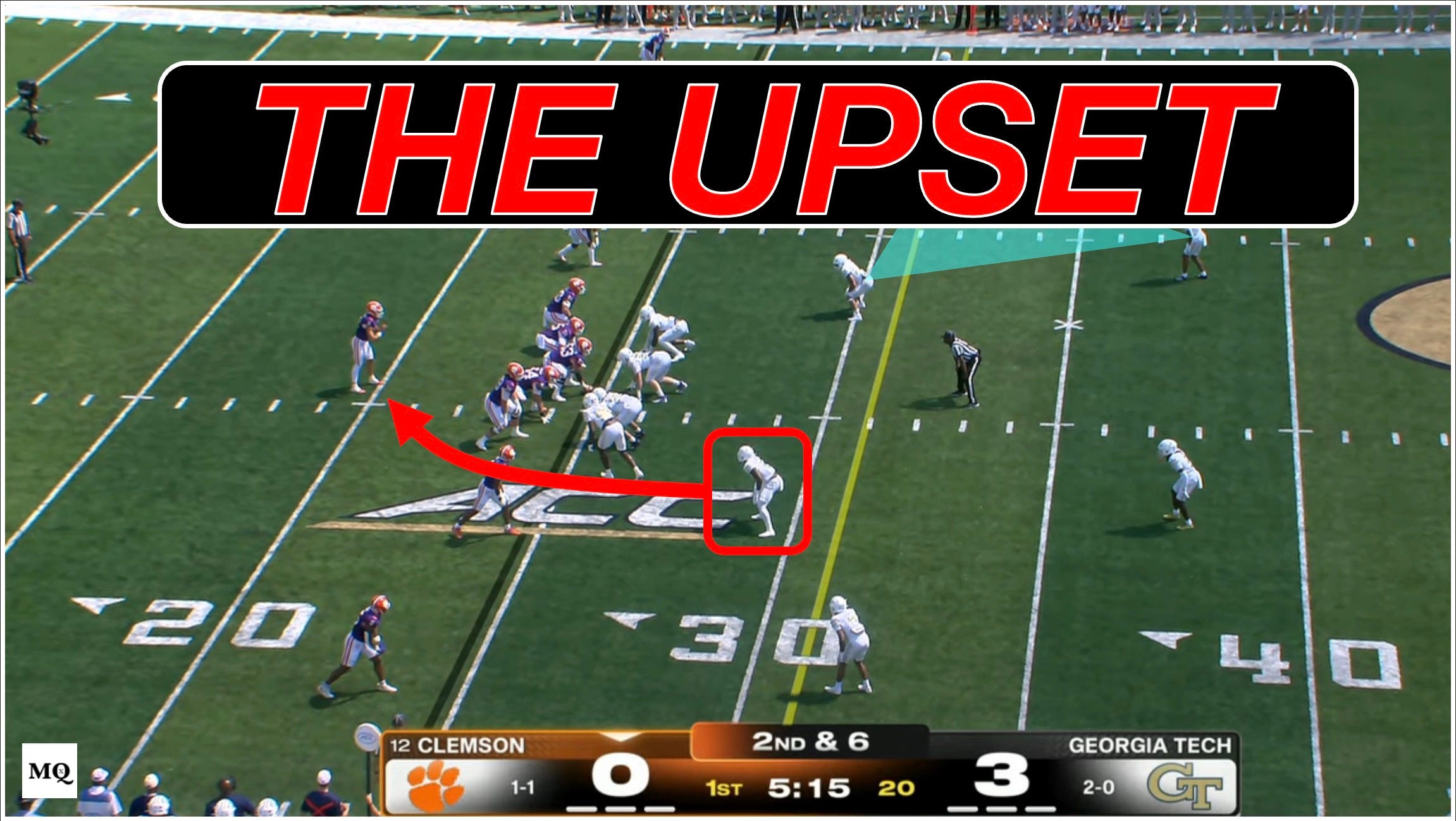
Against Clemson, Gideon employed a simple pressure on early downs (1st/2nd) to counter the Tigers' protection schemes. Utilizing boundary or weak edge pressure allowed the Georgia Tech defense to stay ahead of the chains on early downs. Moreover, the secondary employed a half-field zone concept, which plays Quarters away from the pressure (to the field) and uses man coverage against the blitz. In the Saban vernacular, these are known as “Big 12s” and were popularized several years ago.
The use of these “Big 12s” was crucial to the Yellow Jackets' victory, and the illiterates need to succeed on early downs. Instead of using Creepers or “replacement” pressures, Gideon employed five-man pressures to create one-on-one matchups on the edge of the box. On early downs, defensive coordinators should use utility pressures that can target both runs and pass-protection schemes, often involving play-action. Let’s dive into the tape!


