


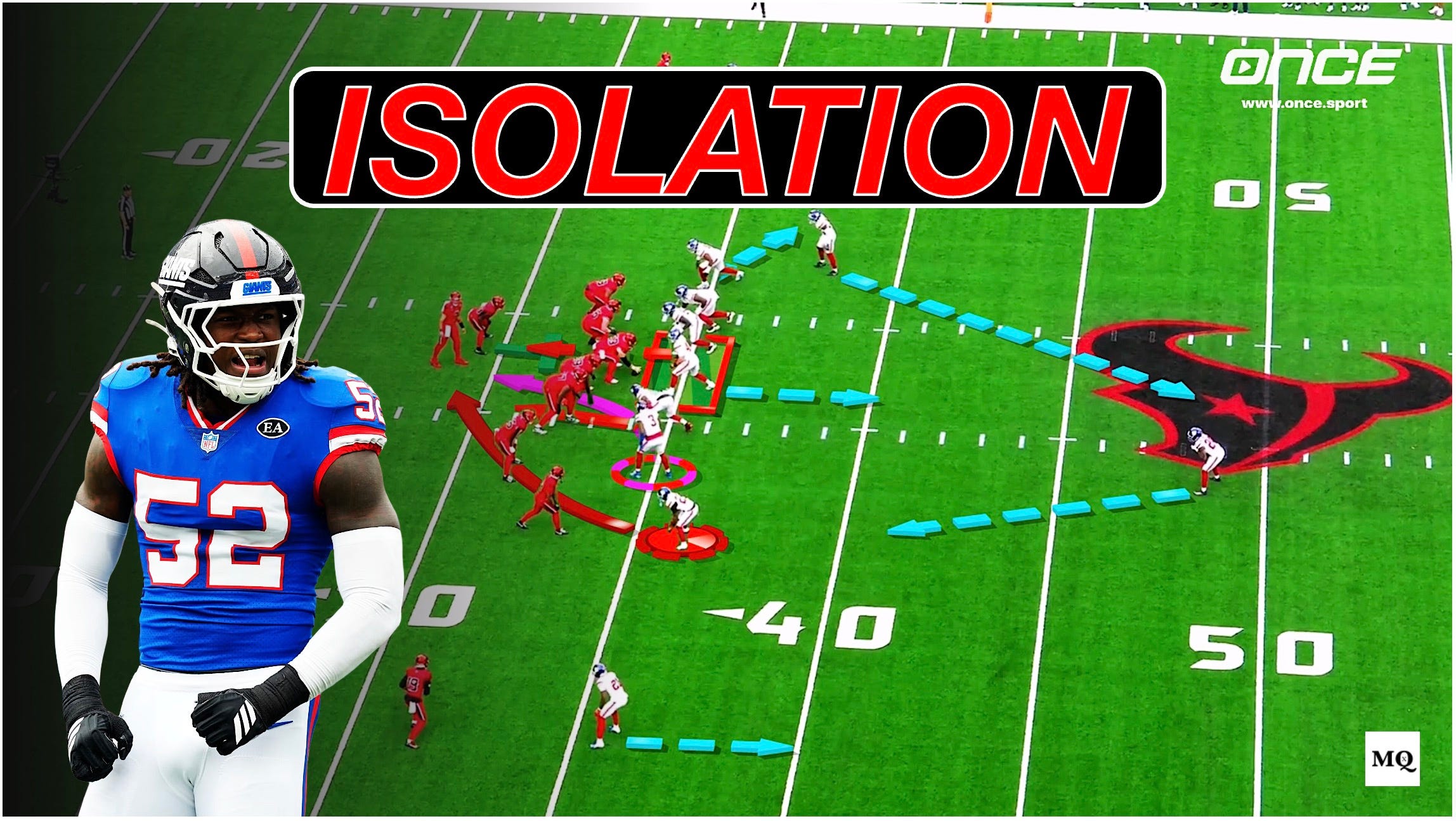
No one had a real idea of what Arvell Reese would truly be at the NFL level because he is the epitome of a hybrid player. In his last season at Ohio State, Reese split his time on the line of scrimmage as an Edge and in the second level as a linebacker, a clean 50/50 split.
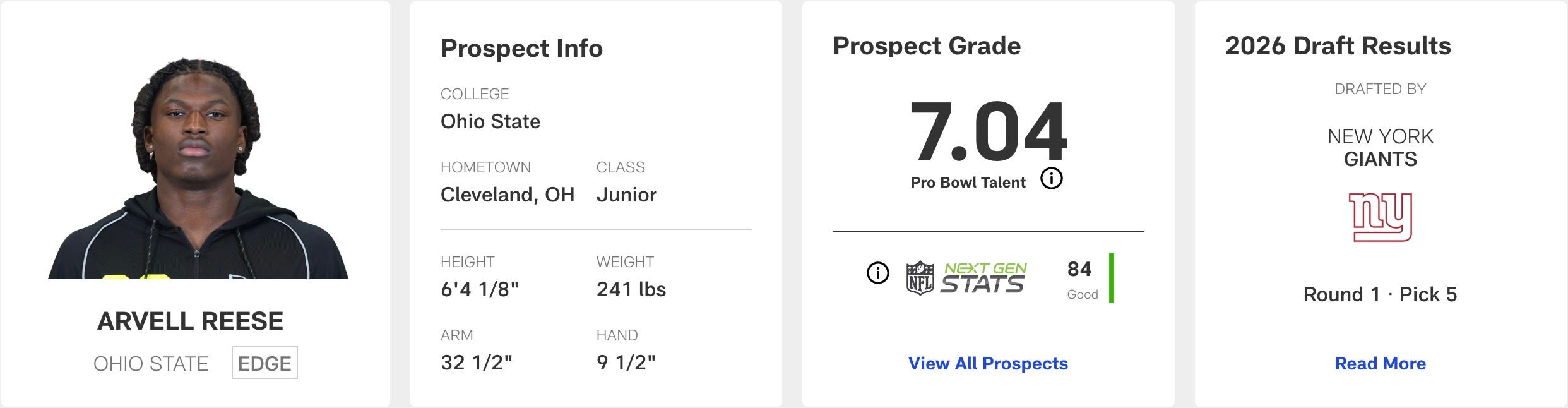
Most pundits saw Reese as a clear Edge; few listed him as a linebacker. The NFL labeled him as such in their draft bio (above).
When Reese was drafted 5th overall, the pick looked redundant. New York had just drafted Abdul Carter in the first round the year prior, paired him with Kayvon Thibodeaux, and already rostered a hybrid Edge/LB in Brian Burns.
But the Giants had a clear plan: Reese was an off-ball linebacker. Coincidentally, the “Sources Tell Us” section of his NFL.com draft card said it best:
“He can play from depth or rush, but in my opinion,
you need to choose one and build from there. – AFC executive
The quickest way to paralyze a young player, especially one with potential in multiple facets of the game, is to overload him with multiple packages and move him around as the team, coaches, and he figure out what he can do in a constantly shifting league.
Ironically, defensive coordinator Dennard Wilson might be the best coordinator for the job, especially after his two-year stint in Tennessee as he tried to navigate a severely depleted roster.
Wilson and John Harbaugh’s relationship goes back to 2023, when he was the Ravens defensive back coach. He was part of the “brain drain” that included Mike Macdonald and Anthony Weaver leaving Baltimore for better job titles.
Last season, Wilson orchestrated a schematic pivot in Tennessee, pared down a rotation-heavy system that bogged down young defenders, and established a more distilled “run and hit” approach that featured its two best defenders, Jeffery Simmons and T'Vondre Sweat (now with the Jets).

For Reese, a stable, defined approach would let him build a solid foundation, then amplify the creativity he showed in college. So far, Wilson has spared Reese diagnostic overload, placing the “green dot” responsibilities on Tremaine Edmunds (49) and Micah McFadden (41).
The Giants are fostering a defensive environment that a young, explosive athlete needs. Too often in the NFL, these “unicorns” enter the league and get bogged down in volume-heavy schemes and packages.
That extreme athleticism is exactly what the front office saw. “...you see him on film, he's moving at a different speed than everybody else," the Giants GM Joe Schoen recently stated, "and he's just so big and fast and violent.”
New York has opted to teach Reese to play off-ball LB full-time, but they're leaning into his pass-rush ability. The Giants aren't using him as a quasi-edge like former NFL DC Matt Patricia did at Ohio State.
Instead, they use Reese in replacement pressures or simple “dogs” that isolate him on a Guard or RB. The Giants aim to create one-on-ones for their most dynamic rushers, Carter and Reese, so they lean heavily on five-man pressures.
When rushing four in standard shells, New York bleeds efficiency. Opponents sit in a clean pocket on 80% of their dropbacks (28th | FTN), generating a 49.3% Success Rate.
But when Wilson sends pressure, the defense becomes elite. The manufactured pressures cut the clean pocket rate by 20%, spike the pass-rush win rate to 53% (5th), and plummet the opponent's EPA/play to -0.16 (4th).
The mechanism driving this shift? A heavy dose of 5-man pressures.
That dichotomy makes the Giants defense unique and ties back to how they use Reese. New York keeps it simple on run downs, then amplifies the pass rush on passing downs by using Reese and Carter’s skill sets.
73% of New York's pressures send five rushers (7th), which creates one-on-one blocking across the board. Wilson currently has the most Cover 0 in the league (23%), suggesting the philosophy is to overwhelm the front and win match-ups.
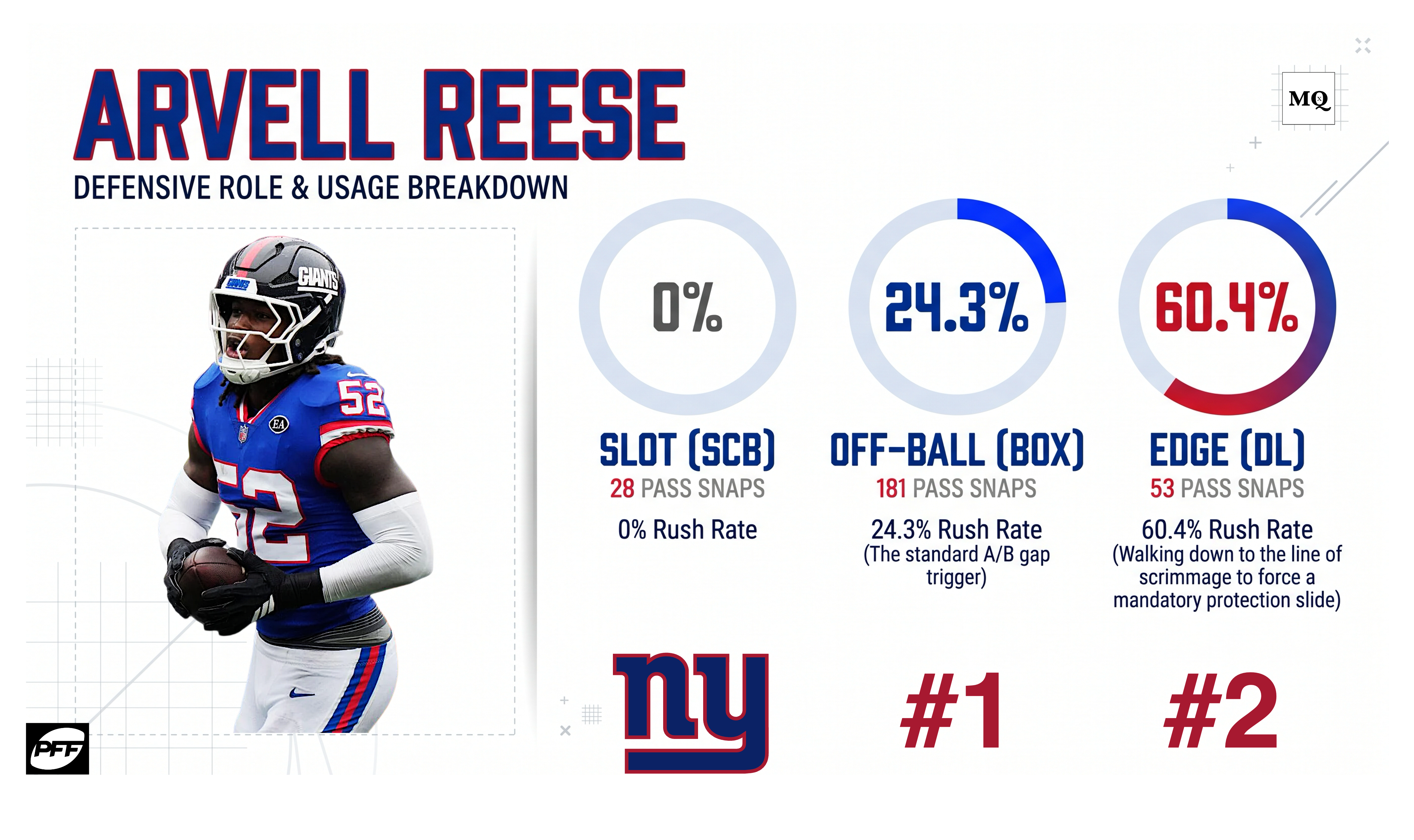
Reese drives the Giants’ pressure package. Over seven weeks, Reese is second only to the Vikings’ Eric Wilson in pass-rush attempts by a LB (76) and rushes the quarterback on almost a third of his snaps (29% | 1st). He also ranks 14th in Pass-Rush Win Rate (11.8%).
Opponents now face the Giants' two-pronged attack. Reese and Carter have been dynamic pass rushers this season. Carter’s 17.7% Win Rate is tenth-best in the league.
In fact, New York doesn’t even drop Carter into coverage; he is a pure pass-rush specialist. His 97% pass-rush rate is the highest among edges (PFF).
Against the Texans, the Giants scheme was on full display. Utilizing five-man pressures created one-on-one opportunities. Houston’s offensive line had to contend not only with Carter, but also with Reese coming off the ball.
It also created openings for tandem LB Micah McFadden, who had two unblocked pressures on seven pass-rush attempts, for a nearly 50% Pressure Rate. This week, I break down the Giants’ five-man pressure menu against the Texans, showing how Reese’s interior blitz tracks and Carter’s perimeter isolation work together.
—
Don’t just dial up pressures; scheme to amplify your best players.
Unlock the rest of the clinic below to see exactly how the Giants manufacture isolated matchups for their premium rushers.
Full 5-man pressure tape study vs. Houston
Double-mug alignment menu
Fire Zone & “Deuce” coverage tags
