


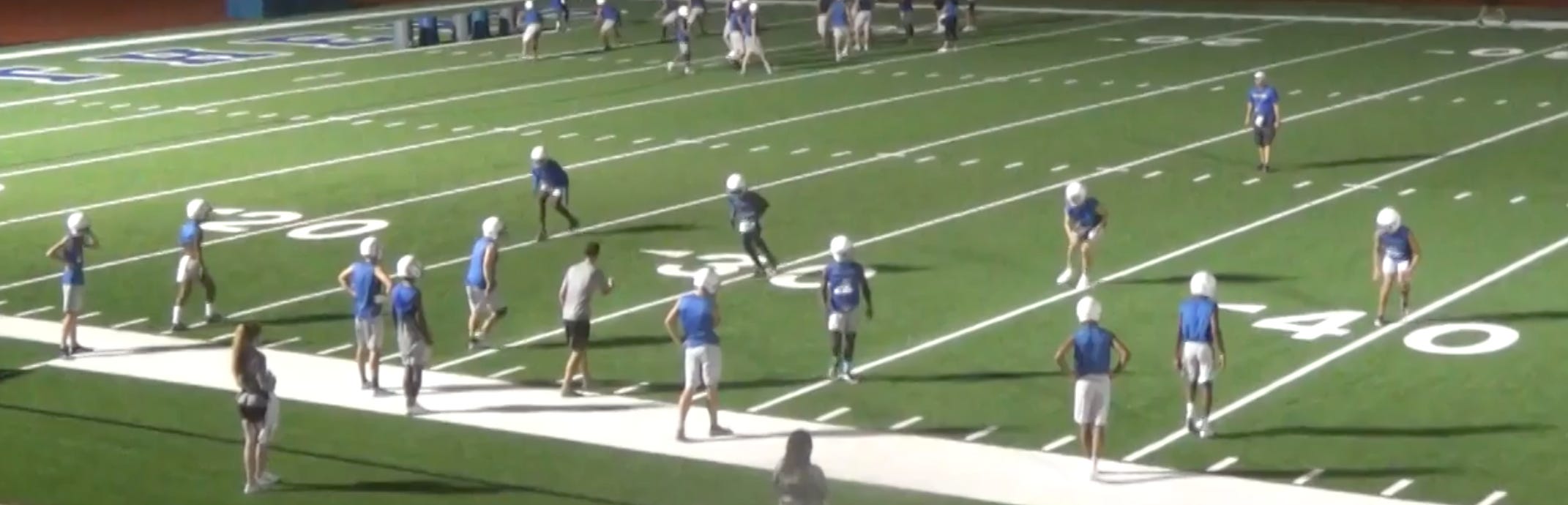
As in the classroom, it is vital to have a syllabus or “calendar” outlining when and how coaches will teach specific topics. Most coaches are familiar with a fall install and usually follow that for their individual periods in the fall, but what do you do with the rest of the calendar year?
In Texas, we are lucky enough to have athletic periods that allow us to work on any sport year-round. I preface this by saying that just because we can work football year-round does not mean we should, or even that we do. Just like at the college level, there are “seasons” that your program should follow. If you don’t have athletic periods, you can create voluntary after-school sessions and plan them for your kids who aren’t in another sport.
Starting in January, most programs will focus on the weight room and general movement exercises. Think of this time as a chance to build a base for strength and pre-track workouts for your athletes. Track in Texas is a big deal, and most football programs want their athletes competing in something in the Spring. The “base” period usually lasts about six to nine weeks and transitions into a pre-Spring “Football School.”
During Football School, programs focus on the fundamental techniques and schemes required to succeed within the program. Techniques are the building blocks (DNA) of your scheme. During this period, the focus is on building foundational tools so that all the different concepts can be taught easily once groups start coming together.
Agility-based exercises focus on movement and position-specific drills. Running is usually done during Track practice, and those who are not on the track team will follow a sprint-based program according to their position (For example, O-linemen don’t need to run a bunch of 200-meter sprints. Short bursts are better).
Personally, my focus has always been on defensive back play. Starting after Spring Break, we focus on agility and quick-twitch exercises that translate into functional movements on the field. As we inch closer to Spring Ball, we begin teaching concepts and focusing on specific techniques needed within the overall scheme. Once we reach Spring Ball, we install our system and shift focus to team play and the basic schematics required for the Fall. The goal is to have everything introduced before Summer Training.
We recycle the Spring semester timeline during the summer but condense it to fit within the time we are given during the off-period (usually six weeks or 24 days). At the beginning of June, the focus is on football-specific skills, with a focus on circuits and universal techniques. Weights, agility, and running are a given; this period comes after the athletes have completed their strength and conditioning training.
From tackling to blitzing, we build specific drills and circuits to maximize our time in June. When leaving for the July 4th holiday, every athlete in the program will know the specific techniques needed for the July pre-Fall install. The schedule enables us to train the athletes in a multidisciplinary way yet still cover critical aspects of our scheme.
Once we get the kids back from the 4th, we now shift focus to our pre-Fall install. Think of this as a pre-test. We are introducing and modeling the first weeks of Fall Camp in July to avoid surprises and maximize our time. Teaching at every level of the defense reflects this process. For this article, I will focus on the Secondary, but any position coach can mirror the philosophy for linebackers and D-line (or even offense).
