


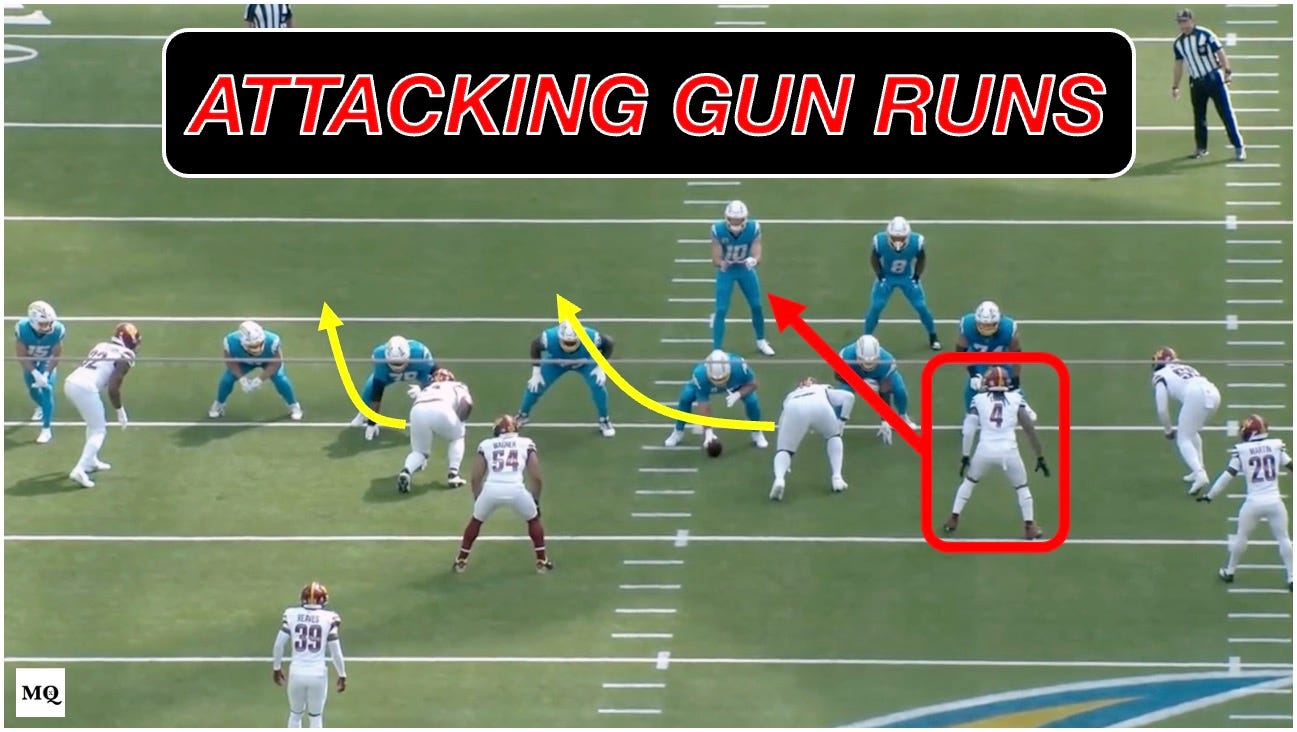
Each year is brand new in the NFL; every team is searching for an edge. In 2025, the Los Angeles Chargers transitioned to a shotgun-based offense centered around their prolific quarterback, Justin Herbert. To begin the season, the offense looked to be humming until Injuries on the line piled up. Then, they ran into Dan Quinn’s Washington Commanders. Washington had a specific way of attacking their shotgun runs—and the solution wasn’t even complex.
Last year, the Chargers favored running the ball from under center. Almost 60% of their runs came from these formations. That trend has shifted in 2025. Now, the Chargers employ a more balanced attack, and through Week 5, they were 50/50 in their formations, using both under center and shotgun.
The shift has coincided with an overall philosophy adjustment away from Jim Harbaugh and Greg Roman's traditional run-oriented offenses. In 2024, the Chargers’ passing rate was right under 55%. It was even lower in the first five weeks (47%).
Through five weeks in 2025, that number has rocketed to ~63%. With quarterback Justin Herbert passing the ball more, the Chargers have also shifted him away from the line of scrimmage. Thus, more shotgun runs.
Offensive coordinator Greg Roman is not opposed to using runs away from under center. Roman has worked with Colin Kaepernick and the Spread-Run attack that took the 49ers to the Super Bowl, as well as with Lamar Jackson, who is arguably the best running quarterback in NFL history.
Herbert is not a running quarterback, and it appears that in 2025, LA is leaning fully into his ability to pass the ball. The run game extension of this comes in the form of an amplified shotgun run system. In 2024, the most efficient runs came from the shotgun.
In 2025, the featured way of running the ball has almost doubled in efficiency. Last season, the Chargers averaged 4.47 yards per carry in gun runs, while this season that number has nearly doubled, reaching 7.16 in the first five weeks (Sumer).
Commanders Head Coach Dan Quinn and defensive coordinator Joe Whitt run a relatively stable defensive scheme. In five weeks, Washington hasn’t shown a significant tendency shift in how they attacked opponents. Each week, they basically run their standard defense with only slight deviations.
Against the Chargers, they altered their blitzing strategy on early downs. Instead of blitzing under center formations, the Commanders used several targeted blitzes against shotgun formations. Three in particular were against designed runs.
In those three designed runs, Omarion Hampton only had five yards of rushing. Without the threat of blizzing, the Chargers were 10-63 with four first downs. The Commanders arguably should have blitzed more! The only significant gain on the ground when Washington blitzed was a 41-yard scamble by Herbert.
Quinn and Whitt made a conscious decision to blitz shotgun formations. The Chargers ran the ball 27 times in total against the Commanders, and Washington only blitzed them four times. But, they all came against gun runs.
The low number is typical of the Commanders. Quinn has never carried a high Blitz Rate, and so far this year, the Blitz Rate against the run is a meager 15% compared to a Pass Blitz Rate of ~37% (Sumer). Washington currently sits in 16th place (dead center) in Blitz Rate for the season (30.4% | FTN).
Washington is Nickel-based defense, and they use All-Pro hybrid linebacker Frankie Luvu as a chess piece in their game plans. Though Luvu is listed as an off-ball linebacker and technically plays as their Will, he can easily shift to the line of scrimmage. The trend in the NFL for many four-down-based defenses is to utilize a hybrid LB as a way to change the spacing up front.

Quinn has traditionally been a four-down defensive coach. With Luvu, he can shift into odd spacing, closing the B-gaps, or blitz Luvu to create odd spacing post-snap. Against the Chargers, Quinn and Whitt unleashed Luvu against LA’s run game in targeted situations, inhibiting their ability to gain traction on the ground when doing so.


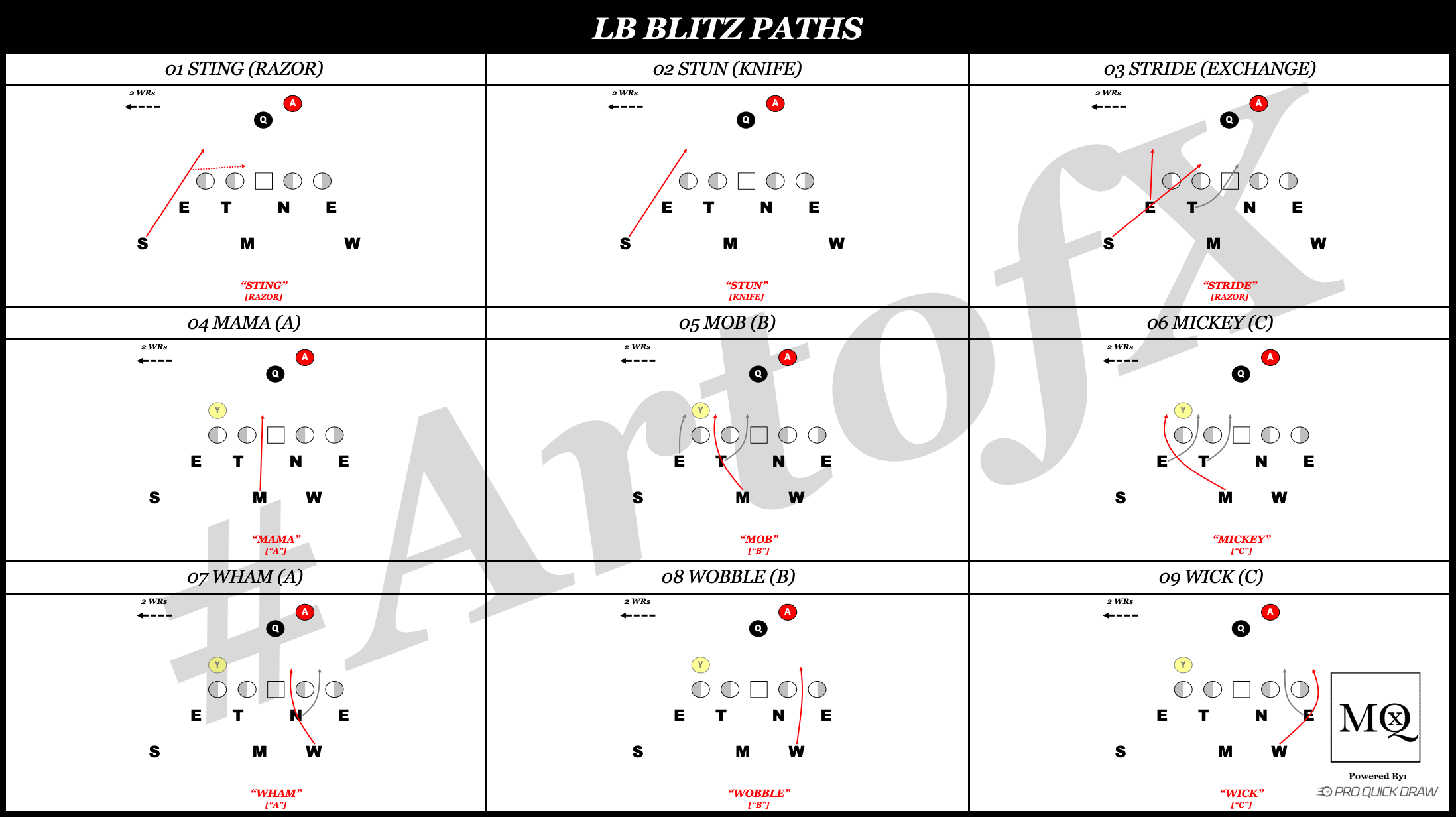
“Dog” tags, or single linebacker pressures, are an easy way to create five-man pressure looks. Typically, behind these defenses will run Cover 1 or a “Fire Zone” (3-under/3-deep) zone coverage. Luvu is already a prolific blitzer and was the main target for these calls. Quinn and Whitt attacked the edges of the box versus the Chargers, focusing on the B- and C-gaps.
Another way to label these is Abel, Baker, or Charlie (Ravens system). Defenses tend to either assign a name to each blitz path or label the gap they enter with a name.

—
